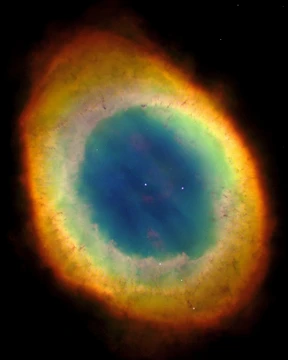
Emission nebula
Ionized gases emit light, often red from hydrogen.
Last updated
An emission nebula is a cloud of ionized gas that shines at multiple wavelengths. The ionization is usually caused by high-energy ultraviolet light from a nearby hot star. Two major types exist: H II regions, where new stars are forming and massive young stars provide the ionizing radiation, and planetary nebulae, where a dying star sheds its outer layers and the exposed hot core ionizes that material.
Because hydrogen is common in interstellar gas and ionizes easily, many emission nebulae glow red from strong Balmer series emissions. The nebula’s color depends on its chemical makeup and how much ionization has occurred; if more energy is available, other elements become ionized, allowing green or blue hues. Astronomers study the spectra of these nebulae to determine their composition, which is typically about 90% hydrogen, with helium, oxygen, nitrogen, and other elements making up the rest.
A young star usually ionizes part of the cloud it formed from, but only massive, hot stars (above 25,000 K) emit enough ultraviolet radiation (wavelengths shorter than 91.2 nm) to make the surrounding emission nebula brighter than a reflection nebula. Cooler stars lack the energy to ionize hydrogen, so their reflection nebulae are dimmer. Often, entire clusters of young stars contribute energy to an emission nebula. Dark patches within these nebulae are caused by dust clouds that block the light.
Some nebulae combine both emission and reflection components, like the Trifid Nebula. Notable examples visible from the northern celestial hemisphere include the North America Nebula (NGC 7000) and the Veil Nebula (NGC 6960/6992) in Cygnus. In the south, the Lagoon Nebula (M8 / NGC 6523) in Sagittarius and the Orion Nebula (M42) are prominent, along with the bright Carina Nebula (NGC 3372) farther south.
Quick Facts
- Typical composition
- About 90% hydrogen
- with remaining helium
- oxygen
- nitrogen
- and other elements
- Ionizing wavelength threshold
- Shorter than 91.2 nm
- Prominent northern examples
- North America Nebula (NGC 7000), Veil Nebula (NGC 6960/6992) in Cygnus
- Prominent southern examples
- Lagoon Nebula (M8; NGC 6523) in Sagittarius
- Orion Nebula (M42)
- Carina Nebula (NGC 3372)
Facts from the source article.
Lore & Background
Emission nebulae form when ionized gases emit light, typically ionized by high-energy ultraviolet photons from a nearby hot star. A young star often ionizes part of the same cloud from which it was born, though only massive, hot stars can release sufficient energy to ionize a significant part of a cloud. In many emission nebulae, an entire cluster of young stars contributes energy. Stars hotter than 25,000 K generally emit enough ionizing ultraviolet radiation (wavelength shorter than 91.2 nm) to cause the emission nebulae around them to be brighter than reflection nebulae; cooler stars produce less energetic radiation that cannot ionize hydrogen, resulting in dimmer reflection nebulae.
The nebula's color depends on its chemical composition and degree of ionization. Due to the prevalence of hydrogen in interstellar gas and its relatively low energy of ionization, many emission nebulae appear red due to strong emissions of the Balmer series.
If more energy is available, other elements become ionized, and green and blue nebulae become possible. By examining the spectra of nebulae, astronomers infer their chemical content. Most emission nebulae are about 90% hydrogen, with the remaining helium, oxygen, nitrogen, and other elements.
Emission nebulae often have dark areas resulting from clouds of dust that block the light. Many nebulae are made up of both reflection and emission components, such as the Trifid Nebula.
The Engine of Ionization
Emission nebulae owe their luminosity to a process rooted in stellar energy. At their core, these clouds consist of ionized gases that release light across a range of wavelengths, and the most frequent trigger for that ionization is a barrage of high-energy ultraviolet photons streaming from a nearby hot star. Typically, a young star will ionize a portion of the very molecular cloud from which it itself condensed, though only the most massive and hottest stars possess the energy budget to light up a significant fraction of that cloud.
In many cases, it is not a single star but an entire cluster of young, energetic stars that collectively pumps enough radiation into the surrounding gas. The threshold is remarkably specific: stars whose surface temperatures exceed roughly 25,000 Kelvin emit ultraviolet radiation at wavelengths shorter than 91.2 nanometers, energetic enough to strip electrons from hydrogen atoms. Cooler stars simply lack the punch to ionize hydrogen, which is why their surroundings tend to produce dimmer reflection nebulae rather than the brilliant glow of an emission nebula.
Color as a Chemical Fingerprint
The hue of an emission nebula is far from arbitrary; it is a direct readout of the gas's chemical makeup and how deeply that gas has been ionized. Because hydrogen dominates interstellar material and requires relatively little energy to ionize, the most common visual signature is a deep red glow produced by the Balmer series of hydrogen emission lines. However, when the ionizing source is powerful enough to reach beyond hydrogen, heavier elements such as oxygen, nitrogen, and helium begin to contribute their own spectral lines, opening the palette to greens and blues.
Astronomers exploit this relationship by carefully examining the spectra of these clouds, effectively decoding their elemental inventory from the pattern of emitted wavelengths. The typical recipe is strikingly simple: roughly ninety percent hydrogen, with the remaining ten percent distributed among helium, oxygen, nitrogen, and trace elements. In this way, the color we observe is not merely aesthetic but a quantitative window into the nebula's composition and the energetic environment sculpting it.
Two Faces of Stellar Evolution
Emission nebulae are not a single phenomenon but rather a family of objects tied to very different chapters in a star's life. On one end stand H II regions, vast zones where active star formation is underway. In these regions, the ionizing photons that make the gas glow come from the young, massive stars that have just ignited within the cloud itself, creating a self-sustaining cycle of birth and illumination. At the opposite extreme lie planetary nebulae, which mark the dramatic finale of a star's existence.
Here, a dying star has expelled its outer envelope into space, and the now-exposed, intensely hot core serves as the ionizing source, painting the ejected shells in brilliant light. Both categories share the fundamental physics of ionized gas emitting multi-wavelength radiation, yet they represent the beginning and the end of stellar life. This duality makes emission nebulae a uniquely powerful tool for studying how stars are born, how they live, and how they ultimately return their material to the interstellar medium.
Landmarks of the Night Sky
Among the most celebrated emission nebulae observable from Earth, a clear hemispheric divide emerges. Northern skies feature the North America Nebula, catalogued as NGC 7000, and the Veil Nebula, designated NGC 6960 and 6992, both located within the constellation Cygnus. Southern skies offer the Lagoon Nebula (M8, also NGC 6523) in Sagittarius, the famous Orion Nebula (M42), and, farther south still, the bright Carina Nebula (NGC 3372). These objects are not uniformly glowing sheets; their structure is often punctuated by dark patches where clouds of dust block the light passing through.
Furthermore, many well-known nebulae are not purely emission objects. The Trifid Nebula, for instance, is composed of both reflection and emission components, blending two distinct modes of light production within a single structure. This layered complexity—bright ionized regions, dark dust silhouettes, and reflected light coexisting—gives these landmarks their rich, multi-textured appearance.
Reader's Guide
Emission nebulae are significant as visible markers of active star formation and stellar evolution. H II regions, a type of emission nebula, indicate sites where young, massive stars are forming and ionizing surrounding gas. Planetary nebulae, another type, represent the final stages of a dying star that has thrown off its outer layers, with the exposed hot core ionizing them. The brightness of emission nebulae relative to reflection nebulae provides a direct observational clue to the temperature of nearby stars: stars hotter than 25,000 K produce enough ionizing ultraviolet radiation to make emission nebulae brighter.
The characteristic red color of many emission nebulae, due to hydrogen's Balmer series emissions, allows astronomers to identify hydrogen-rich regions and infer chemical composition through spectral analysis. Prominent examples visible from Earth include the North America Nebula and Veil Nebula in the northern celestial hemisphere, and the Lagoon Nebula, Orion Nebula, and Carina Nebula in the southern hemisphere. The presence of dark dust clouds within emission nebulae and the combination of emission and reflection components in objects like the Trifid Nebula illustrate the complex interplay of gas, dust, and radiation in the interstellar medium.
More in Emission, Dark and Reflection Nebulae
Sources
Compiled from Wikipedia and the sources listed below. Text from Wikipedia is available under CC BY-SA 4.0; this entry is adapted from it.
- Wikipedia: Emission nebula (CC BY-SA 4.0).
- Word definitions: the Codexery glossary, each quoted from its Wikipedia article.
Spotted an error? Know more?
Reader corrections go straight into our review queue. Suggest an edit · How this site is sourced