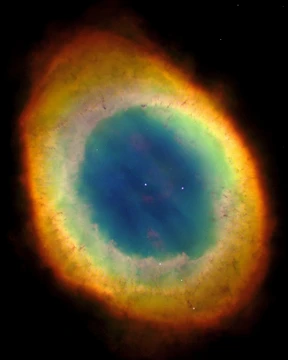
Sh 2-170
Emission nebula in Cassiopeia, dot of the Question Mark Nebula.
Last updated
Sh 2-170, also called the Little Rosette Nebula, is an emission nebula found in the constellation Cassiopeia. Stewart Sharpless first recorded it in the late 1950s, with the discovery published in 1959.
Its name comes from the larger and far more famous Rosette Nebula. This nebula lies within the Perseus Arm of the Milky Way. Though it is a distinct object, it forms the dot of the Question Mark Nebula, acting as an extension of NGC 7822.
At its heart sits the star cluster Stock 18, which spans only 18 arcminutes—much smaller than the nebula’s full apparent size of 56 by 50 arcminutes. The nebula’s glow comes partly from ionized gas, driven by the star BD +63 2093 (also known as LS I +64 11). Astronomers disagree on this star’s classification: a 1995 study labeled it an O8 V type, other papers call it O9 V, and SIMBAD lists it as a G5 star. The nebula contains 71 variable stars.
For observers, Sh 2-170 has a magnitude of about 6.5. It shows best through a hydrogen-alpha filter. Much of the nebula is so faint that cameras need long exposure times to capture it.
Lore & Background
Sh 2-170 was discovered by Stewart Sharpless in the late 1950s, with its discovery published in 1959. The nebula contains a central star cluster, Stock 18, which has an apparent size of 18 arcminutes, much smaller than the nebula's total extent of 56 by 50 arcminutes.
Some of the nebula's illumination is caused by the ionizing of gas by the star BD +63 2093, also designated LS I +64 11. There is dispute between studies as to the nature of this central star: a 1995 paper concluded it was an O8 V type, other papers have identified it as an O9 V type, and SIMBAD labels it as a G5 star. The nebula contains a total of 71 variable stars.
Reader's Guide
Sh 2-170 holds significance as a lesser-known emission nebula that draws its common name from the famous Rosette Nebula, though it is a distinct object in its own right. Its location in the Perseus Arm of the Milky Way and its association with the Question Mark Nebula as an extension of NGC 7822 place it within a larger complex of interstellar gas and dust. The nebula's central star cluster, Stock 18, and the disputed classification of its ionizing star BD +63 2093 highlight ongoing scientific interest in the region.
With a magnitude of about 6.5, the nebula is best viewed with a hydrogen-alpha filter, and most of its structure is faint enough to require longer exposure times for photographic capture. The presence of 71 variable stars within the nebula adds to its value as a site for studying stellar variability and the dynamics of star-forming regions. Its legacy lies in its role as a smaller analog to the Rosette Nebula and as a component of a larger galactic structure, offering observers and researchers a target that bridges the familiar and the less explored.
Frequently Asked Questions
What is Sh 2-170 and where can I find it?
Sh 2-170, popularly called the Little Rosette Nebula, is an emission nebula located in the constellation Cassiopeia. It was first recorded by Stewart Sharpless in his late-1950s survey of H II regions, with the entry published in 1959.
Where does Sh 2-170 sit within the Milky Way and how bright is it?
The nebula lies within the Perseus Arm, one of the galaxy's major spiral structures. At an apparent magnitude of about 6.5, it is faint enough to require dark skies or a small telescope for a comfortable visual observation.
More in Emission, Dark and Reflection Nebulae
Sources
Compiled from Wikipedia and the sources listed below. Text from Wikipedia is available under CC BY-SA 4.0; this entry is adapted from it.
- Wikipedia: Sh 2-170 (CC BY-SA 4.0).
Spotted an error? Know more?
Reader corrections go straight into our review queue. Suggest an edit · How this site is sourced