The Book of the Dead
Ancient Egyptian funerary spells for the afterlife journey
Last updated
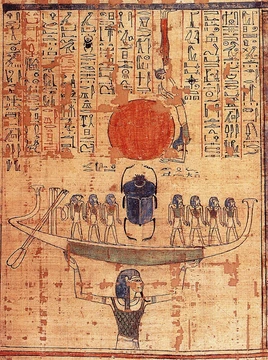
The Book of the Dead is an ancient Egyptian funerary text generally written on papyrus and used from the beginning of the New Kingdom (around 1550 BC) to around 50 BC. It consists of a loose collection of magic spells intended to assist a dead person's journey through the Duat (underworld) and into the afterlife. The original Egyptian name for this collection translates as "Spells of Coming Forth by Day." The modern name was introduced in 1842 by the Egyptologist Karl Richard Lepsius, who gave it the German name Totenbuch, later translated into English as "Book of the Dead." The text was placed in the coffin or burial chamber of the deceased and was part of a long tradition of funerary writings, including the earlier Pyramid Texts and Coffin Texts, which were painted onto objects rather than written on papyrus. Some of its spells were drawn from these older works, dating back to the 3rd millennium BC, while others were composed later, throughout the New Kingdom and subsequent periods.
There was never a single, canonical version; surviving papyri contain varying selections of spells and illustrations, as individuals often commissioned their own copies, choosing the spells they deemed most important for their afterlife. The spells were most commonly written in hieroglyphic or hieratic script on papyrus scrolls and were frequently illustrated with vignettes. A famous example is the Papyrus of Ani, discovered in Luxor in 1888 and now held in the British Museum. Other notable surviving copies include the Papyrus of Hunefer, also in the British Museum, and the Book of the Dead of Kha, housed in the Museo Egizio in Turin.
Quick Facts
- Field
- Funerary text
- Culture
- Ancient Egyptian
- Period
- c. 1550 BC – c. 50 BC
- Known for
- Collection of spells for the afterlife
- Material
- Papyrus scroll
- Language
- Hieroglyphic or hieratic script
Facts from the source article.
Lore & Background
The Book of the Dead is an ancient Egyptian funerary text, typically written on papyrus scrolls, used from the beginning of the New Kingdom (around 1550 BC) until approximately 50 BC. The name is a translation of the German Totenbuch, introduced by Egyptologist Karl Richard Lepsius in 1842; the original Egyptian title translates as "Spells of Coming Forth by Day." It consists of a loose collection of magic spells intended to guide a deceased person through the underworld, known as the Duat, and into the afterlife. These spells were composed by many priests over roughly 1,000 years.
There was no single canonical version; surviving papyri contain varying selections of spells and illustrations, as individuals could commission their own copies, choosing spells they deemed most important for their journey. The text was placed in the coffin or burial chamber of the deceased. It was most commonly written in hieroglyphic or hieratic script and often illustrated with vignettes, such as the famous scene of the heart being weighed against the feather of Maat by the jackal-headed god Anubis, with the ibis-headed Thoth recording the result.
If the heart balanced, the deceased could enter the afterlife; if not, they were devoured by the chimeric creature Ammit. The Book of the Dead developed from earlier funerary traditions, including the Pyramid Texts (first used around 2400 BC) and the Coffin Texts, which were painted onto objects rather than papyrus. Some spells date back to the 3rd millennium BC, while others were composed later, primarily during the New Kingdom and continuing into later periods.
Common Misconceptions (Editorial)
Some people think "The Book of the Dead" was a single, standardized book, but it was actually a loose collection of magic spells with no fixed order. Others assume it was used throughout all of ancient Egyptian history, yet it dates specifically from around 1550 BC to about 50 BC. A further misconception is that it was always written on tomb walls, whereas the facts confirm it was generally written on papyrus scrolls.
Why It Matters (Editorial)
The Book of the Dead endures because it reveals how ancient Egyptians confronted humanity's oldest questions about death and what comes after. Its spells and rituals offer a window into their beliefs about judgment, resurrection, and the soul's journey—themes that still resonate across cultures and centuries.
Reader's Guide
The Book of the Dead was a collection of magical spells, written on papyrus scrolls in hieroglyphic or hieratic script, intended to guide a deceased person through the underworld and into the afterlife. It was placed within the coffin or burial chamber. The spells served to preserve and reunite the different aspects of the dead person’s being, grant them control over the afterlife, protect them from hostile forces, and navigate the Duat. A famous example is Spell 125, which depicts the Weighing of the Heart ceremony.
In this vignette, the deceased’s heart is weighed against the feather of Maat by the jackal-headed god Anubis. The ibis-headed god Thoth records the result; if the heart balances, the soul passes into the afterlife, but if it is heavier, the soul is devoured by Ammit, a chimeric creature part crocodile, lion, and hippopotamus. Such illustrations were common. The text developed from earlier funerary traditions, including the Pyramid Texts inscribed on royal pyramid walls and the Coffin Texts painted on coffins, which themselves represented a democratization of the afterlife for wealthy individuals.
The Book of the Dead first emerged in Thebes around 1700 BC, with the earliest known spells appearing on the coffin of Queen Mentuhotep of the 16th Dynasty. By the 17th Dynasty, it was used not only by royalty but also by courtiers and officials. There was no single canonical version; surviving papyri contain varying selections of spells and illustrations, as individuals often commissioned copies with spells they deemed most important for their own journey. The Papyrus of Ani, discovered in Luxor in 1888 and now in the British Museum, is considered the finest extant example.
Sources
Compiled from Wikipedia and the sources listed below. Text from Wikipedia is available under CC BY-SA 4.0; this entry is adapted from it.
- Wikipedia: Book of the Dead (CC BY-SA 4.0).
Spotted an error? Know more?
Reader corrections go straight into our review queue. Suggest an edit · How this site is sourced