The Great Sphinx
The oldest known monumental sculpture in Egypt, the Great Sphinx of Giza remains an enduring mystery of ancient craftsmanship.
Last updated
Where it is
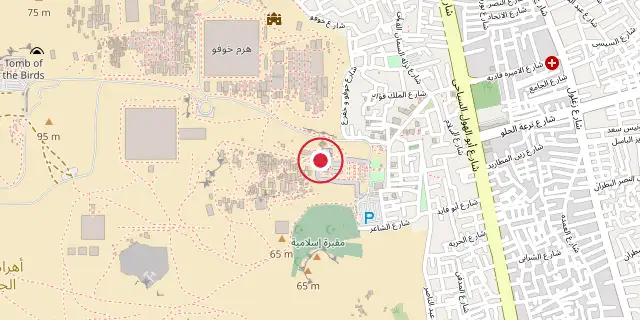
Coordinates: 29°58′30″N 31°08′17″E (29.9750, 31.1380) · Open in OpenStreetMap
Coordinates and connected clubs: the infobox of Wikipedia: Great Sphinx of Giza (CC BY-SA 4.0). Map: drawn by Codexery from OpenStreetMap tiles.
Carved directly from the limestone bedrock of the Giza Plateau, the Great Sphinx is a colossal statue of a mythical creature—part human, part lion—reclining on its haunches. Facing east on the west bank of the Nile, it is the oldest monumental sculpture known in Egypt and forms part of the Memphite Necropolis, a UNESCO World Heritage Site. Experts believe it was built during the Old Kingdom, either under Pharaoh Khufu (c. 2590–2566 BC) or his son Khafre (c. 2558–2532 BC).
The face is thought to represent one of these rulers—possibly Khufu, Djedefre, or Khafre—but no consensus exists, and the identity remains disputed. The statue measures 73 meters from paw to tail, stands 20 meters tall from base to head, and is 19 meters wide at the rear haunches. Its nose was deliberately removed with rods or chisels, contradicting the popular tale that Napoleon’s troops shot it off with cannonfire in 1798.
The original name given by its creators is lost, as the surrounding temple and enclosure were never finished, leaving little cultural context. By the New Kingdom, the Sphinx was worshipped as the solar deity Hor-em-akhet, or “Horus of the Horizon,” a name recorded on the Dream Stele of Pharaoh Thutmose IV around 1400 BC.
The common English name “Sphinx” dates to classical antiquity, borrowed from a Greek mythological beast—often female, winged, and lion-bodied—that strangled those who failed its riddle. Medieval Arab writers called it Belhib, Balhubah, or Abū il-Hawl (“father of terror”), terms derived from the Canaanite god Hauron. The Sphinx has been restored multiple times, most recently by replacing limestone blocks around its base.
Lore & Background
Archaeological evidence suggests the Sphinx was created by Egyptians of the Old Kingdom during the reign of Khufu () or Khafre (). Scholars and Egyptologists believe the face of the Sphinx was carved to represent either the pharaoh Khufu or one of his sons, pharaohs Djedefre and Khafre, but a consensus has not been reached and the person(s) in whose likeness the Sphinx was carved remains in dispute. The original name the Old Kingdom creators gave the Sphinx is unknown. In the New Kingdom, the Sphinx was revered as the solar deity Hor-em-akhet.
The commonly used name 'Sphinx' was given to it in classical antiquity. Medieval Arab writers call the Sphinx by an Arabized Coptic name Belhib, Balhubah, or Belhawiyya. The medieval Egyptian Arabic name is Abū il-Hawl, meaning 'father of terror'.
Common Misconceptions (Editorial)
- Some believe the Sphinx’s nose was destroyed by Napoleon’s cannonfire, but it was actually deliberately broken off with rods or chisels.
- It is often assumed the Sphinx was entirely carved by human hands, but it may have begun as a natural yardang shaped by wind before being sculpted.
Why It Matters (Editorial)
The Great Sphinx endures as a silent witness to the Old Kingdom’s ambitions, its weathered face and incomplete temple reminding us that even the most monumental works of antiquity remain shrouded in mystery. Its survival across millennia challenges us to respect the fragility of cultural heritage while inspiring curiosity about the beliefs, rulers, and craftsmanship that shaped one of humanity’s most iconic symbols.
Reader's Guide
The Great Sphinx is a monolith carved from the limestone bedrock of the Giza Plateau, which also served as a quarry for nearby pyramids. One geological theory suggests its head may have been initially shaped by wind erosion as a natural yardang, with the surrounding ditch later quarried to expose the full body. The stones removed from the enclosure were used to build a temple in front of the statue, though neither the temple nor the enclosure was ever completed, and there is little evidence of a cult dedicated to the Sphinx during the Old Kingdom.
The monument was part of the Khafre funerary complex, as the construction of the Sphinx required the deconstruction of a wall in Khafre’s Valley Temple, and the causeway linking Khafre’s pyramid to that temple already existed when the Sphinx was planned. After the Giza Necropolis was abandoned during the First Intermediate Period, drifting sand buried the Sphinx up to its shoulders. The first recorded excavation occurred under the New Kingdom pharaoh Thutmose IV, who cleared the front paws and erected a shrine between them housing the Dream Stele. This stele, though damaged, associates the Sphinx with the pharaoh Khafre, though the relevant hieroglyphs are incomplete.
Later, Ramesses II may have undertaken a second excavation. The Sphinx was later revered as the solar deity Hor-em-akhet. Its modern name derives from classical antiquity, referencing the Greek mythological sphinx, while medieval Arabic sources called it Abū al-Hawl, meaning “father of terror.”
Sources
Compiled from Wikipedia and the sources listed below. Text from Wikipedia is available under CC BY-SA 4.0; this entry is adapted from it.
- Wikipedia: Great Sphinx of Giza (CC BY-SA 4.0).
Spotted an error? Know more?
Reader corrections go straight into our review queue. Suggest an edit · How this site is sourced