Book of the Dead
Ancient Egyptian funerary spells for the afterlife journey.
Last updated
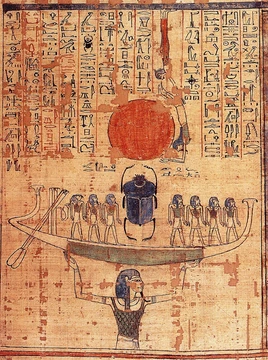
The Book of the Dead is an ancient Egyptian funerary text written on papyrus, used from around 1550 BC to about 50 BC.[1] It is a loose collection of magic spells intended to assist a dead person's journey through the underworld and into the afterlife.[1]
Quick Facts
- Time period
- c. 1550 BC – c. 50 BC
- Original language
- Egyptian (hieroglyphic or hieratic script)
- Number of known spells
- 192
- Notable manuscript
- Papyrus of Ani
Facts from the source article.
Key facts and history
The Book of the Dead developed from earlier funerary manuscripts, beginning with the Pyramid Texts of the Old Kingdom around 2400 BC.[2] In the Middle Kingdom, the Coffin Texts emerged, written on coffins and available to wealthy private individuals.[3] The Book of the Dead first developed in Thebes around 1700 BC, with the earliest known spells from the coffin of Queen Mentuhotep.[4] In the 25th and 26th Dynasties, the text was standardized into the 'Saite recension', with spells ordered and numbered consistently for the first time.[5]
What the cited sources add
Most owners were part of the social elite, initially reserved for the royal family, but later found in tombs of scribes, priests, and officials.[6] The dimensions varied widely, with the longest scroll measuring 40 m and some as short as 1 m.[7] Books were often prefabricated in funerary workshops, with spaces left for the deceased's name to be written later.[8] Scribes created the Book of the Dead on commission, either for individuals planning their own funerals or for the family of someone who had died.[9]
These scrolls were costly; one record indicates a price of one deben of silver, which might equal about half a laborer's yearly earnings.[9]
References
- Wikipedia, "Book of the Dead" (CC BY-SA 4.0), which cites: Taylor 2010, p.54; The Egyptian Book of the Dead by Anonymous (2 Jun 2014) ...with an introduction by Paul Mirecki (VII) (original not read by us) en.wikipedia.org
- Wikipedia, "Book of the Dead" (CC BY-SA 4.0), which cites: Faulkner p. 54 (original not read by us) en.wikipedia.org
- Wikipedia, "Book of the Dead" (CC BY-SA 4.0), which cites: D'Auria et al p.187 (original not read by us) en.wikipedia.org
- Wikipedia, "Book of the Dead" (CC BY-SA 4.0), which cites: Taylor 2010, p.34 (original not read by us) en.wikipedia.org
- Wikipedia, "Book of the Dead" (CC BY-SA 4.0), which cites: Taylor 2010, p.59 60 (original not read by us) en.wikipedia.org
- Wikipedia, "Book of the Dead" (CC BY-SA 4.0), which cites: Taylor 2010, p. 62–63 (original not read by us) en.wikipedia.org
- Wikipedia, "Book of the Dead" (CC BY-SA 4.0), which cites: Taylor 2010, p. 264 (original not read by us) en.wikipedia.org
- Wikipedia, "Book of the Dead" (CC BY-SA 4.0), which cites: Taylor 2010, p. 267; Faulkner 1994, p. 142 (original not read by us) en.wikipedia.org
- Wikipedia, "Book of the Dead" (CC BY-SA 4.0), which cites: Taylor 2010, p. 62; Faulkner 1994, p. 142 (original not read by us) en.wikipedia.org
Each numbered sentence above was checked against the source it cites before publication. Sentences citing Wikipedia adapt text from the English Wikipedia article Book of the Dead (contributors), used under CC BY-SA 4.0; this entry is available under the same licence. Other sources were used for facts only; no text or images are copied from them.
Also in the Codexery
More in Egyptian mythology
Sources
Compiled from Wikipedia and the sources listed below. Text from Wikipedia is available under CC BY-SA 4.0; this entry is adapted from it.
- Wikipedia: Book of the Dead (CC BY-SA 4.0).
Spotted an error? Know more?
Reader corrections go straight into our review queue. Suggest an edit · How this site is sourced