Ra
Ancient Egyptian sun god, creator of life, and first pharaoh.
Last updated
Ra was the ancient Egyptian deity of the Sun, and by the Fifth Dynasty (25th and 24th centuries BC) he had become one of the most significant gods in the Egyptian pantheon, primarily linked to the midday Sun. He held dominion over the sky, the Earth, and the Duat (underworld), and was also regarded as the first pharaoh of Egypt, embodying order, kingship, and the heavens. In art, Ra was typically depicted as a falcon, sharing traits with the sky-god Horus; the two were sometimes combined as Ra-Horakhty, meaning "Ra, who is Horus of the Two Horizons." During the New Kingdom, the rising prominence of the god Amun led to a fusion with Ra as Amun-Ra. The cult of the Mnevis bull, an earthly embodiment of Ra, was centered at Heliopolis, with a dedicated burial ground for sacrificed bulls north of the city.
Journey of the Sun
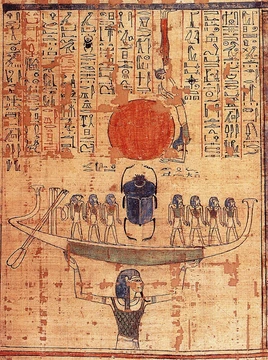
According to myth, all life was created by Ra. Humans were said to have been formed from his tears and sweat, and the Egyptians called themselves the "Cattle of Ra." In the Celestial Cow myth, humanity plotted against Ra, prompting him to send his eye as the goddess Sekhmet to punish them. Ra’s daily journey involved crossing the sky on his solar barque, the Mandjet, in falcon-headed form, lighting the day.
At sunset, he passed through the western horizon into the Duat, transforming into a ram-headed form and sailing the subterrestrial Nile on the Mesektet barque. During this twelve-hour night voyage, he faced the serpent Apophis, who attacked the sun-boat each night; after defeating him, Ra emerged at dawn. In the underworld, he was accompanied by deities such as Sia, Hu, and Heka, and sometimes by Set and Mehen for protection.
Sun as a creator
Ra was also a creator god. In the beginning, only chaos existed—a vast watery mass called Nun. From this emerged the Benben, a pyramid mound, and a lotus flower; when the lotus blossomed, Ra appeared. He then created Shu (air) and Tefnut (moisture), who represented life and justice.
Ra brought all forms of life into existence by speaking their secret names. He was often combined with Atum (his human form), Khepri (the scarab beetle), and Horus (the falcon). His most common depiction is a man with a falcon’s head, topped by a solar disc and cobra, symbolizing the Eye of Ra.
Lore & Background
Ra was portrayed as a falcon and shared characteristics with the sky-god Horus. At times, the two deities were merged as Ra-Horakhty, "Ra, who is Horus of the Two Horizons". When the god Amun rose to prominence during Egypt's New Kingdom, he was fused with Ra as Amun-Ra. The cult of the Mnevis bull, an embodiment of Ra, had its center in Heliopolis and there was a formal burial ground for the bulls north of the city.
All forms of life were believed to have been created by Ra. In some accounts, humans were created from Ra's tears and sweat, hence the Egyptians call themselves the "Cattle of Ra". In the myth of the Celestial Cow, it is recounted how humankind plotted against Ra and how he sent his eye as the goddess Sekhmet to punish them.
The Solar Journey and the Nightly Trial
Ra's daily cycle was the backbone of Egyptian cosmology. Each morning, in his falcon-headed guise aboard the Mandjet Barque—called the Boat of Millions of Years—he carried the sun across the sky, bringing light and warmth to the world. As twilight fell, he passed through the akhet, the western horizon, which was sometimes imagined as a gate opening into the Duat. There, his vessel switched to the Mesektet, and he assumed his ram-headed form to navigate the subterrestrial Nile.
The journey required him to pass through twelve gates and regions, and at every stage the chaos serpent Apophis lurked, trying to devour the boat or freeze it with a hypnotic gaze. Deities like Set and Mehen stood guard, and the Ennead sometimes assisted. Once the serpent was defeated, Ra emerged at dawn, and the sky-goddess Nut received him as a rebirth. In the underworld he also merged with Osiris, the lord of the dead, and visited each of his own divine forms.
Creation from Primordial Waters
Before anything existed, the universe was a boundless expanse of primordial waters called Nun. From this formless chaos rose the Benben, a pyramid-shaped mound, and beside it a lotus flower. When that flower opened, Ra emerged into being.
In his earliest guise as Atum, he stood alone in the waters, and from solitude he brought order into existence. He called forth Shu, the god of air, and Tefnut, the goddess of moisture—two siblings embodying the principles of life and justice. Ra created all living things by speaking their secret names into being.
In some traditions, humankind was fashioned from his tears and sweat, a detail that led the Egyptians to call themselves the Cattle of Ra. Yet in the myth of the Celestial Cow, humanity turned against him, and he dispatched his own eye, the fierce goddess Sekhmet, to punish the rebels. Ra thus occupied a dual role: tender creator and avenging sovereign.
Forms, Fusions, and the Language of Iconography
Ra's visual identity was remarkably fluid. His most recognizable depiction was a man crowned with a falcon's head, a solar disk, and a coiled cobra representing the Eye of Ra. This falcon aspect linked him directly to Horus, the sky-god, and the two were sometimes merged into Ra-Horakhty, meaning Ra who is Horus of the Two Horizons. When the god Amun gained supreme status during the New Kingdom, the fusion produced Amun-Ra, a unified deity of creation and sovereignty.
Beyond the falcon, Ra appeared as a scarab beetle in his Khepri form, a ram, a full-bodied bull, a phoenix, a heron, a serpent, a cat, or a lion. In the underworld he was most often shown with a ram's head. The Mnevis bull, regarded as a living embodiment of Ra, was venerated in Heliopolis, where a dedicated burial ground lay north of the city for the sacrificed animals. This multiplicity of forms allowed Ra to be present in every aspect of the created world.
Sovereignty, Kingship, and the Living Cult
By the Fifth Dynasty, spanning the 25th and 24th centuries BC, Ra had ascended to a position of supreme importance in Egyptian religion. He was recognized as the first pharaoh, the original ruler who governed the sky, the Earth, and the underworld simultaneously. His dominion extended over order, kingship, and the celestial sphere, earning him the title King of the Gods. His influence radiated across the entire country, inspiring countless local representations and name combinations.
The sun's life-giving power—ripening crops, warming the land—anchored the theological argument for his divinity. The cult of the Mnevis bull centered in Heliopolis, where formal rituals and the burial of sacred bulls reinforced Ra's living presence. Accompanying deities such as Sia, Hu, and Heka traveled with him in the solar barque, underscoring that his journey was not merely a celestial event but a sustained act of cosmic governance that sustained all life.
Common Misconceptions (Editorial)
A common misconception is that Ra was solely a sun god; however, the facts confirm he ruled the sky, Earth, and underworld. Another error is thinking Ra was always fused with Amun; in fact, Amun was merged with Ra as Amun-Ra only during the New Kingdom, long after Ra’s initial prominence. Some may believe Ra’s only form was a falcon, but the record shows he also took ram-headed and beetle forms, among others.
Why It Matters (Editorial)
Ra endures as a symbol of ancient Egypt’s sophisticated cosmology, where a single deity governed creation, kingship, and the daily cycle of life and death. His myth—battling chaos each night to bring the dawn—reflects a timeless human struggle for order against darkness, making him a lasting archetype in both historical study and popular culture.
Reader's Guide
According to Egyptian myth, when Ra became too old and weary to reign on Earth, he relinquished and went to the skies. As the Sun god, his duty was to carry the Sun across the sky on his solar barque to light the day. When the sun set and twilight came, he and his vessel passed through the akhet, the horizon, in the west, and traveled to the Duat (underworld).
At times, the horizon has been described as a gate or door that leads to the Duat. There, he would have to sail on the subterrestrial Nile and crossed through the twelve gates and regions. Through the course of his underworld journey, he would transform into his Ram-headed form.
Every night, Apophis would attack Ra in an attempt to stop the sun-boat's journey. After defeating the snake, Ra would leave the underworld, returning at dawn, lighting the day once again. He was said to have traveled across the sky in his falcon-headed form on the Mandjet Barque through the hours of the day, and then switch to the Mesektet Barque in his ram-headed form to descend into the underworld for the hours of the night.
Did You Know?
- The chief cultic center of Ra was Iunu, later known as Heliopolis.
Frequently Asked Questions
Who is Ra?
Ra (also called Re) is the ancient Egyptian god of the Sun and a creator deity. He is additionally revered as the very first pharaoh to rule over Egypt.
What is Ra known for?
As the noon-day Sun, Ra held sovereignty over the sky, the Earth, and the underworld all at once. His daily passage across the heavens and his nightly voyage through the Duat made him the sustaining force behind the natural order.
What animal or symbolic forms is Ra associated with?
Ra is depicted in several guises, including a falcon, a ram, a scarab beetle, and a human figure bearing a falcon's head. These varied representations reflected different facets of his solar power as it shifted across the day.
Sources
Compiled from Wikipedia and the sources listed below. Text from Wikipedia is available under CC BY-SA 4.0; this entry is adapted from it.
- Wikipedia: Ra (CC BY-SA 4.0).
Spotted an error? Know more?
Reader corrections go straight into our review queue. Suggest an edit · How this site is sourced