The Duat
Last updated
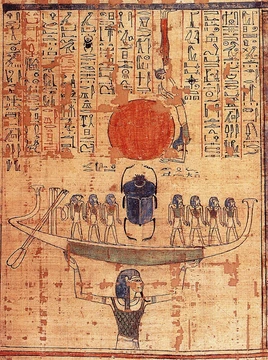
The Duat is a dark subterranean realm that houses the deceased and a variety of deities, known principally from funerary texts such as the Book of Gates and the Book of the Dead.[1] The Duat is primarily portrayed as the location where souls undergo judgment after death and where the sun god Ra is reborn each night.[2]
Key facts and history
The Duat is divided into twelve sections by guarded gates that represent each hour of the night and are closely associated with the journey of Ra.[2] Each night Ra travelled through the Duat in his ram-headed form Af, bringing revivification to the dead.[3] The dead king travelled through the Duat, the Kingdom of Osiris, using special knowledge recorded in the Coffin Texts.[4] According to the Amduat, the underworld consists of twelve regions signifying the twelve hours of the sun god's journey, during which he battles Apep.[4]
Important locations include 'The Hall of Truth', where the 'Weighing of the Heart' ritual occurs, and A'aru, the 'Field of Reeds', a paradise of eternal spring.[5][6] On his Atet barge, Ra journeyed beneath the earth moving westward to eastward, changing from his older manifestation Atum into his youthful form Khepri.[3] The Duat contains both ordinary geographical elements—rivers, islands, fields, paths, and lakes—and supernatural ones including flaming lakes, iron walls, and turquoise trees.[7][8] In ancient Egyptian belief, the ultimate penalty for wrongdoers was the annihilation of their existence after death, accomplished when Ammit consumed their heart.[9]
The Duat should not be confused with the Hell found in Abrahamic faiths.[9]
What the cited sources add
Scholar Rosalie David describes the Field of Reeds as enjoying eternal springtime, unfailing harvests, and no pain or suffering.[10] By the Middle Kingdom, the cult of Osiris was firmly established, and a more elaborate vision of the afterlife emerged including judgment of the soul in the Hall of Truth.[10] Once Osiris was reassembled, he descended into the dark realm of Duat where he reigned as just judge and king of the dead.[10] The soul was granted eternal paradise in A'aru based on how virtuous the person had been in life.[10]
References
- Wikipedia, "Duat" (CC BY-SA 4.0), which cites: "Ancient Egyptian Book of the Dead", British Museum Press, 2010; "The Egyptian Book of the Dead: The book of going forth by day", Chronicle Books, 2000; Hornung, "The Egyptian Book of Gates", Living Human Heritage Publications, 2013; "Egyptian Book of the Dead", 2012-09-26; Taylor, "Death and the Afterlife in Ancient Egypt", The University of Chicago Press, 2001, p. 34; Zago, "Imagining the Beyond: The Conceptualization of Duat between the Old and the Middle Kingdoms", Journal of the American Research Center in Egypt, 2018, p. 203–218 (we also rea en.wikipedia.org
- Wikipedia, "Duat" (CC BY-SA 4.0), which cites: "Book of the Am-Tuat Index", sacred-texts.com; Bunson, "Encyclopedia of Ancient Egypt", Facts on File Inc., 2002, p. 412 (original not read by us) en.wikipedia.org
- Wikipedia, "Duat" (CC BY-SA 4.0), which cites: Weigal, "A Guide to the Antiquities of Upper Egypt", Taylor & Francis, 2005-05-27, p. 199 (we also read that source) en.wikipedia.org
- Wikipedia, "Duat" (CC BY-SA 4.0), which cites: Taylor, "Death and the Afterlife in Ancient Egypt", The University of Chicago Press, 2001, p. 34 (we also read that source) en.wikipedia.org
- Wikipedia, "Duat" (CC BY-SA 4.0), which cites: "Book of the Dead: A Guidebook to the Afterlife", ARCE; "Book of the Am-Tuat Index", sacred-texts.com; Mark, "Field of Reeds (Aaru)", World History Encyclopedia (we also read that source) en.wikipedia.org
- Wikipedia, "Duat" (CC BY-SA 4.0), which cites: Mark, "Field of Reeds (Aaru)", World History Encyclopedia (we also read that source) en.wikipedia.org
- Wikipedia, "Duat" (CC BY-SA 4.0), which cites: Pinch, "Magic in Ancient Egypt", British Museum Press, 1994; Kandil, "The Function and Symbolism of the Akh in Ancient Egypt", Faculty of Arts Journal, 2012, p. 1–14 (original not read by us) en.wikipedia.org
- Wikipedia, "Duat" (CC BY-SA 4.0), which cites: "Ancient Egyptian Book of the Dead", British Museum Press, 2010; Hornung, "The Egyptian Book of Gates", Living Human Heritage Publications, 2013; Hornung, "The Egyptian Book of Gates", Living Human Heritage Publications, 2013; "Book of the Am-Tuat Index", sacred-texts.com (we also read that source) en.wikipedia.org
- Wikipedia, "Duat" (CC BY-SA 4.0), which cites: Pinch, "Magic in Ancient Egypt", British Museum Press, 1994 (original not read by us) en.wikipedia.org
- Mark, "Field of Reeds (Aaru)", World History Encyclopedia. worldhistory.org
Each numbered sentence above was checked against the source it cites before publication. Sentences citing Wikipedia adapt text from the English Wikipedia article Duat (contributors), used under CC BY-SA 4.0; this entry is available under the same licence. Other sources were used for facts only.
More in Egyptian Myths
Sources
Compiled from Wikipedia and the sources listed below. Text from Wikipedia is available under CC BY-SA 4.0; this entry is adapted from it.
- Wikipedia: Duat (CC BY-SA 4.0).
Spotted an error? Know more?
Reader corrections go straight into our review queue. Suggest an edit · How this site is sourced