
Degos disease
Rare disease causing papules and internal organ damage.

Madhero88 · CC BY-SA 3.0
Degos disease, also called Köhlmeier-Degos disease or malignant atrophic papulosis, is a very rare disorder in which arteries and veins become blocked. People with the condition develop papules, and some also face complications from damage to internal organs. The reason these blockages occur is not known, and no effective treatment has been found yet. Fewer than 50 people with the disease are known to be alive today, and fewer than 200 cases have been described in medical literature. However, many cases may go undiagnosed because the disease is so rare. Symptoms usually appear between ages 20 and 50, though cases outside this range have been reported.
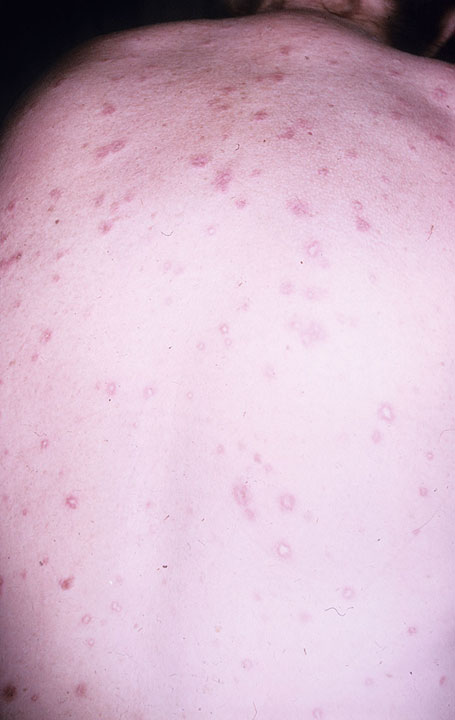
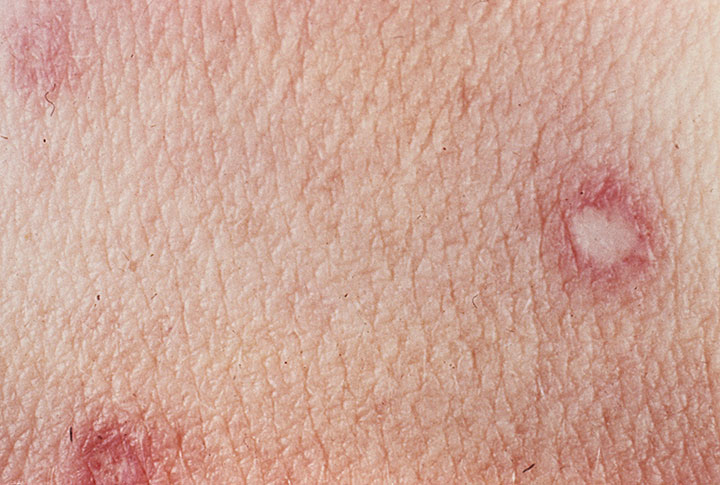
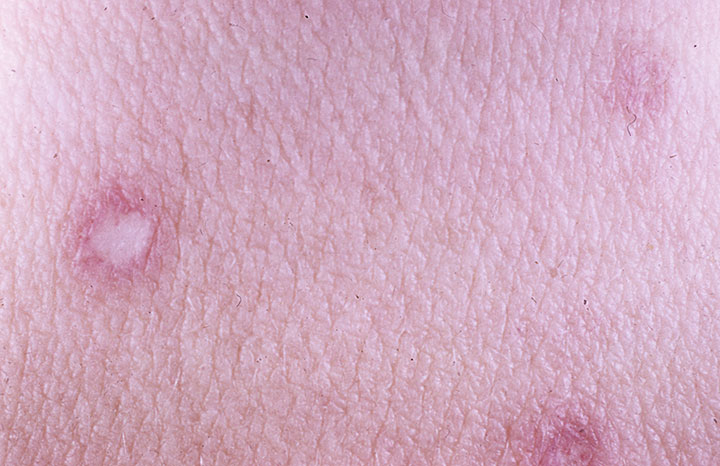
The main sign of Degos disease is the appearance of papules. At first, a person may have skin lesions or rashes, but these turn into distinct bumps. The papules are round, with a porcelain-white center and a red border. As they age, the white centers sink in, leaving only the raised border. They are typically 0.5 to 1 cm wide and appear on the trunk and upper arms, but not on the palms, soles, scalp, or face.
Symptoms depend on whether a person has the benign or malignant form. Both forms involve the characteristic papules. In the benign form, the papules may last for a few years or for a lifetime, and no internal organs are affected. In the malignant form, internal organs are involved. Most malignant cases affect the gastrointestinal tract, causing small intestine lesions, abdominal pain, diarrhea, and bowel perforation. If the central nervous system is involved, symptoms can include headaches, dizziness, seizures, cranial nerve paralysis, weakness, stroke, small brain infarcts from artery blockages, and cerebral hemorrhage. Other commonly affected organs are the heart, lungs, and kidneys, leading to symptoms such as double vision, clouding of the eye lenses, optic disc swelling, partial vision loss, shortness of breath, chest pain, epilepsy, and thickening of the pericardium. A person with the benign form may suddenly develop malignant symptoms. Symptoms can last from a few weeks to several years. Onset typically occurs between ages 20 and 50, though a few newborn cases have been described.
The papules form because of infarctions—blockages in small to medium arteries and veins. The underlying cause is unknown. Although not confirmed, some cases show signs of inheritance among first-degree relatives.
- Field
- Medicine
- Known for
- Characteristic porcelain-white papules with red borders; blockage of small- and medium-sized arteries and veins
- Rarity
- Fewer than 50 living patients known worldwide; fewer than 200 reported in medical literature
- Typical age of onset
- 20–50 years
Lore & Background
Degos disease was first described in 1941 by Köhlmeier, and recognized as a new clinical entity by Robert Degos in 1942. The condition is characterized by the development of circular papules with a porcelain-white center and red border, typically appearing on the trunk and upper extremities. Papules range from 0.5 to 1 cm in width and are not found on the palms, soles, scalp, or face.
The disease has both a benign and a malignant variant. In the benign form, only the papules are present and may persist for years or throughout life. The malignant form involves internal organs, most commonly the gastrointestinal tract, leading to abdominal pain, diarrhea, and bowel perforation, as well as the central nervous system, heart, lungs, and kidneys. Symptoms can include headaches, seizures, stroke, double vision, shortness of breath, and chest pain. A person with the benign form may suddenly develop the malignant form.
Reader's Guide
Degos disease is significant as an extremely rare and poorly understood condition with fewer than 200 reported cases in medical literature. Its underlying mechanism remains unknown, though hypotheses include inflammation of blood vessels, coagulopathy, or abnormal swelling of vascular endothelium. Diagnosis relies on clinical evaluation of characteristic papules and histological findings showing wedge-shaped connective tissue necrosis. No effective treatment has been established; fibrinolytic and immunosuppressive therapies have been mostly unsuccessful. Recent research has shown improvement with eculizumab and treprostinil, though eculizumab's effect is of limited duration and expensive, requiring infusion every 14 days. All known long-term survivors of systemic Degos disease are being treated with a combination of eculizumab and treprostinil. The disease's rarity and diagnostic challenges mean many individuals may go undiagnosed.
Did You Know?
- The characteristic papules have a porcelain-white center and red border, and are not found on the palms, soles, scalp, or face.
- Fewer than 50 living patients are known worldwide, and fewer than 200 have been reported in medical literature.
The Two Faces of the Disease
The condition presents in two fundamentally different trajectories, and distinguishing between them is critical for patient management. In its milder expression, the disease manifests solely through the skin: small, circular bumps with a porcelain-white core ringed by a red border, typically measuring half to one centimeter across. These papules appear on the torso and upper arms but conspicuously spare the face, palms, soles, and scalp. Over time, the white centers atrophy and sink inward, leaving only the raised red rim. In this benign form, internal organs remain untouched, and the lesions can persist for years or even a lifetime without progressing. The malignant variant, however, introduces a far more dangerous dimension. Here, the same vascular blockages that create the skin lesions extend into the gastrointestinal tract, central nervous system, heart, lungs, and kidneys. Patients may experience abdominal pain, bowel perforation, seizures, stroke, cranial nerve paralysis, shortness of breath, and vision loss. Crucially, a person living with the benign form for years can suddenly shift into the malignant course, making vigilant follow-up essential.
The Unraveling Mystery
Despite roughly seven decades of medical observation, no one has definitively identified what triggers the vascular occlusions at the heart of this condition. The papules and organ damage all stem from blockages in small and medium-sized arteries and veins, yet the root cause of those blockages remains elusive. Several competing hypotheses have emerged over the years. One points to vascular inflammation as a possible initiator. Another frames the disease as a coagulopathy, where abnormal clot formation reduces blood flow, damages the endothelial lining, and ultimately produces the characteristic skin lesions. A third theory proposes that abnormal swelling and proliferation of the vascular endothelium sets off thrombosis in the intestines and brain, cascading into the full symptom picture. On the genetic front, the picture is equally uncertain. Some cases have appeared among first-degree relatives, leading researchers to speculate about an autosomal dominant inheritance pattern. However, this has never been confirmed, and in most familial clusters the milder, skin-only variant has been observed. Because the pathomechanism is unresolved, no prevention strategies exist, and the condition remains a mystery without a solution.
Identifying a Ghost
Diagnosing a condition with fewer than fifty known living patients worldwide and fewer than two hundred documented cases in the medical literature is an extraordinary challenge. The rarity itself becomes a barrier: many individuals likely go undiagnosed simply because clinicians have never encountered the condition before. When it is recognized, the process often begins with a dermatologist identifying the telltale papules—those small, round lesions with their distinctive white centers and red borders. A skin biopsy then provides histological confirmation, typically revealing a wedge-shaped area of connective tissue necrosis in the deeper dermis, a pattern that mirrors the occlusion of small feeding arteries. The diagnostic workup must also determine whether the disease is confined to the skin or has spread systemically. Depending on which organs are suspected, physicians may order brain imaging, colonoscopy, chest radiography, or abdominal ultrasound. The stakes of getting this assessment right are high, because a patient who has carried benign papules for years can abruptly develop the malignant, organ-involving form. Regular follow-up evaluations are therefore not optional but a matter of survival.
The Long Search for a Cure
No definitive cure exists for this condition, and the absence of one is a direct consequence of the unresolved pathophysiology. Because clinicians do not yet know precisely what initiates the vascular blockages, treatment has historically been limited to managing symptoms as they arise. Early therapeutic attempts have been largely disappointing. Fibrinolytic agents designed to dissolve clots and immunosuppressive regimens aimed at dampening inflammatory responses were both tested and found to be mostly unsuccessful. For years, this left patients with little more than supportive care. A more recent and encouraging development involves two drugs: eculizumab, a complement-inhibiting antibody, and treprostinil, a vasodilator. After first addressing comorbid conditions, physicians have observed symptomatic improvement in patients receiving these agents. Notably, dermatopathologist Cynthia Magro identified the response to eculizumab, which in some cases has been immediate and dramatic. However, the durability of that response remains limited, and the therapeutic picture is still evolving. With so few patients available for study, every case carries weight, and the search for a reliable, long-term treatment continues.
Gallery
Frequently Asked Questions
What exactly is Degos disease?
Degos disease, also referred to as Köhlmeier-Degos disease or malignant atrophic papulosis, is an extremely rare vascular disorder in which small and medium-sized blood vessels become obstructed. This blockage leads to the formation of distinctive skin papules and can cause serious damage to internal organs.
What are the signature visual signs of Degos disease?
The condition is best recognized by its hallmark porcelain-white papules ringed with a reddish border on the skin. Beyond the skin, the vascular occlusions can affect internal organs, producing a range of secondary complications.
How rare is Degos disease in the real world?
It is extraordinarily uncommon—fewer than 50 living individuals are known to carry the diagnosis, and fewer than 200 cases have ever been documented in medical literature. Many suspected cases likely go undiagnosed simply because the condition is so scarce.
What triggers the vessel blockages, and is there a cure?
The underlying mechanism behind the arterial and venous occlusions remains unidentified, and no effective treatment has been established to date. This makes it one of the most medically unresolved rare vascular conditions.
At what age does Degos disease typically emerge?
Symptoms most commonly present between the ages of 20 and 50, though the exact timing can vary from person to person. The progressive nature of the vascular damage means that early recognition is critical, even though the diagnostic window is narrow.
More in Disorders causing seizures 1-24
Spotted an error? Know more?
Reader corrections go straight into our review queue. Suggest an edit · How this site is sourced