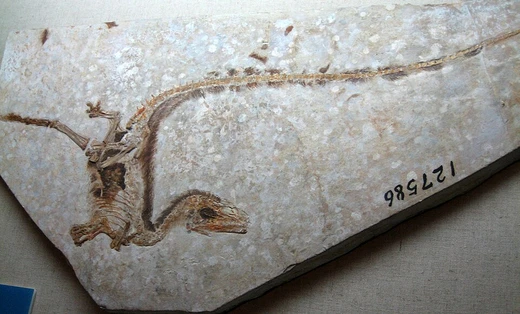
Compsognathus
The first theropod dinosaur known from a reasonably complete skeleton, once mistaken for a lizard.

Compsognathus (from Greek *kompsos* meaning "elegant" or "dainty" and *gnathos* meaning "jaw") is a genus of small, bipedal, carnivorous theropod dinosaur. The only recognized species, *Compsognathus longipes*, lived approximately 150 million years ago during the Tithonian age of the Late Jurassic in what is now Europe. Although often described as "chicken-sized," this comparison is based on the smaller German specimen, which is now believed to be a juvenile. The genus is known from two well-preserved fossils: one discovered in Germany in the 1850s and a larger one found in France around 1971. The German specimen was originally described in 1859 by paleontologist Johann A. Wagner, who mistook it for a lizard rather than a dinosaur. It was later acquired by the paleontological state collection in Munich. The French specimen, once thought to be a separate species called *C. corallestris*, is now considered another example of *C. longipes*. Notably, *Compsognathus* is one of the few dinosaurs whose diet is directly known: both specimens preserve the remains of small, agile lizards in their stomach cavities. It was also the first theropod dinosaur known from a reasonably complete skeleton, though this was not recognized at the time. Until the 1990s, it held the title of the smallest known non-avialan dinosaur. In the late 1860s and 1870s, Thomas Huxley compared *Compsognathus* to the early bird *Archaeopteryx*, concluding that birds evolved from dinosaurs, a finding that made *Compsognathus* widely famous. Additional teeth found in Portugal may represent further remains of this genus.
- scientific_name
- Compsognathus longipes
- location
- Europe (Germany and France)
- diet
- Carnivorous (small vertebrates, known from lizard remains in both specimens)
- size
- German specimen 70–89 cm long; French specimen 1.25–1.4 m long
- weight
- German specimen 0.32–0.58 kg; French specimen 2.5–3.5 kg
- known_for
- First theropod dinosaur known from a reasonably complete skeleton; once considered the smallest non-avialan dinosaur
Lore & Background
Many presentations still describe Compsognathus as "chicken-sized" dinosaurs because of the size of the German specimen, which is now believed to be a juvenile. Compsognathus longipes is one of the few dinosaur species whose diet is known with certainty: the remains of small, agile lizards are preserved in the bellies of both specimens. Teeth discovered in Portugal may be further fossil remains of the genus. Although not recognized as such at the time of its discovery, Compsognathus is the first theropod dinosaur known from a reasonably complete fossil skeleton. Until the 1990s, it was the smallest-known non-avialan dinosaur, with the preceding centuries incorrectly labelling it as the closest relative of Archaeopteryx.
Reader's Guide
Compsognathus is known from two almost complete skeletons. The German specimen (specimen number BSP AS I 563) stems from limestone deposits in Bavaria and was part of the collection of physician and fossil collector Joseph Oberndorfer. Oberndorfer lent the specimen to paleontologist Johann A. Wagner, who published a brief discussion in 1859, where he coined the name Compsognathus longipes. Wagner did not recognise Compsognathus as a dinosaur, but instead described it as one of the "most curious forms among the lizards". He published a more detailed description in 1861. In 1866, Oberndorfer's collection, including the Compsognathus specimen, was acquired by the paleontological state collection in Munich. The year of discovery and the exact locality of the German specimen are unknown. The larger French specimen (Y85R M4M) was discovered in around 1971 in the Portlandian lithographic limestone of Canjuers near Nice. It dates to the lower Tithonian. The specimen was originally part of a large private fossil collection of Louis Ghirardi, the owner of the Canjures quarries. The collection, including the Compsognathus specimen, was sold to the National Museum of Natural History in Paris in 1983. Alain Bidar and Gérard Thomel, in a brief 1972 description, announced the new find under a separate species, Compsognathus corallestris. Ostrom, Jean-Guy Michard and others have since relabeled it as another example of Compsognathus longipes. In 1984, George Callison and Helen Quimby identified the smaller German specimen as a juvenile of the same species. For decades, Compsognathus was known as the smallest known non-avian dinosaur, although some dinosaurs discovered later, such as Mahakala and Microraptor, were even smaller. The German specimen was estimated to be 70–75 cm and 89 cm in length by separate authors, while the larger French specimen was estimated at 1.25 m and 1.4 m in length. The height at the hip has been estimated at 20 cm for the German specimen and at 29 cm for the French specimen. The German specimen was estimated to have weighed 0.32 kg and 0.58 kg, and the French specimen 2.5 kg and 3.5 kg. Compsognathus were small, bipedal animals with long legs and longer tails, which they used for balance during locomotion. The forelimbs were smaller than the hindlimbs. The hand bore two large, clawed digits and a third, smaller digit that may have been non-functio
Did You Know?
- Compsognathus is the first theropod dinosaur known from a reasonably complete fossil skeleton, though this was not recognized at its discovery.
- Until the 1990s, it was the smallest-known non-avialan dinosaur.
- The remains of small, agile lizards are preserved in the bellies of both known specimens, making its diet known with certainty.
Common Misconceptions (Editorial)
Some people assume Compsognathus was the smallest non-avialan dinosaur in general, but it held that title only until the 1990s, and the French specimen reached 1.4 meters in length—much larger than a chicken. Others might think its diet is unknown or speculative, but the fossil evidence clearly shows lizard remains preserved in the bellies of both known specimens.
Why It Matters (Editorial)
Compsognathus matters because it was the first theropod dinosaur found as a nearly complete skeleton, giving paleontologists an early, vivid window into the anatomy of small predatory dinosaurs. Its preserved stomach contents offer rare, direct proof of diet, making it a key example of how fossil evidence can confirm behavior that is usually only guessed at.
Frequently Asked Questions
What is Compsognathus?
Compsognathus is a small, two-legged carnivorous theropod dinosaur known from a single species, Compsognathus longipes. Its remains come from two nearly complete skeletons recovered in Europe, making it one of the best-preserved Jurassic meat-eaters.
How big was Compsognathus?
The German specimen measured roughly 70 to 89 centimeters and weighed about 0.32 to 0.58 kilograms, while the French specimen reached 1.25 to 1.4 meters and 2.5 to 3.5 kilograms. In everyday terms, it was in the ballpark of a large chicken.
What did Compsognathus eat?
It was a small-vertebrate predator, and both known specimens preserve lizard remains in their gut regions, confirming a carnivorous diet focused on animals like lizards.
Why is Compsognathus important to paleontology?
It was the first theropod ever identified from a reasonably complete skeleton, a fact that was not fully appreciated at the time of its original description. It also held the record as the smallest known non-avialan dinosaur until new species were described in the 1990s.
More in Dinosaurs 1-22
Spotted an error? Know more?
This is a living reference — every entry is fact-audited, and reader corrections feed straight into our audit queue. Suggest an edit · See this site's audit record