Tyrannosaurus rex
The tyrant lizard king of the late Cretaceous.

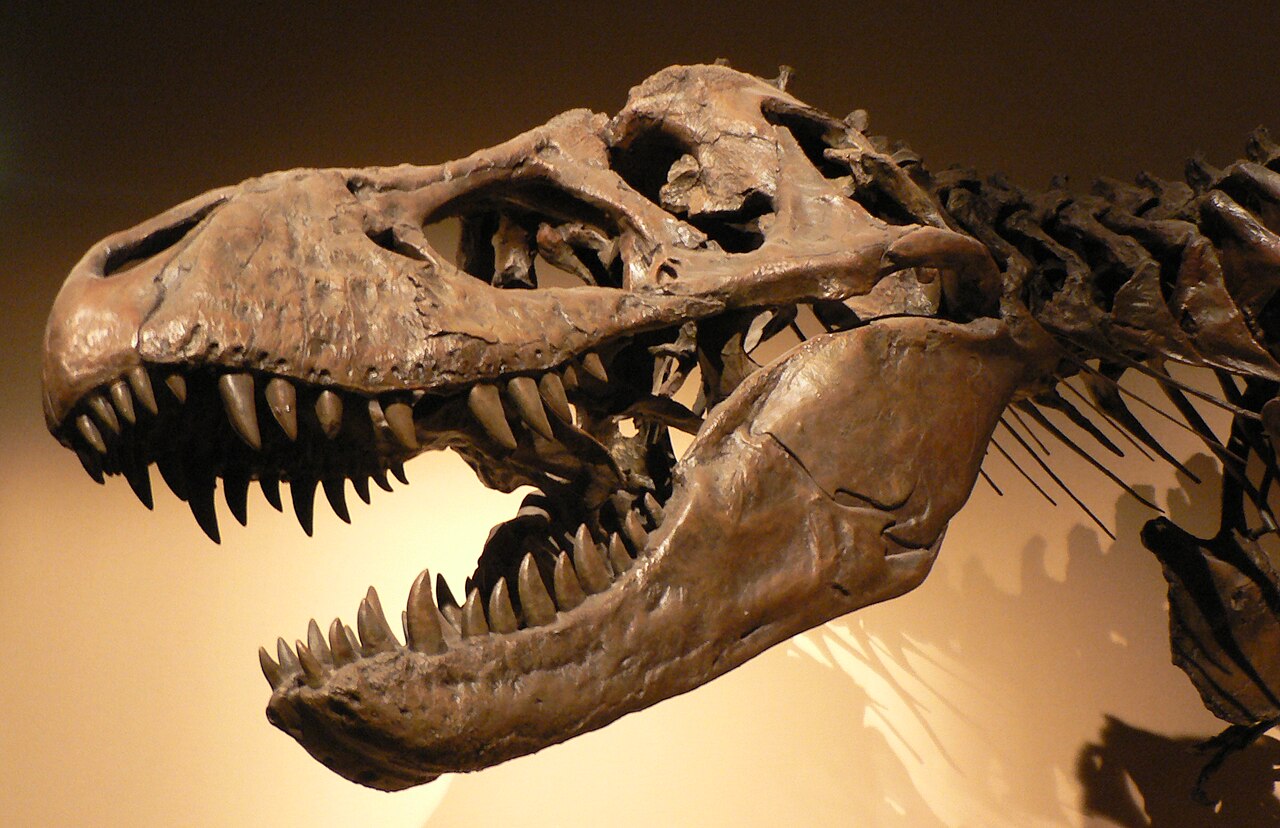
Copyright © 2005 David Monniaux · CC BY-SA 3.0
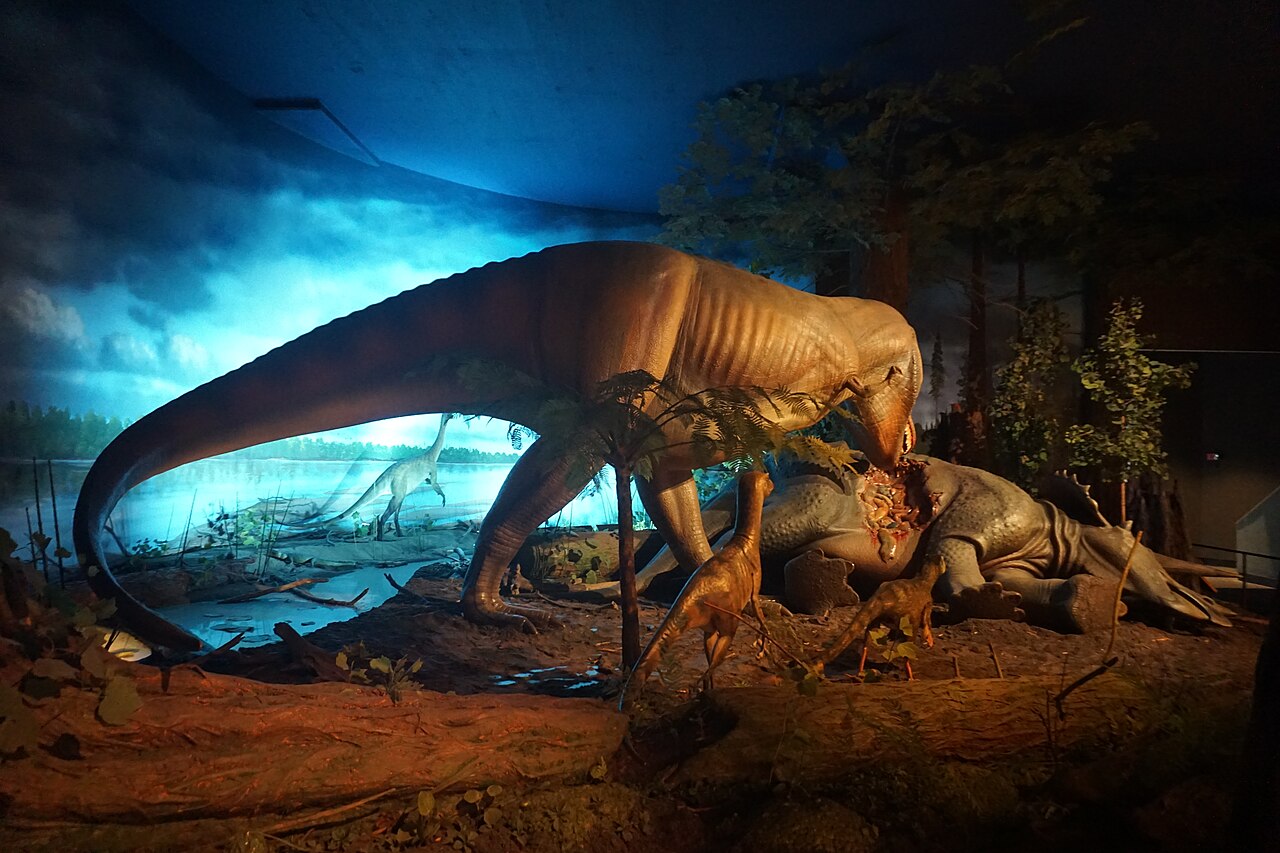
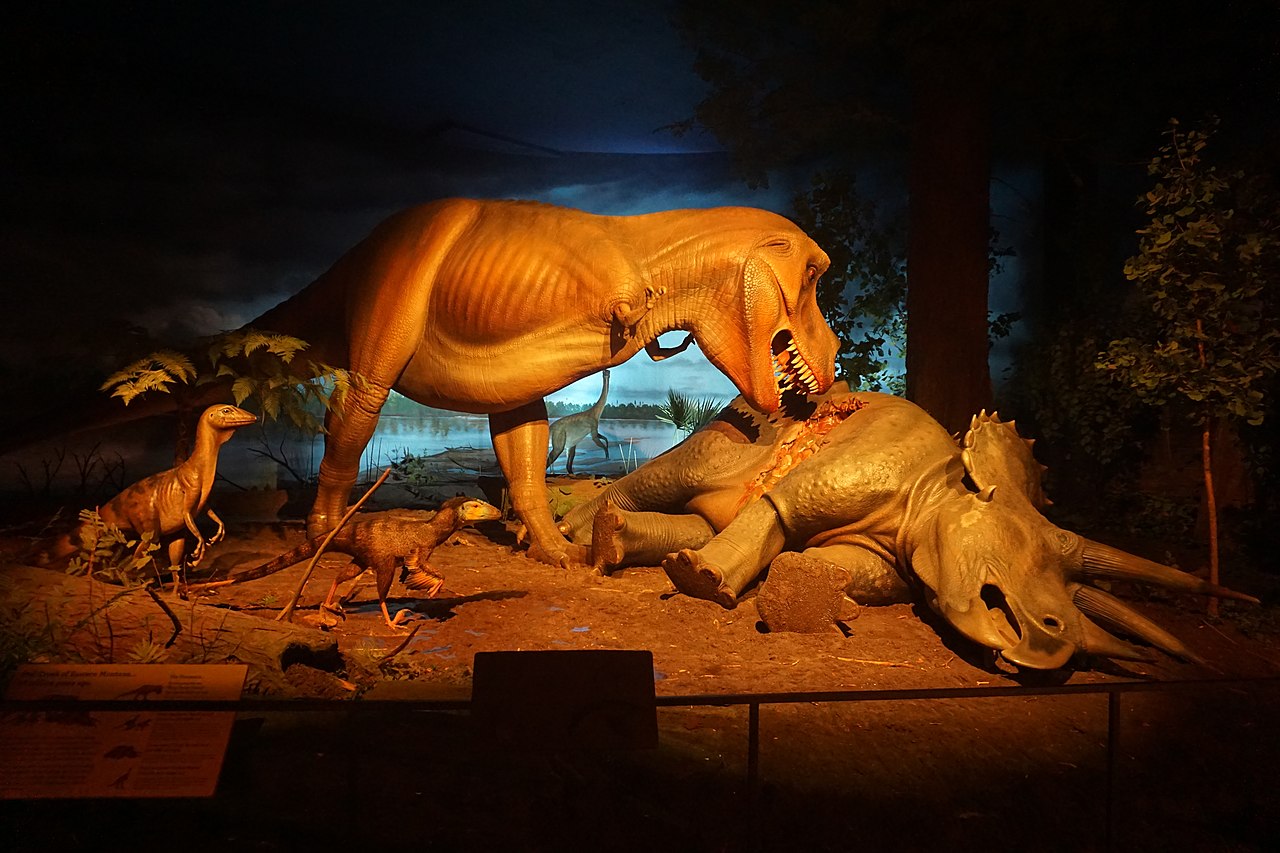
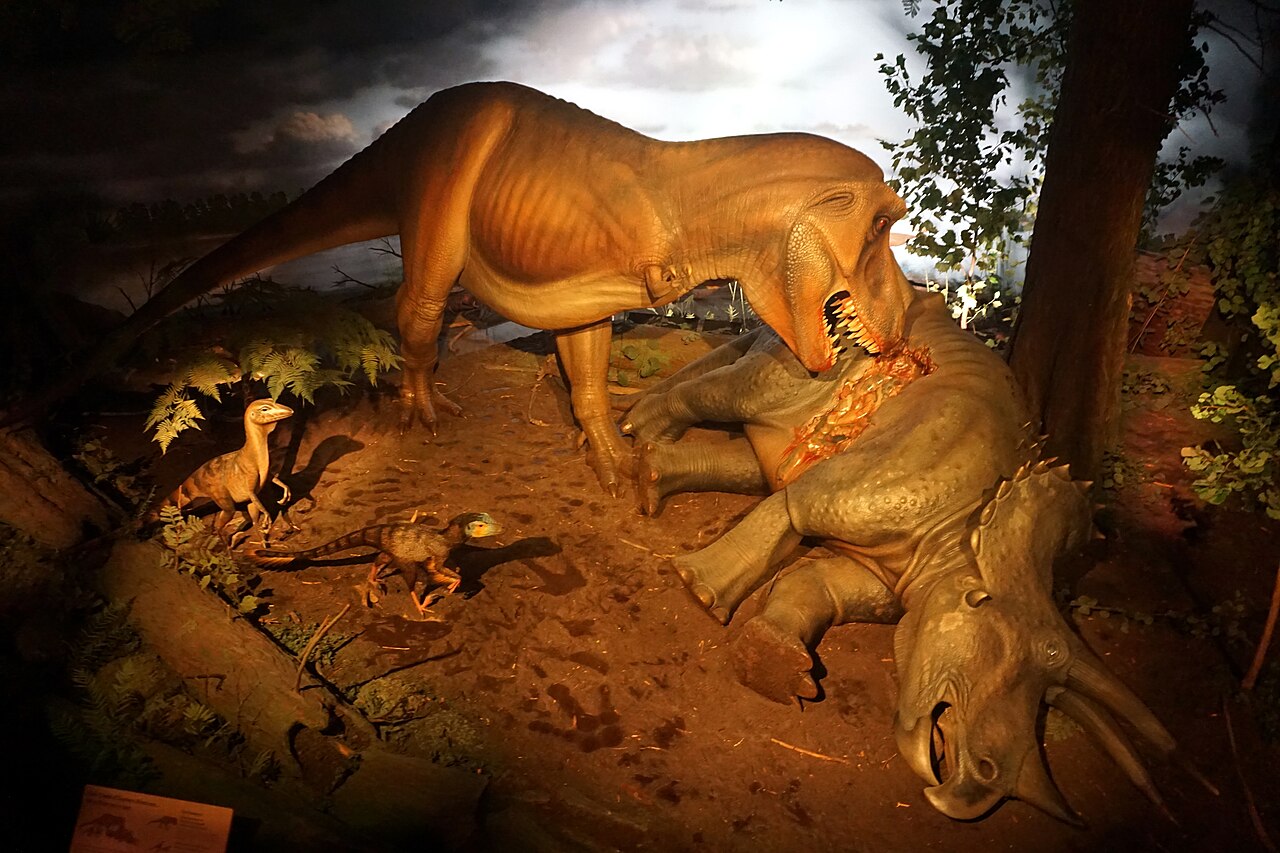
Tyrannosaurus is a genus of large theropod dinosaur, with the type species *Tyrannosaurus rex* (Latin for 'king') being one of the best-represented theropods known to science. This dinosaur lived throughout what is now western North America, on an island continent called Laramidia, and its fossils have been found in several geological formations dating to the late Maastrichtian age of the late Cretaceous period, roughly 69 to 66 million years ago. Some isolated specimens hint at an even earlier origin in the middle Campanian age. *Tyrannosaurus* was among the last non-avian dinosaurs to exist before the Cretaceous–Paleogene extinction event. As a bipedal carnivore, it possessed a massive skull balanced by a long, heavy tail. Its hind limbs were large and powerful, while its forelimbs were short but unusually strong for their size, ending in two clawed digits. The most complete specimen measures around 12.3 to 12.4 meters in length, though modern estimates suggest it could have exceeded 13 meters, with a hip height of 3.7 to 4 meters and a mass of 8.8 tonnes. It is among the largest known land predators, with the greatest estimated bite force of any terrestrial animal. By far the largest carnivore in its environment, *T. rex* was likely an apex predator, feeding on hadrosaurs, juvenile armored herbivores such as ceratopsians and ankylosaurs, and possibly sauropods. The long-standing debate over whether it was a pure scavenger or an active predator has largely been resolved; most paleontologists now accept it was both. The abundance of fossil material, including nearly complete skeletons and reported soft tissue and proteins, has enabled extensive research into its life history, biomechanics, and physiology. Its taxonomy remains controversial, with the Asian *Tarbosaurus bataar* considered very closely related, and several North American tyrannosaurids have been synonymized with *Tyrannosaurus*, while some specimens have been proposed as distinct species, such as *T. mcraeensis*. Since the early 20th century, *Tyrannosaurus* has been one of the best-known dinosaurs, a popular museum attraction, and a fixture in media such as *Jurassic Park*.
- Time period
- Late Cretaceous (69–66 million years ago)
- Location
- Western North America (Laramidia)
- Length
- Up to 13 m (43 ft)
- Mass
- Up to 8.8 t (9.7 short tons)
- Diet
- Carnivore (apex predator and scavenger)
- Notable specimens
- Sue (most complete, ~85%) and Stan
Lore & Background
Tyrannosaurus rex was a large, bipedal carnivore with a massive skull balanced by a long, heavy tail. Its forelimbs were short but unusually powerful for their size, ending in two clawed digits, while its hind limbs were large and strong. The most complete specimen measures about 12.3 to 12.4 meters in length, though modern estimates suggest it could have exceeded 13 meters, with a hip height of 3.7 to 4 meters and a mass of 8.8 tonnes. Its bite force is considered the largest among all terrestrial animals. It lived throughout what is now western North America, on the island continent of Laramidia, and had a much wider range than other tyrannosaurids. Fossils are found in geological formations dated to the late Maastrichtian age of the late Cretaceous, 69 to 66 million years ago, with isolated specimens possibly indicating an earlier origin in the middle Campanian. It was among the last non-avian dinosaurs before the Cretaceous–Paleogene extinction event. By far the largest carnivore in its environment, it was most likely an apex predator, preying upon hadrosaurs, juvenile armored herbivores like ceratopsians and ankylosaurs, and possibly sauropods. The long debate over whether it was a predator or scavenger has been resolved; most paleontologists now accept it was both. Some nearly complete skeletons have been found, and soft tissue and proteins have been reported in at least one specimen.
Reader's Guide
Tyrannosaurus rex lived during the late Maastrichtian age of the late Cretaceous period, between 69 and 66 million years ago, on the island continent of Laramidia in what is now western North America. It had a wider range than other tyrannosaurids, with fossils found in various geological formations. As a bipedal carnivore, it possessed a massive skull balanced by a long, heavy tail, and its hind limbs were large and powerful. The forelimbs, though short, were unusually strong for their size and ended in two clawed digits. Modern estimates suggest it could exceed 13 meters in length, stand 3.7 to 4 meters at the hip, and weigh up to 8.8 metric tons. Its bite force is the largest known among terrestrial animals. By far the biggest predator in its environment, it likely preyed on hadrosaurs, juvenile armored herbivores such as ceratopsians and ankylosaurs, and possibly sauropods. The long-standing debate over whether it was an apex predator or a pure scavenger has been resolved; most paleontologists now accept it was both a predator and a scavenger, with the scavenger-only hypothesis discredited. Some nearly complete skeletons have been found, and soft tissue and proteins have been reported in at least one specimen. This abundance of material has enabled extensive research into its life history, biomechanics, feeding habits, physiology, and potential speed, though many aspects remain debated. Its taxonomy is also contentious; the Asian Tarbosaurus bataar is very closely related and has sometimes been considered a species of Tyrannosaurus, while several North American tyrannosaurids have been synonymized with it. Some Tyrannosaurus specimens have been proposed as distinct species, such as T. mcraeensis, but their validity is disputed. Since the early 20th century, Tyrannosaurus has been one of the best-known dinosaurs, called the "ultimate dinosaur" by science writer Riley Black, and its fossils are popular museum attractions, with appearances in media like Jurassic Park.
Did You Know?
- The name Tyrannosaurus rex translates to 'tyrant lizard the king'.
- Sue, the most complete Tyrannosaurus skeleton, is about 85% complete.
- Tyrannosaurus lived on the island continent of Laramidia.
- The first partial skeleton of T. rex was found in 1900 in eastern Wyoming.
A Serendipitous Find on a Flat-Tire Day
In the summer of 1990, a team from the Black Hills Institute in Hill City was combing the Cheyenne River Indian Reservation in western South Dakota, near the town of Faith, for fossils. By late summer they had turned up Edmontosaurus remains and were packing up to head home. What saved the expedition from ending that day was a flat tire on their truck. On August 12, while the rest of the crew drove into town for repairs, collector Sue Hendrickson wandered along the base of an unexplored cliff. There she spotted small fragments of bone. Glancing upward, she noticed much larger bones jutting from the cliff face. She carried two tiny pieces back to camp and showed them to institute president Peter Larson, who recognized the distinctive contour and texture as belonging to a Tyrannosaurus rex. Further inspection of the cliff revealed numerous exposed bones and even articulated vertebrae. The crew scrambled to order extra plaster, and Hendrickson joined a small group to begin the painstaking excavation. The excitement was immediate: earlier T. rex finds typically lacked more than half their skeleton, yet this one clearly held far more.
An Unusually Complete Giant
Sue stands out among all known Tyrannosaurus rex specimens for the sheer volume of material preserved. By bulk, more than ninety percent of the skeleton was recovered; when measured by individual bone elements, the figure is approximately seventy-three percent. Of the roughly three hundred and sixty bones recognized in the species, around two hundred and fifty were pulled from the ground. The arrangement of the bones told a story of rapid burial: scientists believe the animal was quickly smothered by water and mud shortly after death, which kept scavengers from disarticulating the carcass. The same rushing water, however, jumbled the skeleton in its final moments, leaving the hip bones stacked above the skull and the leg bones tangled among the ribs. This degree of completeness was extraordinary for a T. rex, as most previously discovered specimens were missing well over half their bones. The combination of size, condition, and extent made Sue one of the most significant dinosaur fossils ever unearthed.
A Legal Battle and a Record-Breaking Auction
The moment the excavation wrapped up, a fight over ownership erupted. The Black Hills Institute had secured permission from landowner Maurice Williams and paid him five thousand dollars, but Williams later argued that sum covered only removal and cleaning, not a sale. As a member of the Sioux tribe, he maintained the bones belonged to the tribe, and the land was held in trust by the U.S. Department of the Interior. The skeleton sat in storage at the South Dakota School of Mines while penal and civil cases wound through the courts. After a lengthy civil proceeding, a judge ruled that Williams retained ownership. He then put the specimen up for auction through Sotheby's. Fearing it would vanish into a private vault, the Field Museum rallied donors—including the California State University system, Walt Disney Parks and Resorts, McDonald's, and Ronald McDonald House Charities—to bid.
Preparation Under Public Eyes
The real work of making the skeleton visible began in two newly built research laboratories, both funded by McDonald's. One lab was housed inside the Field Museum itself; the other opened at the Animal Kingdom in Disney World, Orlando. In each, teams of museum preparators set about the painstaking task of slowly and carefully removing every last grain of rock matrix from the bone surfaces. What made the process remarkable was its transparency: millions of visitors walked past glass windows to watch the preparators at work in both locations, and the museum also posted footage of the cleaning on its website. Before this public preparation, the bones had been carefully wrapped in burlap, coated in plaster, and shipped from the Black Hills Institute offices, where initial cleaning had already begun. The decision to prepare Sue in full view transformed what would have been a behind-the-scenes scientific procedure into a shared public spectacle, ensuring that the fossil's journey from raw block to mounted skeleton was witnessed by the very audience it was meant to inspire.
Common Misconceptions (Editorial)
Some people think that the name Tyrannosaurus rex simply means "tyrant lizard," but the correct translation is "tyrant lizard the king," since *rex* is Latin for "king." Another common misunderstanding is that the species was first recognized from the most complete specimen, Sue; in reality, the first partial skeleton was initially assigned to a different species before being identified as T. rex.
Why It Matters (Editorial)
Tyrannosaurus rex endures as a cultural icon because it represents one of the most powerful land predators ever to exist, embodying both scientific mystery and raw prehistoric terror. Its well-preserved fossils, like the famous Sue and the record-selling Stan, continue to fuel public fascination and important paleontological research into dinosaur growth, behavior, and extinction.
Gallery
Frequently Asked Questions
What is Tyrannosaurus rex?
T. rex is a massive meat-eating dinosaur in the theropod group whose name means 'tyrant lizard king.' It roamed western North America during the very end of the Cretaceous, roughly 69 to 66 million years ago, and is one of the most thoroughly documented large predators in the fossil record.
What ecological role did Tyrannosaurus rex fill?
As both a top-tier predator and an opportunistic scavenger, T. rex occupied the highest trophic level in Late Cretaceous ecosystems across the Laramidia landmass. Reaching nearly 9 tons and up to 43 feet in length, it had no contemporary rivals of comparable size.
How did Tyrannosaurus rex go extinct?
T. rex was among the last non-avian dinosaurs to perish in the Cretaceous–Paleogene mass extinction about 66 million years ago. As one of the final surviving tyrannosaurids, it left no direct descendants to carry on its lineage.
Why is Tyrannosaurus rex so important to science and culture?
Specimens like Sue (roughly 85 percent complete) and Stan give paleontologists an unusually detailed picture of its skeleton and physiology. That depth of evidence, combined with its sheer size, has cemented T. rex as the single most recognizable dinosaur in popular culture.
Where exactly did Tyrannosaurus rex live?
T. rex inhabited the island continent of Laramidia, which corresponds to much of present-day western North America during the late Maastrichtian stage. Its range stretched across a wide swath of that geographically isolated landmass.
More in Dinosaurs 1-22
Spotted an error? Know more?
This is a living reference — every entry is fact-audited, and reader corrections feed straight into our audit queue. Suggest an edit · See this site's audit record