Parasaurolophus
A large, crested hadrosaurid from the Late Cretaceous of North America and possibly Asia.

Gretaz · CC BY-SA 3.0
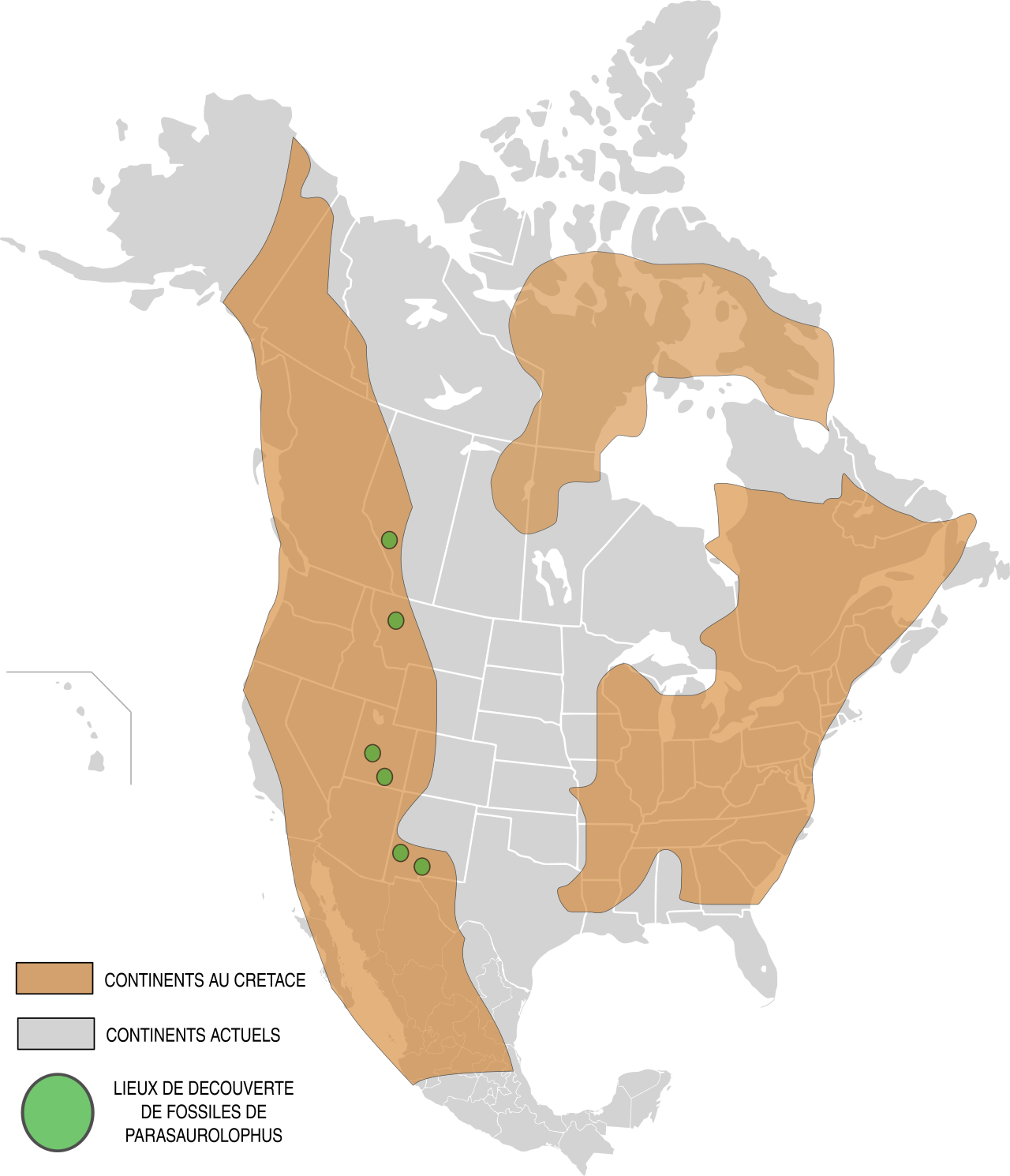
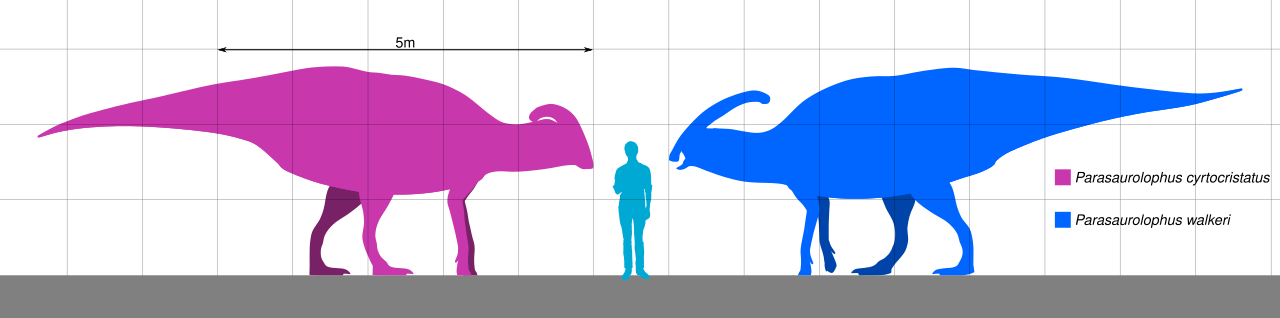
Parasaurolophus is a genus of hadrosaurid, or duck-billed, dinosaur that inhabited western North America and possibly Asia during the Late Cretaceous, roughly 76.5 to 73 million years ago. This large herbivore could exceed 9 meters in length and weigh over 5 metric tons, moving both on two legs and on all fours. The name, meaning "beside crested lizard," references the related dinosaur Saurolophus. Three species are widely accepted: the type species *P. walkeri*, *P. tubicen*, and the shorter-crested *P. cyrtocristatus*. A proposed fourth species, *P. jiayinensis*, is usually assigned to the separate genus *Charonosaurus*. Fossils have been found in Alberta, New Mexico, and Utah, with possible remains from Heilongjiang if *Charonosaurus* belongs to the same genus.
The genus was first described in 1922 by William Parks, based on a skull and partial skeleton (ROM 768) discovered in 1920 along the Red Deer River in Alberta, within what is now the Dinosaur Park Formation. Parks named the specimen *P. walkeri* in honor of Sir Byron Edmund Walker. *Parasaurolophus* remains are rare in Alberta, with only a few additional specimens possibly belonging to the genus. In 1931, Carl Wiman described a second species, *P. tubicen*, from a partial skull found in New Mexico's Kirtland Formation; its name means "trumpeter." A nearly complete *P. tubicen* skull was later found in New Mexico in 1995, and a 1999 monograph used CT scans to study its crest anatomy and possible functions. John Ostrom named *P. cyrtocristatus* in 1961 from a partial skull with a short, rounded crest, found in either the Fruitland or Kirtland Formation of New Mexico. Additional *P. cyrtocristatus* specimens have since been recovered from Utah's Kaiparowits Formation.
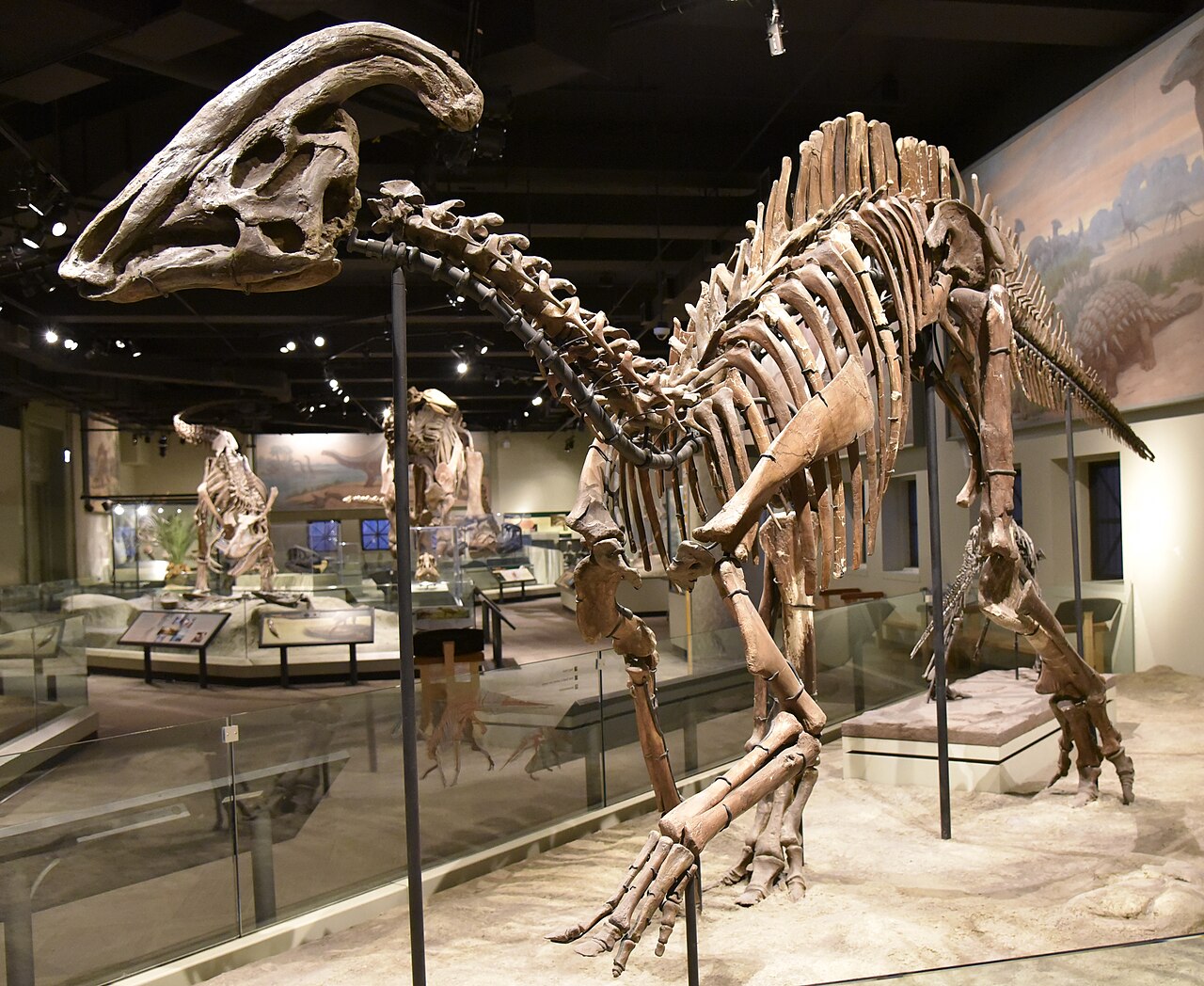
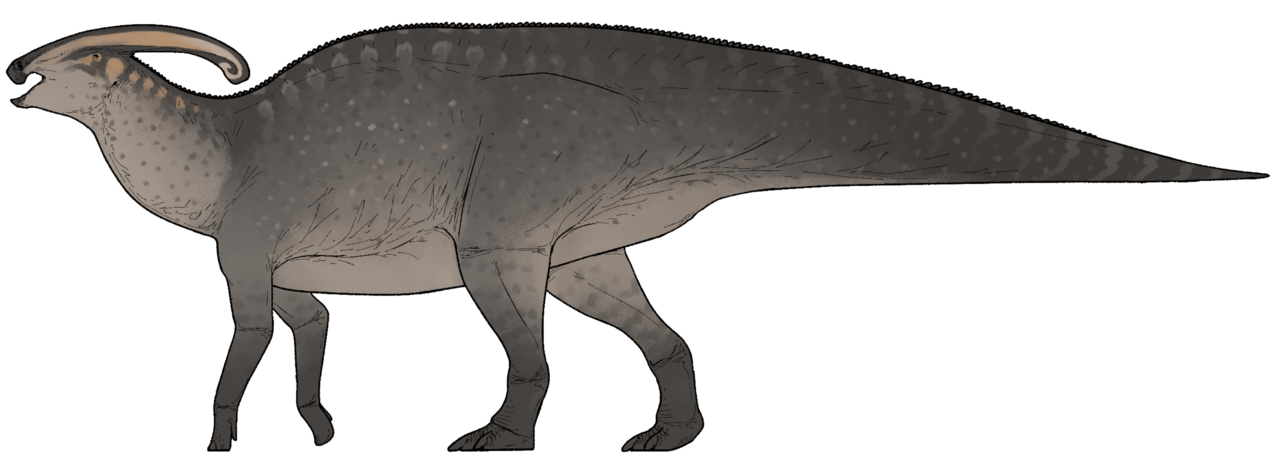
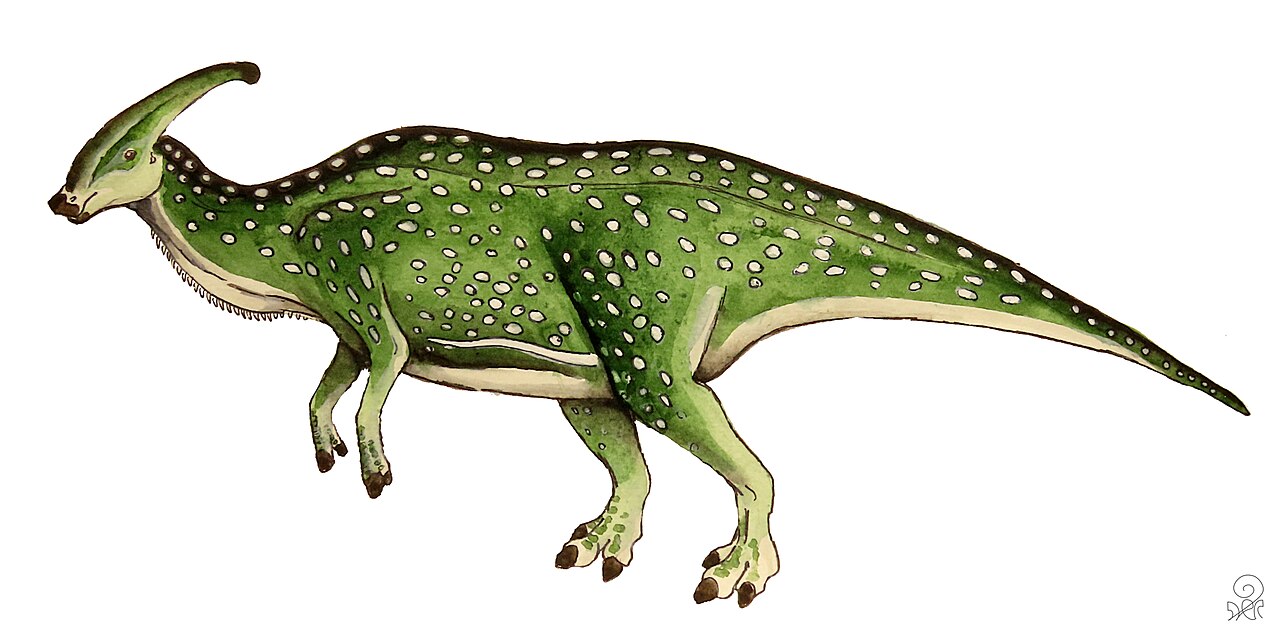
The most distinctive feature of *Parasaurolophus* is its large, hollow cranial crest, which forms a long, curved tube projecting backward from the skull. This crest likely served multiple purposes, including visual species and sex recognition, acoustic resonance for communication, and possibly thermoregulation. The crest's internal structure varies among species: *P. tubicen* has the most complex interior, while *P. walkeri* has a simpler one and a straighter crest. *P. cyrtocristatus* is the smallest species and possesses the most curved crest. The Chinese dinosaur *Charonosaurus*, possibly a close relative, had a similar skull and cr
- time_period
- Late Cretaceous, about 76.5–73 million years ago
- length
- over 9 metres (30 ft)
- weight
- over 5 metric tons (5.5 short tons)
- diet
- herbivore
- locomotion
- bipedal and quadrupedal
- known_for
- large hollow cranial crest used for communication and hearing
Quick Facts
- Taxon
- Parasaurolophus
- Type Species
- Parasaurolophus walkeri
- Type Species Authority
- Parks, 1922
- Subdivision
- P. tubicen / Wiman, 1931 · P. cyrtocristatus / Ostrom, 1961 · P. jiayinensis? / (Godefroit, Zan & Jin, 2000) Paul, 2010
Facts from the source article.
Lore & Background
Parasaurolophus is a hadrosaurid, part of a diverse family of large Late Cretaceous ornithopods that are known for their range of bizarre head adornments, which were likely used for communication and increased hearing. This genus is known for its large, elaborate cranial crest, which forms a long curved tube projecting upwards and back from the skull in its largest form. Charonosaurus from China, which may have been its closest relative, had a similar skull and a potentially similar crest. Visual recognition of both species and sex, acoustic resonance, and thermoregulation have been proposed as functional explanations for the crest. It is one of the rarer hadrosaurids, known from only a handful of good specimens.
Reader's Guide
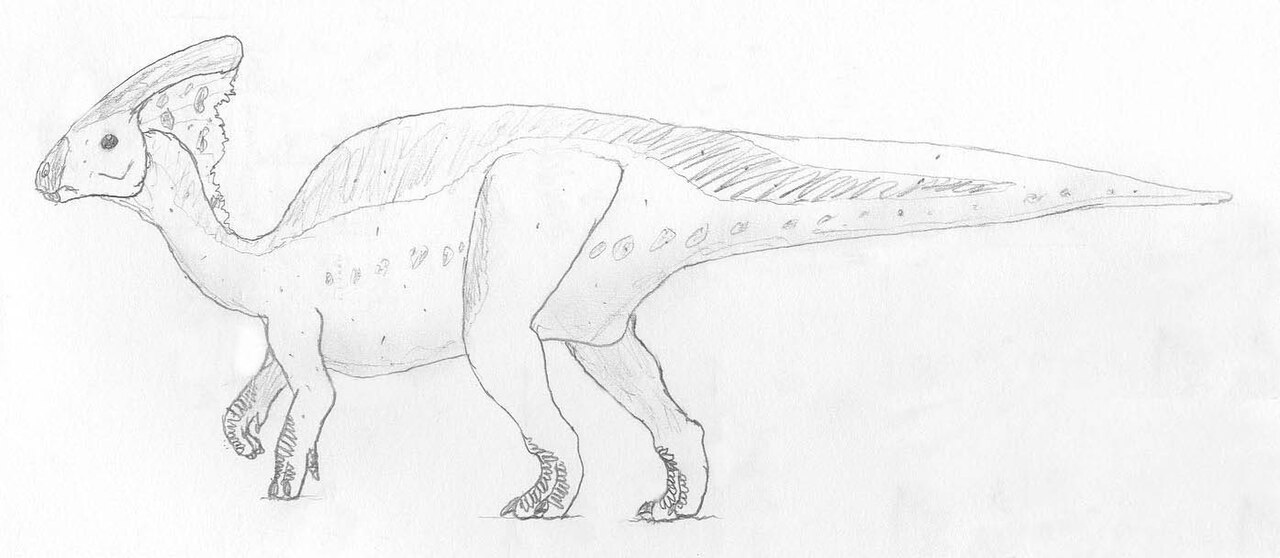
The most noticeable feature was the cranial crest that protruded from the rear of the head and was made up of the premaxilla and nasal bones. The crest was hollow, with distinct tubes leading from each nostril to the end of the crest before reversing direction and heading back down the crest and into the skull. The tubes were simplest in P. walkeri, and more complex in P. tubicen, where some tubes were blind and others met and separated. While P. walkeri and P. tubicen had long crests with slight curvature, P. cyrtocristatus had a short crest with a more circular profile. Like most dinosaurs, the skeleton of Parasaurolophus is incompletely known. The length of the type specimen of P. walkeri is estimated at 9.45 m, and allometry-based body mass estimates indicate that a 9 m long individual would have weighed more than 5 MT. Gregory S. Paul estimated that an average adult individual of the type species would measure 7.5 m long and weigh 2.6 MT. The skull of the P. walkeri type specimen is about 1.6 m long, including the crest. Its single known arm was relatively short for a hadrosaurid, with a short but wide shoulder blade. The thighbone measures 103 cm long in P. walkeri and is robust for its length when compared to other hadrosaurids. The upper arm and pelvic bones were also heavily built. Like other hadrosaurids, it was able to walk on either two legs or four. It probably preferred to forage for food on four legs, but ran on two. The neural spines of the vertebrae were tall, as was common in lambeosaurines. At their tallest over the hips, they increased the height of the back. Skin impressions are known for P. walkeri, showing uniform tubercle-like scales, but no larger structures.
Did You Know?
- The name Parasaurolophus means "beside crested lizard" in reference to Saurolophus.
- Three species are universally recognized: P. walkeri, P. tubicen, and P. cyrtocristatus.
- The crest was hollow, with distinct tubes leading from each nostril to the end of the crest and back into the skull.
- Parasaurolophus remains are rare, known from only a handful of good specimens.
From Sand Creek to the Museum
Two years later, William Parks formally described it and gave it the name Parasaurolophus walkeri, honoring Sir Byron Edmund Walker, who chaired the Board of Trustees of the Royal Ontario Museum. The genus name, drawn from Greek roots meaning "beside" or "near," "lizard," and "crest," was a nod to the closely related Saurolophus. The find came from the Dinosaur Park Formation, a Campanian-age rock unit of the Late Cretaceous. The genus's roster grew steadily. Sternberg pulled a partial skull from the Kirtland Formation in San Juan County, New Mexico. That specimen traveled to Uppsala, where Carl Wiman erected it as a second species, P. A decade later, John Ostrom named P. cyrtocristatus from another New Mexican find.
The Architecture of the Crest
Parasaurolophus belongs to the hadrosaurids, a sprawling family of Late Cretaceous ornithopods celebrated for their extraordinary head ornaments. Within that group, this genus stands out for a single, sweeping feature: a long, tubular crest that arcs upward and backward from the back of the skull. The internal architecture of that tube varies noticeably between species, with P. tubicen showing the most intricate internal structure and P. walkeri a comparatively simpler one. Scientists have long debated what the crest actually did. The leading hypotheses include acoustic resonance, suggesting the animal could produce or amplify low-frequency calls; visual signaling for species and sex recognition; and even thermoregulation. The hadrosaurid family as a whole is thought to have used its diverse cranial adornments for communication and enhanced hearing, and Parasaurolophus fits neatly into that pattern. A potentially close relative, Charonosaurus from China, possessed a similar skull shape and may have carried a comparable crest, hinting that this elaborate design was a shared trait across a wider clade. Despite decades of study, no single function has been confirmed as the sole purpose, and the crest likely served multiple roles simultaneously.
Three Species, One Debate
Three species are universally accepted within Parasaurolophus, each clearly distinct from the others. P. walkeri, the type species, is characterized by a straighter crest and a simpler internal crest structure. P. tubicen, the largest of the three, boasts a long, straight crest with the most complex interior of any known member; all its specimens come from the De-Na-Zin Member of the Kirtland Formation in New Mexico. P. Its specimens span the Fruitland and Kaiparowits Formations of New Mexico and Utah. A persistent question has surrounded cyrtocristatus: could it simply be a female of one of the other two species? Because it is smaller and its crest shape differs, some researchers have speculated it represents a sexually dimorphic form. Thomas Williamson noted that the type material measures roughly 72 percent the size of P. tubicen, close to the threshold at which other lambeosaurines begin showing definitive crest dimorphism. Yet other studies have pushed back, pointing to age differences and structural distinctions that support its status as a genuine, separate species.
A Rare Giant of the Western Cretaceous
Parasaurolophus was a massive herbivore that roamed western North America and possibly parts of Asia during the Late Cretaceous, roughly 76.5 to 73 million years ago. At full growth, an individual could exceed nine metres in length and tip the scales past five metric tons. Despite its bulk, it was not locked into a single gait; it could walk on all four legs or rise onto its hind limbs, giving it a versatile range of locomotion. Its geographic footprint stretched from Alberta through New Mexico and Utah, with a possible extension into Heilongjiang, China, if the genus Charonosaurus is ultimately folded into Parasaurolophus. Yet for an animal of such imposing size, the fossil record is surprisingly thin. It ranks among the rarer hadrosaurids, with only a handful of well-preserved specimens known. In Alberta, beyond the type material, just one other partial skull and three body fragments lacking skulls have been tentatively assigned to the genus. A brief mention of possible P. walkeri material in Montana's Hell Creek Formation appears in some faunal lists, but no subsequent work has followed up on that claim. This scarcity of remains makes every new find a significant addition to our understanding of the species.
Common Misconceptions (Editorial)
Some people think Parasaurolophus used its large crest as a weapon or for display only, but the facts show it was hollow, with distinct tubes from the nostrils to the end of the crest and back into the skull, indicating it was used for communication and hearing. Another common error is assuming all Parasaurolophus had the same long, curved crest, but the facts note that P. cyrtocristatus has a shorter, more curved crest and is the smallest species.
Why It Matters (Editorial)
Parasaurolophus endures in popular imagination because its elaborate, tube-like crest offers a vivid example of dinosaur diversity and the surprising ways evolution solved problems like communication and herd recognition. The ongoing debate over whether some fossils belong to Parasaurolophus or a separate genus, Charonosaurus, also highlights how paleontology constantly refines our understanding of ancient life through new evidence.
Gallery
Frequently Asked Questions
What is Parasaurolophus?
Parasaurolophus is a genus of duck-billed hadrosaurid dinosaur that lived in western North America during the Late Cretaceous, roughly 76.5 to 73 million years ago. It is instantly recognizable by the long, hollow, tube-shaped crest that curves upward and backward from the top of its skull.
What was Parasaurolophus's crest actually used for?
The large hollow crest is thought to have acted as a vocal-resonance chamber, letting the animal produce deep, low-frequency calls for communication. It also likely aided in hearing and may have served as a visual signal for species recognition or mate selection.
How big was Parasaurolophus?
Adults reached over nine metres (about 30 feet) in length and tipped the scales at more than five metric tons. They were capable of moving both bipedally and quadrupedally, giving them flexible locomotion across their habitat.
What did Parasaurolophus eat?
As a strict herbivore, Parasaurolophus fed on low-growing vegetation such as ferns, conifers, and early flowering plants. Its broad, duck-like beak was well suited for cropping and processing tough plant material.
More in Dinosaurs 1-22
Spotted an error? Know more?
This is a living reference — every entry is fact-audited, and reader corrections feed straight into our audit queue. Suggest an edit · See this site's audit record