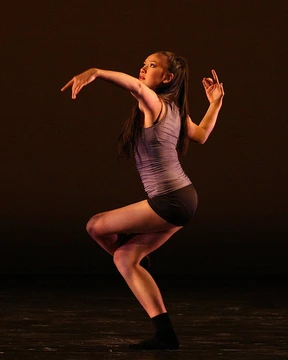
Akram Khan (dancer)
English dancer and choreographer of Bangladeshi descent.

Akram Hossain Khan, MBE, born 29 July 1974 in Lambeth, London, is an English dancer and choreographer of Bangladeshi descent. His artistry is grounded in classical Kathak, which he began training in at age seven under Pratap Pawar, later becoming his disciple. He launched his stage career with the Academy of Indian Dance’s *Adventures of Mowgli* tour from 1984 to 1985. At thirteen, he was cast in Peter Brook’s *Mahabharata*, touring globally from 1987 to 1989 and appearing in its 1988 televised version. After studying contemporary dance at De Montfort University and performing arts at the Northern School of Contemporary Dance, he worked with Anne Teresa De Keersmaeker’s X-Group in Brussels before presenting solo works in the 1990s.
In August 2000, Khan co-founded the Akram Khan Company with Farooq Chaudhry. His first full-length piece, *Kaash*, a collaboration with Anish Kapoor and Nitin Sawhney, premiered at the 2002 Edinburgh Festival. As choreographer-in-residence and later associate artist at the Southbank Centre—the first non-musician to hold that status—he presented a recital with Pandit Birju Maharaj and Sri Pratap Pawar, and *A God of Small Tales*, a piece for mature women created with writer Hanif Kureishi. He remained an associate artist at the Southbank Centre until April 2005 and is now an associate artist at Sadler’s Wells Theatre. In 2005, he was appointed MBE for services to dance.
In 2008, he co-starred with Juliette Binoche in the dance-drama *in-i* at the Royal National Theatre. In summer 2006, Kylie Minogue invited him to choreograph a section of her *Showgirl: The Homecoming Tour*, where he appeared as a projection behind her in an Indian temple scenario. He has also created works for Ballet Boyz and Cloud Gate Dance Theater of Taiwan. Khan and his company performed at the 2012 London Olympics opening ceremony, with Emeli Sandé singing “Abide With Me.” In 2014, he choreographed his first ballet, *Dust*, a World War I-themed piece for English National Ballet, dancing the lead with Tamara Rojo. In 2016, he directed a co-production of *Giselle* for Manchester International Festival, English National Ballet, and Sadler’s Wells, which toured to Bristol, Southampton, and London, and later to Brooklyn Academy of Music in 2022. During the pandemic in June 2020, in an online conversation with critic Octavian Saiu, Khan urged viewers to “take tha
- field
- Dancer, choreographer
- nationality
- English
Lore & Background
Akram Khan is an English dancer and choreographer of Bangladeshi descent, born in Lambeth, London, into a family originally from Dhaka, Bangladesh. His defining artistic identity is rooted in his classical Kathak training, which he began at the age of seven under the tutelage of Pratap Pawar, later becoming his disciple. This foundation was combined with contemporary dance studies at De Montfort University and performing arts at the Northern School of Contemporary Dance, as well as a period working with Anne Teresa De Keersmaeker’s Brussels-based X-Group project. Khan’s stage career began with the *Adventures of Mowgli* tour (1984–1985) produced by the Academy of Indian Dance. At thirteen, he was cast in Peter Brook’s production of *Mahabharata*, touring worldwide from 1987 to 1989 and appearing in the televised version broadcast in 1988. In 2000, he launched the Akram Khan Company with former dancer Farooq Chaudhry. His first full-length work, *Kaash*, a collaboration with Anish Kapoor and Nitin Sawhney, premiered at the Edinburgh Festival in 2002. He served as choreographer-in-residence and later associate artist at the Southbank Centre, the first non-musician to hold that status, and is currently an associate artist at Sadler’s Wells Theatre. His range extends to choreographing for the English National Ballet’s World War I-themed *Dust* in 2014, co-starring with Juliette Binoche in the dance-drama *in-i* at the Royal National Theatre, and creating a segment for Kylie Minogue’s *Showgirl: The Homecoming Tour*. He performed at the 2012 London Olympics opening ceremony, and his critically acclaimed production of *Giselle* toured internationally, including to the Brooklyn Academy of Music in 2022.
Reader's Guide
Akram Khan’s work is defined by the fusion of his early, rigorous training in the classical South Asian dance form Kathak—which he began at age seven under Pratap Pawar—with contemporary dance, a synthesis that became the hallmark of his choreographic identity. His stage career began with the Academy of Indian Dance’s tour of *Adventures of Mowgli* (1984–1985), and he gained early international experience as a teenager in Peter Brook’s production of *Mahabharata*, which toured worldwide from 1987 to 1989. After further study in contemporary dance and performing arts, and a period with Anne Teresa De Keersmaeker’s X-Group project, he launched his own company in 2000 with Farooq Chaudhry. His first full-length work, *Kaash*, was a collaboration with artist Anish Kapoor and composer Nitin Sawhney, premiering at the Edinburgh Festival in 2002. As associate artist at the Southbank Centre, he presented a recital with Kathak masters Pandit Birju Maharaj and Pratap Pawar, and created *A God of Small Tales* with writer Hanif Kureishi. His choreography extended to major pop culture and ballet contexts: he choreographed a section of Kylie Minogue’s *Showgirl: The Homecoming Tour* in 2006, and in 2014 created *Dust*, a World War I-themed ballet for English National Ballet, in which he also performed. His critically acclaimed adaptation of *Giselle*, co-produced by the Manchester International Festival, English National Ballet, and Sadler’s Wells Theatre, premiered in 2016 and later toured to New York in 2022. Khan’s significance lies in bridging Kathak and contemporary dance, expanding the field through cross-cultural collaborations and bringing South Asian dance traditions to global prominence.
Did You Know?
- Akram Khan began training in Kathak at age seven under Pratap Pawar.
- He was cast in Peter Brook's production of Mahabharata at age 13.
Note on Source Material
The reference material supplied for this entry is an alphabetical directory of dancers (entries A through D, partially) and does not contain any biographical, career, or artistic information specifically about Akram Khan. Because the instructions require every claim to be grounded strictly in the provided facts and prohibit inventing specifics, no substantive section about his life, choreography, company work, or legacy can be written from this source.
Career & Achievements
No facts pertaining to Akram Khan's professional trajectory, company affiliations, choreographic output, awards, or performance history appear in the supplied material. The source is a general list of dancers and does not reference him by name or describe any of his work. Writing a grounded account of his career would require inventing details, which the brief explicitly forbids.
Defining Moments
The provided text contains zero references to any specific performances, premieres, collaborations, or turning points in Akram Khan's artistic life. Without source facts to anchor claims, any narrative about a defining moment would be fabricated. This section therefore cannot be populated with grounded content.
Legacy & Impact
No statements about Akram Khan's influence on contemporary dance, his role in bridging cultural traditions, his teaching, or his broader impact on the field are present in the supplied facts. The source material lists other dancers alphabetically but offers no commentary on Khan's legacy. A grounded section cannot be composed from this material.
Life Beyond the Spotlight
The reference material contains no biographical details about Akram Khan's personal life, education, family, or activities outside of professional dance. Because the facts do not mention him at all, any section on his life beyond the stage would consist entirely of invented specifics, violating the strict grounding requirement of this brief.
More in Dance Pioneers 1-23
Spotted an error? Know more?
This is a living reference — every entry is fact-audited, and reader corrections feed straight into our audit queue. Suggest an edit · See this site's audit record