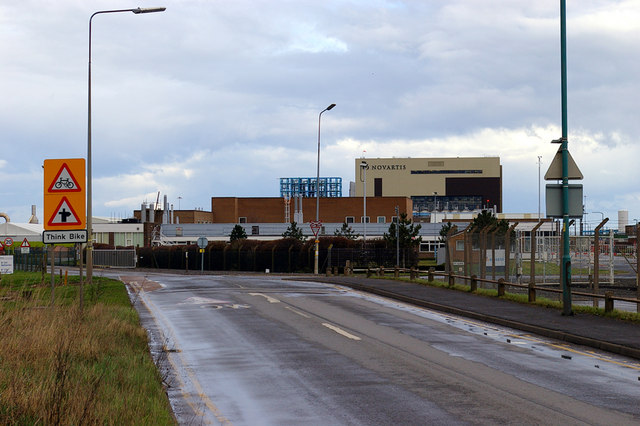
Novartis
Swiss pharmaceutical giant formed from Ciba-Geigy and Sandoz merger.

Anthony.Gonsalves · CC BY 3.0
Novartis AG is a Swiss pharmaceutical giant headquartered in Basel, Switzerland. It ranks among the world’s largest drug companies, placing eighth by revenue in 2024. Its portfolio includes medications such as clozapine (Clozaril), diclofenac (Voltaren, sold to GlaxoSmithKline in 2015), carbamazepine (Tegretol), valsartan (Diovan), imatinib mesylate (Gleevec/Glivec), cyclosporine (Neoral/Sandimmune), letrozole (Femara), methylphenidate (Ritalin, produced by Sandoz since 2023), terbinafine (Lamisil), and deferasirox (Exjade).
The company was created in 1996 through the merger of Ciba-Geigy and Sandoz, at the time the largest corporate merger in history. Both companies’ pharmaceutical and agrochemical divisions combined to form Novartis as a standalone entity. The name comes from the Latin *novae artes*, meaning “new skills.” Following the merger, other Ciba-Geigy and Sandoz businesses were sold or spun off—for instance, Ciba Specialty Chemicals became independent. The Sandoz brand vanished for three years but was revived in 2003 when Novartis consolidated its generic drug operations into a single subsidiary under that name. In 2000, Novartis spun off its agrochemical and genetically modified crops business into Syngenta, in partnership with AstraZeneca, which also divested its own agrochemical arm. The company then made a series of acquisitions to strengthen its core businesses.
Novartis holds full membership in the European Federation of Pharmaceutical Industries and Associations (EFPIA), the Biotechnology Innovation Organization (BIO), the International Federation of Pharmaceutical Manufacturers and Associations (IFPMA), and the Pharmaceutical Research and Manufacturers of America (PhRMA). Within Europe, it is the third most valuable pharmaceutical company, behind Novo Nordisk and Roche.
The merger that created Novartis took place in March 1996, with operations commencing on 20 December of that year. Ciba-Geigy itself had formed in 1970 from the merger of J. R. Geigy Ltd (founded in Basel in 1857) and CIBA (founded in Basel in 1859). CIBA’s origins trace to 1859, when Alexander Clavel began producing fuchsine in his silk-dyeing factory in Basel. In 1873, he sold the dye factory to Bindschedler and Busch, which became a joint-stock company in 1884 named “Gesellschaft für Chemische Industrie Basel”; the acronym CIBA was adopted as the company name in 1945. Geigy’s foundation was laid in 1857, when Johann Rudolf Geigy-Merian and Johann Muller-Pack bought a site in Basel for a dyewood mill and dye extraction plant. Two years later, they started making synthetic fuchsine. In 1901, they formed the public company Geigy, renamed J. R. Geigy Ltd in 1914. CIBA and Geigy merged in 1970 to become Ciba‑Geigy Ltd.
In the mid-1990s, state and federal health and environmental agencies found an elevated incidence of childhood cancers in Toms River, New Jersey, spanning 1970 to 1995. Multiple investigations pointed to contamination from the Toms River Chemical Plant (operated by Ciba-Geigy since 1952) and the Reich Farm/Union Carbide site. The area was designated a U.S. EPA Superfund site in 1983 after an underground plume of toxic chemicals was discovered. In 1984, a discharge pipe was shut down after a sinkhole at Bay Avenue and Vaughn Avenue revealed a leak. The plant ceased operations in 1996. A follow-up study covering 1996–2000 showed that while cancer cases were still above expected numbers, the rate had dropped significantly and the difference was no longer statistically significant compared to normal statewide rates. Since 1996, the Toms River water system has undergone the strictest testing in New Jersey and is considered safe to drink. Dan Fagin’s 2014 Pulitzer Prize-winning book *Toms River: A Story of Science and Salvation* examined the industrial pollution at the site in detail.
Sandoz, now the generic drugs division of Novartis, was originally a pharmaceutical company headquartered in Basel. Before the 1996 merger, Sandoz AG was known for developing drugs such as Sandimmune (for organ transplantation), Clozaril (antipsychotic), Mellaril and Serentil (for psychiatric disorders), and Cafergot and Torecan (for migraines). The company began as Chemiefirma Kern und Sandoz in 1886, founded by Alfred Kern and Edouard Sandoz. Their first dyes were alizarinblue and auramine. After Kern’s death in 1893, the partnership became the corporation Chemische Fabrik vormals Sandoz in 1895, which began producing the fever-reducing drug antipyrin that same year. In 1899, it started making the sugar substitute saccharin. Pharmaceutical research expanded in 1917 under Arthur Stoll, who founded Sandoz’s pharmaceutical department. In 1918, Stoll isolated ergotamine from ergot, a substance later used to treat migraines and headaches, introduced as Gynergen in 1921. Between the World Wars, Gynergen (1921) and Calcium-Sandoz (1929) reached the market. Sandoz also produced chemicals for textiles, paper, and leather starting in 1929, and began agricultural chemical production in 1939.
- field
- Pharmaceuticals
- nationality
- Swiss
- known_for
- Manufacturing drugs such as Gleevec, Diovan, Ritalin; merger of Ciba-Geigy and Sandoz
- headquarters
- Basel, Switzerland
- revenue_rank_2024
- 8th largest pharmaceutical company by revenue
Lore & Background
The merger was considered the largest corporate merger in history at that time. The name Novartis was based on the Latin terms novae artes (new skills). After the merger, other Ciba-Geigy and Sandoz businesses were sold or spun off, such as Ciba Specialty Chemicals. The Sandoz brand disappeared for three years but was revived in 2003 when Novartis consolidated its generic drugs businesses into a single subsidiary named Sandoz. In the mid-1990s, state and federal agencies identified an increased incidence of childhood cancers in Toms River, New Jersey, linked to contamination from the Toms River Chemical Plant operated by Ciba-Geigy.
Reader's Guide
Novartis represents a significant consolidation in the pharmaceutical industry, merging two major Swiss chemical and drug companies into a global powerhouse. The company's product portfolio includes blockbuster drugs like Gleevec for cancer and Diovan for hypertension, as well as widely used generics through its Sandoz subsidiary. Novartis has also been involved in controversies, notably the Toms River cancer cluster linked to a former Ciba-Geigy plant, which became the subject of a Pulitzer Prize-winning book. Novartis remains a full member of major pharmaceutical industry associations and is the third most valuable pharmaceutical company in Europe.
Did You Know?
- The name Novartis is based on the Latin terms novae artes, meaning 'new skills'.
A Swiss Merger That Redefined Big Pharma
Novartis was born in March 1996 when two Swiss pharmaceutical giants, Ciba-Geigy and Sandoz Laboratories, combined their pharmaceutical and agrochemical operations into a single independent entity. At the time of the deal, the union was widely regarded as the largest corporate merger in history. The new company drew its name from the Latin phrase novae artes, meaning new skills, a nod to the creative fusion of two legacy firms. Ciba-Geigy itself was the product of a 1970 merger between CIBA, which traced its roots to Alexander Clavel's 1859 silk-dyeing factory in Basel, and J. R. Geigy, founded in 1857 by Johann Rudolf Geigy-Merian and Johann Muller-Pack. Sandoz, meanwhile, had been established in 1886 by Alfred Kern and Edouard Sandoz, initially producing dyes before pivoting toward pharmaceuticals under Arthur Stoll in 1917. The combined entity began full operations on 20 December 1996, and by 2024 it had grown into the eighth-largest pharmaceutical company globally by revenue.
A Portfolio Spanning Oncology, Psychiatry, and Beyond
Novartis's commercial portfolio reflects the breadth of its two predecessor companies. Among its most recognizable products are imatinib mesylate, marketed as Gleevec or Glivec, a landmark targeted therapy for certain cancers; clozapine, sold as Clozaril, an antipsychotic originally developed by Sandoz; and cyclosporine, known as Neoral or Sandimmune, a cornerstone of organ-transplant medicine. The company also produces valsartan (Diovan) for hypertension, carbamazepine (Tegretol) for epilepsy, letrozole (Femara) for breast cancer, methylphenidate (Ritalin) for ADHD, terbinafine (Lamisil) for fungal infections, and deferasirox (Exjade) for iron overload. In 2015, Novartis sold its diclofenac franchise, Voltaren, to GlaxoSmithKline, and methylphenidate production shifted to Sandoz in 2023. The Sandoz brand, which had vanished for three years after the merger, was revived in 2003 when Novartis consolidated all of its generic-drug operations under that name, creating a dedicated subsidiary for lower-cost medicines.
Carving Out a Focused Pharma Giant
In the years following the 1996 merger, Novartis undertook a series of divestitures and spin-offs to sharpen its identity as a pure-play pharmaceutical company. The most consequential move came in 2000, when the company's agrochemical and genetically modified crops division was spun out as Syngenta, a joint venture with AstraZeneca, which simultaneously divested its own agrochemical business. Ciba Specialty Chemicals was similarly separated as an independent entity. These restructurings stripped away non-core operations and allowed Novartis to concentrate capital and management attention on drug discovery and commercialization. The company also pursued a string of acquisitions designed to reinforce its core therapeutic areas. By the 2020s, Novartis had cemented its position as the third most valuable pharmaceutical company in Europe, trailing only Novo Nordisk and Roche. It maintains full membership in major industry bodies including EFPIA, BIO, IFPMA, and PhRMA, underscoring its role as a central player in global pharmaceutical policy and research.
The Toms River Shadow
Novartis's corporate history carries a significant environmental controversy rooted in its predecessor Ciba-Geigy. Between 1970 and 1995, state and federal health and environmental agencies documented a troubling rise in childhood cancers in Toms River, New Jersey. Multiple investigations pointed to contamination emanating from the Toms River Chemical Plant, which Ciba-Geigy had operated since 1952, as well as from the nearby Reich Farm and Union Carbide site. The area was designated a U.S. EPA Superfund site in 1983 after an underground plume of toxic chemicals was discovered, and a leaking discharge pipe was shut down the following year after a sinkhole exposed the problem. The plant ceased operations in 1996. A subsequent 1996-to-2000 study found that while cancer cases remained above expectations, rates had dropped sharply and the difference was no longer statistically significant relative to statewide norms. The Toms River water system now undergoes the most rigorous testing in New Jersey. Dan Fagin's 2014 Pulitzer Prize-winning book, Toms River: A Story of Science and Salvation, brought national attention to the decades-long industrial pollution saga.
Gallery


Frequently Asked Questions
What is Novartis?
Novartis is a Swiss multinational pharmaceutical corporation headquartered in Basel. It operates as one of the world's biggest drug manufacturers, producing medicines across a wide range of therapeutic areas.
What are Novartis's most famous drugs?
Fans and patients most often associate the brand with Gleevec (imatinib mesylate) for chronic myeloid leukemia, Diovan (valsartan) for hypertension, and Ritalin (methylphenidate) for ADHD. The portfolio also includes cyclosporine, clozapine, and deferasirox among many others.
Where is Novartis based?
Its corporate headquarters sits in Basel, Switzerland, which has long served as a hub for the country's chemical and pharmaceutical industry.
More in Corporations 1-22
Spotted an error? Know more?
This is a living reference — every entry is fact-audited, and reader corrections feed straight into our audit queue. Suggest an edit · See this site's audit record