
Microsoft
American multinational technology company dominating PC software and cloud computing.

3aFW · CC0
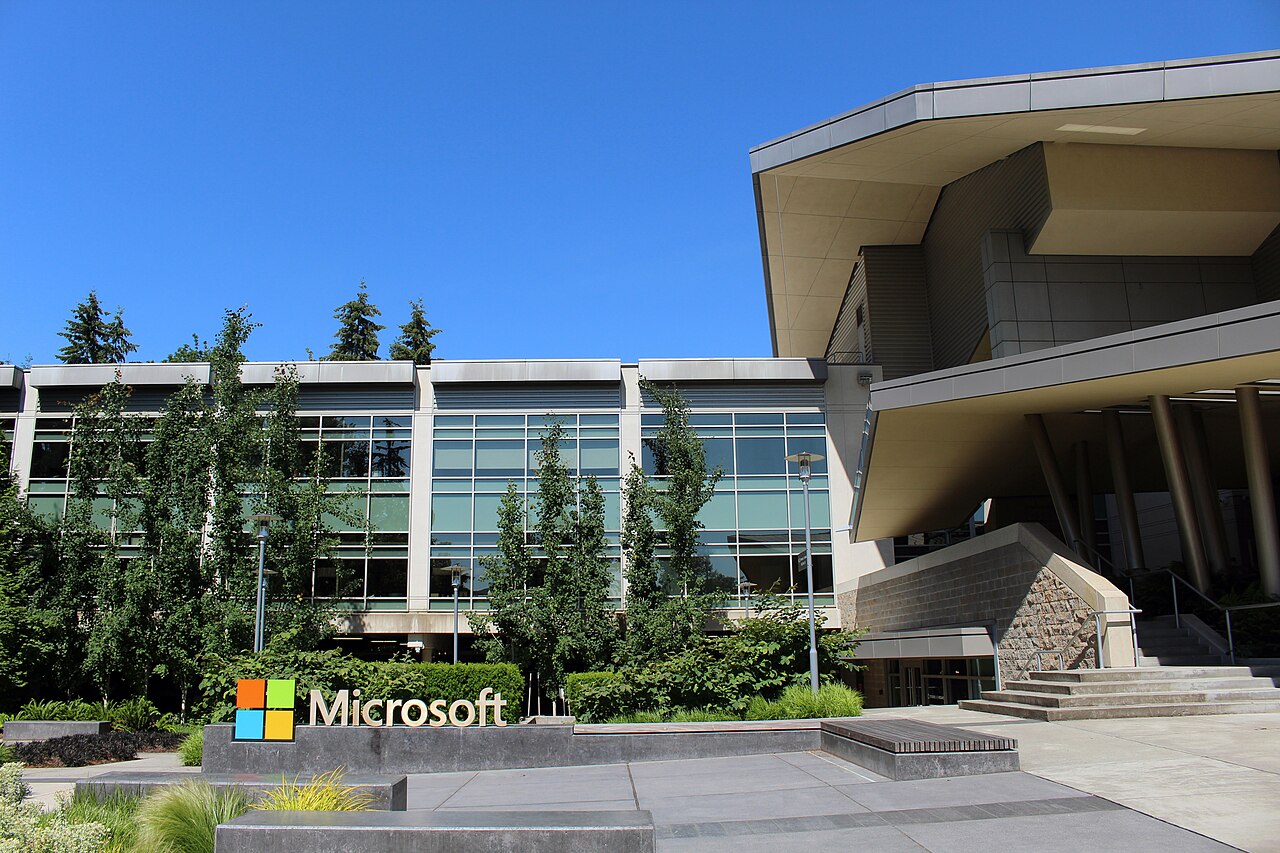
Microsoft, an American multinational tech firm based in Redmond, Washington, helped drive the personal computer revolution with its Windows software. Since then, it has branched into cloud computing, artificial intelligence, online services, video games, and other fields. As a Big Tech company, it leads the software industry in revenue, ranks among the world's most valuable publicly traded firms, and holds one of the strongest brand valuations globally.
The company was launched in 1975 by Bill Gates and Paul Allen, initially selling BASIC interpreters for the Altair 8800. It gained dominance in PC operating systems with MS-DOS in the mid-1980s, followed by Windows. Its 1986 IPO and rising stock price created three billionaires and roughly 12,000 millionaires among its staff. From the 1990s onward, Microsoft diversified. Steve Ballmer took over as CEO in 2000, overseeing the acquisition of Skype Technologies in 2011, the launch of its first in-house PC line, the Surface, in 2012, and the creation of Microsoft Mobile via Nokia. Satya Nadella became CEO in 2014, shifting focus to cloud computing and buying LinkedIn in 2016. Under him, the company expanded its Xbox gaming business, forming the Microsoft Gaming division in 2022 and acquiring Activision Blizzard in 2023.
Since the 1990s, Microsoft has dominated the IBM PC–compatible operating system and office software markets. Its most famous products include the Windows operating system family and the Microsoft Office and Microsoft 365 productivity suites—featuring Word, Excel, and PowerPoint. Its main hardware offerings are the Surface line of PCs and Xbox game consoles, along with the Xbox network. Online services include Bing search, the MSN portal, Outlook.com (Hotmail) email, and the Microsoft Store. For enterprise and development, it provides the Azure cloud platform, SQL Server database, and Visual Studio.
In April 2019, Microsoft became the third U.S. publicly traded company to exceed a $1 trillion valuation. It has faced criticism for monopolistic practices, and its software has been faulted for usability, stability, and security issues. The company has also drawn criticism for providing services to Israel during the Gaza war.
**History**
**1972–1985: Founding**
Childhood friends Bill Gates and Paul Allen aimed to build a business around computer programming. In 1972, they founded Traf-O-Data, which sold a basic computer for tracking traffic data. The January 1975 issue of *Popular Electronics* featured the Altair 8800 microcomputer, prompting Allen to suggest they could write a BASIC interpreter for it. Gates called MITS, claiming a working interpreter, and MITS requested a demo. Allen built a simulator for the Altair while Gates wrote the interpreter; it worked perfectly during their March 1975 demonstration in Albuquerque, New Mexico. MITS agreed to distribute it as Altair BASIC. Gates and Allen founded Microsoft on April 4, 1975, with Gates as CEO; Allen coined the name "Micro-Soft," short for microcomputer software. In August 1977, they partnered with ASCII Magazine in Japan, establishing their first international office, ASCII Microsoft. The company moved its headquarters to Bellevue, Washington, in January 1979.
Microsoft entered the operating system business in 1980 with its own Unix variant, Xenix, licensed from AT&T the year before. But MS-DOS cemented its dominance. In November 1980, IBM contracted Microsoft to provide a version of CP/M for the IBM Personal Computer. Microsoft bought a CP/M clone called 86-DOS from Seattle Computer Products, branding it MS-DOS (IBM rebranded it as IBM PC DOS). After the IBM PC launched in August 1981, Microsoft kept ownership of MS-DOS. IBM copyrighted the PC BIOS, forcing other companies to reverse-engineer it for compatible hardware, but no such restriction applied to the OS. Microsoft expanded into new markets with the Microsoft Mouse in 1983 and a publishing division, Microsoft Press. Paul Allen resigned in 1983 after being diagnosed with Hodgkin's lymphoma.
**1985–1994: Windows and Office**
Microsoft released Windows 1.0 on November 20, 1985, as a graphical extension for MS-DOS, despite having begun jointly developing OS/2 with IBM that August. The company moved its headquarters from Bellevue to Redmond, Washington, on February 26, 1986, and went public on the NASDAQ on March 13. The IPO's stock surge created an estimated four billionaires and 12,000 millionaires among employees. Microsoft shipped its version of OS/2 to OEMs on April 2, 1987. In 1990, the Federal Trade Commission investigated Microsoft for possible collusion with IBM, beginning over a decade of legal battles with the government. Meanwhile, Microsoft worked on Windows NT, heavily based on its copy of the OS/2 code; it shipped on July 21, 1993, featuring a new modular kernel and the 32-bit Win32 API.
- founders
- Bill Gates and Paul Allen
- headquarters
- Redmond, Washington, United States
- field
- Technology
- nationality
- American
- known_for
- Windows operating system, Microsoft Office, Azure cloud computing, Xbox video game consoles
Lore & Background
Since the 1990s, Microsoft has steadily moved beyond its core software roots. Under CEO Steve Ballmer, who took over from Bill Gates in 2000, the company executed its largest acquisition at the time by purchasing Skype Technologies in 2011. Ballmer also pushed into hardware, launching the first in-house Surface line of personal computers in 2012 and forming Microsoft Mobile through a deal with Nokia. When Satya Nadella became CEO in 2014, the strategic focus shifted heavily toward cloud computing. He oversaw the acquisition of LinkedIn in 2016 and greatly expanded the video gaming business, which already included the Xbox brand. In 2022, Microsoft formally established the Microsoft Gaming division, and the following year it acquired Activision Blizzard. The company’s defining products remain the Windows operating system and the Microsoft Office suite (now part of Microsoft 365), which includes Word, Excel, and PowerPoint. Its flagship hardware includes the Surface computers and Xbox consoles, supported by the Xbox network. Online services comprise the Bing search engine, the MSN portal, Outlook.com email, and the Microsoft Store. For enterprise and development, Microsoft offers the Azure cloud platform, SQL Server database software, and Visual Studio. In April 2019, Microsoft became the third publicly traded U.S. company to exceed a $1 trillion valuation. The company has faced persistent criticism for monopolistic practices, as well as for issues with software usability, security, and robustness. It has also been criticized for providing services to Israel during the Gaza war.
Reader's Guide
Microsoft's significance lies in its central role in the personal computer revolution, first through MS-DOS and then Windows, which became the dominant operating system for IBM PC–compatible computers. Its Office suite similarly dominated productivity software. The company's expansion into cloud computing under Satya Nadella, particularly with Azure, and its video gaming business through Xbox and the acquisition of Activision Blizzard, have kept it a major force in technology. Microsoft has been criticized for monopolistic practices, and its software received criticism for problems with ease of use, robustness, and security. It has also been criticized for its role in providing services to Israel during the Gaza war. Despite controversies, Microsoft became the third publicly traded U.S. company to be valued at over $1 trillion in April 2019, reflecting its enduring market influence.
Did You Know?
- Microsoft was originally named 'Micro-Soft', short for micro-computer software, suggested by Paul Allen.
- Microsoft became the third publicly traded U.S. company to be valued at over $1 trillion in April 2019.
- The company acquired Activision Blizzard in 2023 under CEO Satya Nadella.
From Altair to Empire – The Founding Years
Bill Gates and Paul Allen, childhood friends who had already founded Traf-O-Data in 1972 to track automobile traffic, spotted an opportunity when the January 1975 issue of Popular Electronics featured the Altair 8800 microcomputer. Allen proposed they write a BASIC interpreter for the device. Gates phoned MITS and asserted a working interpreter already existed, buying the pair precious time. Allen built a simulator while Gates developed the actual interpreter, and the duo demonstrated it flawlessly in Albuquerque in March 1975. MITS agreed to distribute it under the name Altair BASIC. On April 4, 1975, Gates and Allen formally established Microsoft, with Allen suggesting the name as a contraction of micro-computer software. Gates assumed the CEO role. By August 1977, the company had signed an agreement with ASCII Magazine in Japan, opening its first international office. The headquarters relocated to Bellevue, Washington, in early 1979, positioning the young firm for its next transformative leap into operating systems.
The Windows Revolution and Office Dominance
Microsoft's foray into operating systems began in 1980 with Xenix, a Unix variant licensed from AT&T, but the November 1980 IBM contract truly reshaped the company's destiny. Microsoft acquired 86-DOS from Seattle Computer Products, rebranded it as MS-DOS, and retained ownership even after the IBM PC launched in August 1981. Because IBM copyrighted its BIOS but not the operating system, rival manufacturers could build compatible machines running MS-DOS, locking in Microsoft's market position. Windows 1.0 arrived on November 20, 1985, as a graphical layer atop MS-DOS, even though the company had begun co-developing OS/2 with IBM that same August. The 1986 NASDAQ IPO created an estimated four billionaires and 12,000 millionaires among employees. Windows NT shipped in July 1993 with a 32-bit Win32 API, and the OS/2 partnership with IBM fell apart. Microsoft Office, introduced in 1990 with Word and Excel bundled together, alongside Windows 3.0's refined interface, established the productivity-suite dominance that endures to this day.
Leadership Shifts and Strategic Reinvigoration
The company's trajectory has been profoundly shaped by its chief executives. Bill Gates steered Microsoft through its PC-dominance era before stepping aside, and Steve Ballmer took the CEO seat in 2000. Ballmer's tenure featured the 2011 acquisition of Skype Technologies, then the largest corporate purchase in Microsoft's history, alongside a hardware push that produced the Surface PC line in 2012 and the Microsoft Mobile division built around Nokia. In 2014, Satya Nadella assumed the CEO role and redirected the company toward cloud computing, acquiring LinkedIn in 2016. Under Nadella's direction, the gaming business expanded to bolster the Xbox brand, culminating in the formal establishment of the Microsoft Gaming division in 2022 and the landmark acquisition of Activision Blizzard in 2023. These successive leadership transitions illustrate how Microsoft has repeatedly reinvented its core strategy, evolving from a software-centric identity into a diversified enterprise spanning cloud infrastructure, gaming, social networking, and consumer hardware.
Market Power, Enterprise Reach, and Controversies
Microsoft's commercial footprint is immense. In April 2019, it became the third publicly traded U.S. company to surpass a one-trillion-dollar valuation. Its software portfolio—Windows, Microsoft Office, and Microsoft 365—has dominated the PC operating system and office productivity markets since the 1990s. In enterprise and development, the company delivers the Azure cloud platform, SQL Server database software, and Visual Studio. Consumer-facing services include Bing search, the MSN portal, Outlook.com email, and the Microsoft Store, while hardware spans the Surface PC lineup and Xbox consoles with their associated network. Yet this dominance has drawn sustained scrutiny. The company has faced criticism for monopolistic practices, and its software has been faulted for shortcomings in usability, robustness, and security. More recently, Microsoft has drawn criticism for its role in providing services to Israel during the Gaza war, adding a geopolitical dimension to an already complex public reputation.
Gallery



Frequently Asked Questions
What is Microsoft's role in the tech world?
The company essentially shaped the modern personal-computer era with its Windows operating system and the Office productivity suite. Today it also leads in cloud infrastructure through Azure, artificial intelligence, and the Xbox gaming ecosystem.
How does Microsoft's story end?
There is no ending yet—Microsoft remains an ongoing, dominant force in Big Tech. Its narrative keeps evolving as it pushes deeper into AI, cloud services, and new hardware ventures.
Why is Microsoft important to the canon?
As the largest software company by revenue and one of the most valuable brands worldwide, it is a cornerstone of the corporate landscape. Few entities have reshaped how billions of people work, play, and communicate the way Microsoft has.
What is Microsoft most known for?
Fans and analysts most commonly point to the Windows OS, the Office suite, Azure cloud computing, and the Xbox console line as its signature achievements. These four pillars define its identity across computing, business, and entertainment.
More in Corporations 1-22
Spotted an error? Know more?
This is a living reference — every entry is fact-audited, and reader corrections feed straight into our audit queue. Suggest an edit · See this site's audit record