Bearing (mechanical)
Machine element that reduces friction and constrains motion.
Last updated

Nadinviki · CC BY-SA 4.0
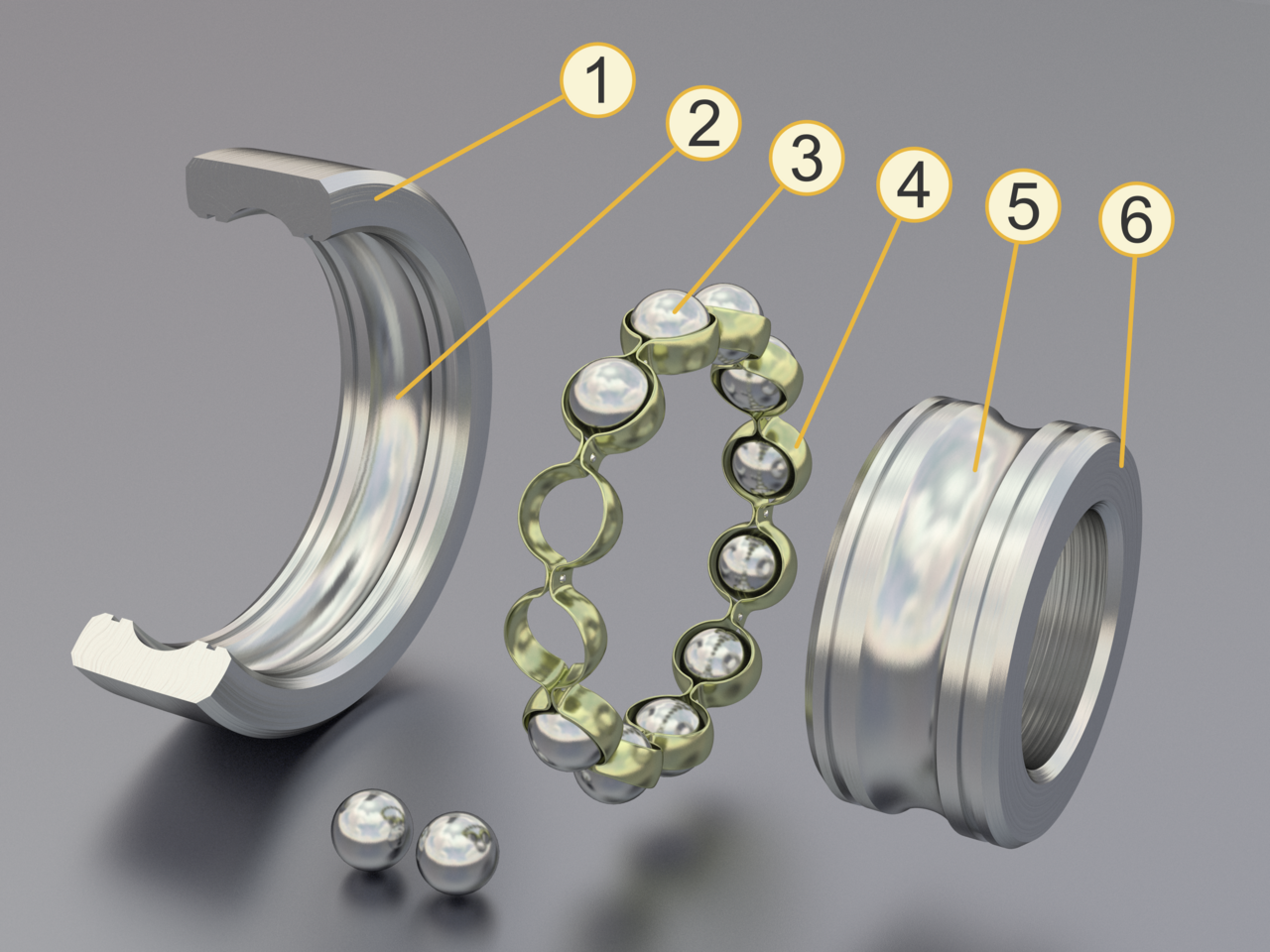
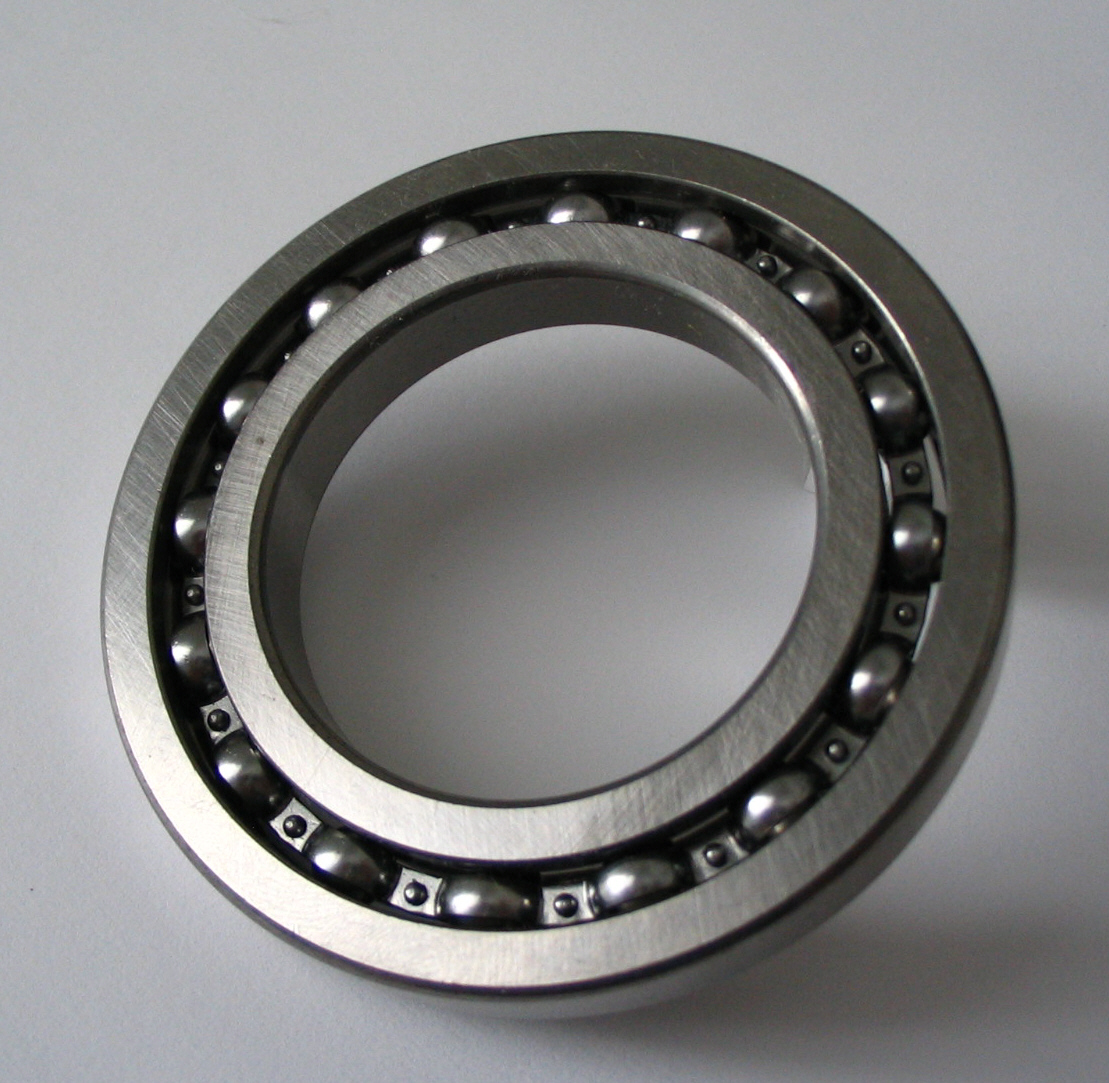
A bearing is a machine element that supports and guides moving parts while reducing friction.[1] Bearings can be divided into two main families: plain bearings, where motion occurs by sliding, and rolling-element bearings, where balls or rollers reduce friction by rolling between races.[1] Mechanical bearings come in at least six widely recognized varieties, each functioning through a distinct operational mechanism.[2]
Quick Facts
- Field
- Mechanical engineering
- Common types
- Plain bearing
- ball bearing
- roller bearing
- tapered roller bearing
- wire race bearing
- vee groove bearing
Facts from the source article.
Key facts and history
It is sometimes assumed that the invention of the rolling bearing, in the form of wooden rollers supporting an object being moved, predates the invention of a wheel rotating on a plain bearing.[3] Wheeled vehicles using plain bearings emerged between about 5000 BC and 3000 BC.[4] The wrecks were dated to 40 BC.[5] The first patent for a radial-style ball bearing was awarded to Jules Suriray, a Parisian bicycle mechanic, on 3 August 1869.[6]
No physical evidence from archaeological digs confirms the hypothesized progression from rollers to wheeled bearings.[3] A wooden ball bearing that once supported a rotating table was recovered from the Roman Nemi ships, which were found in Lake Nemi, Italy.[5] Around the year 1500, Leonardo da Vinci included sketches of ball bearings within his helicopter design.[7] In 1794, Philip Vaughan, a Welsh inventor and ironmaster from Carmarthen, received the first patent for ball bearings.[8]
What the research sources say
The source "Bearings in mechanical Sibo" states that the word "bearing" comes from Old English beran ("to carry" or "support"), with the mechanical sense first recorded around 1791.[1] The same source notes that around 1500, Leonardo da Vinci sketched mechanisms that appear to include ball bearings, although these remained theoretical and were never built.[1] According to "Bearings in mechanical Sibo", in 1794 Philip Vaughan patented a design with balls running in a grooved axle.[1] The source "Bearings in mechanical Sibo" reports that in 1869 Jules Suriray patented the first radial ball bearing, which was used to win a bicycle race in Paris.[1]
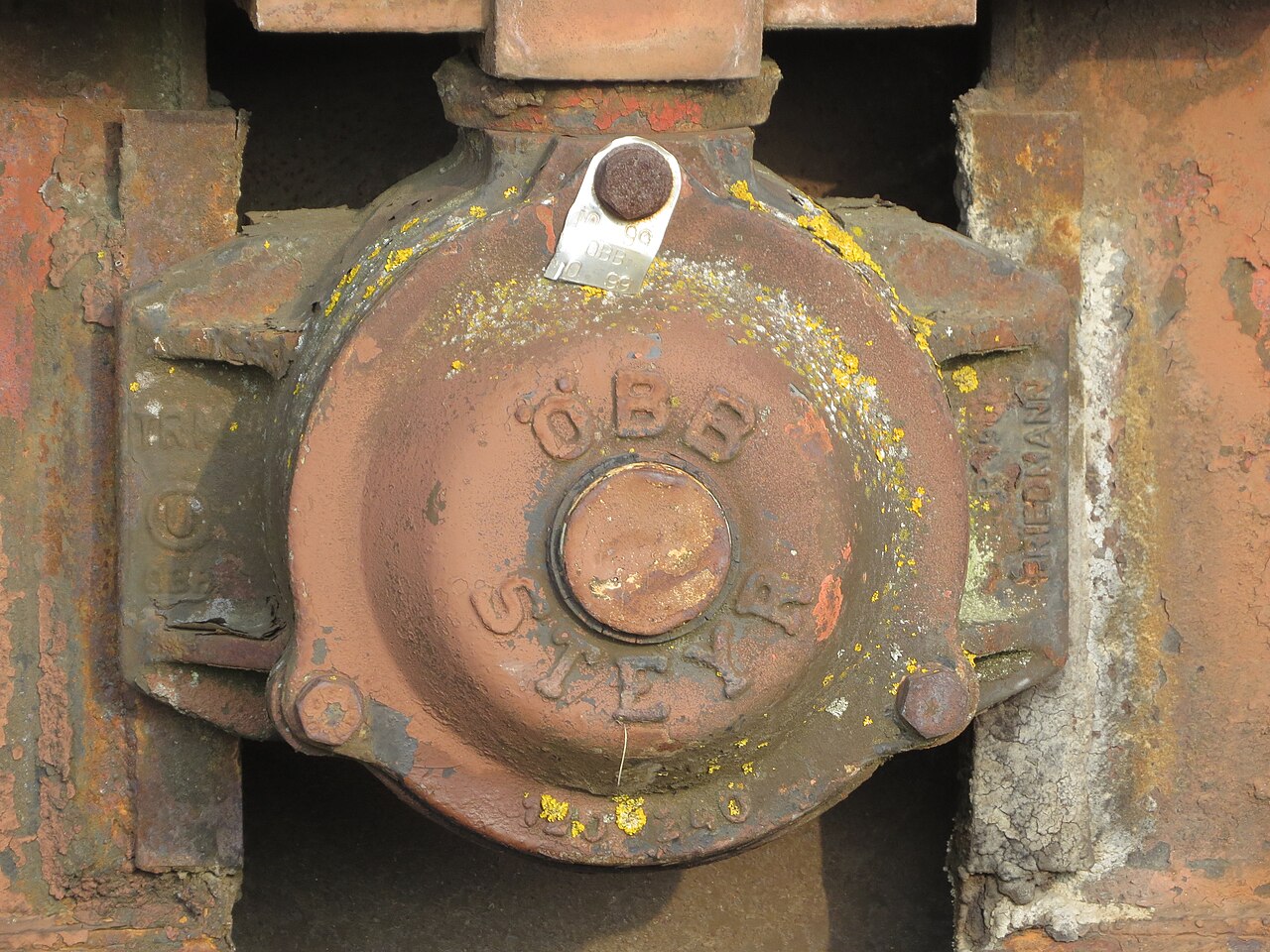
The source "Bearings in mechanical Sibo" states that Friedrich Fischer invented a machine to grind steel balls accurately in 1883, enabling mass production of ball bearings.[1] The same source reports that Henry Timken patented the tapered roller bearing in 1898, now fundamental in automotive wheel hubs.[1]
References
- "Bearings in mechanical Sibo", 15 September 2025. facts only, no text reused. sibo.eu
- Wikipedia, "Bearing (mechanical)" (CC BY-SA 4.0), which cites: "6 Most Popular Types of Mechanical Bearings", Craftech Industries, 22 January 2014 (original not read by us) en.wikipedia.org
- Wikipedia, "Bearing (mechanical)" (CC BY-SA 4.0), which cites: Cassidy, "Who Invented the Wheel? And How Did They Do It?", The Washington Post, 6 May 2020; Peacock, "Mons Porphyrites", p. 640–643; Bunch, "The History of Science and Technology: A Browser's Guide to the Great Discoveries, Inventions, and the People who Made Them, from the Dawn of Time to Today", Houghton Mifflin, 2004; McCoy, "The surprisingly simple way Egyptians moved massive pyramid stones without modern technology", Washington Post, 26 October 2021; Bunch, "The History of Science and Technology: A Browser's Guide to the Grea en.wikipedia.org
- Wikipedia, "Bearing (mechanical)" (CC BY-SA 4.0), which cites: Bunch, "The History of Science and Technology: A Browser's Guide to the Great Discoveries, Inventions, and the People who Made Them, from the Dawn of Time to Today", Houghton Mifflin, 2004 (we also read that source) en.wikipedia.org
- Wikipedia, "Bearing (mechanical)" (CC BY-SA 4.0), which cites: Carlson, "The ships of Lake Nemi", 1 July 2010}}, p. 26–31; "Bearing Timeline", American Bearing Manufacturers Association (we also read that source) en.wikipedia.org
- Wikipedia, "Bearing (mechanical)" (CC BY-SA 4.0), which cites: "Bicycle History, Chronology of the Growth of Bicycling and the Development of Bicycle Technology by David Mozer", Ibike.org (original not read by us) en.wikipedia.org
- Wikipedia, "Bearing (mechanical)" (CC BY-SA 4.0), which cites: Rubio, "Advances in Mechanism and Machine Science", 2024, p. 991–1002 (we also read that source) en.wikipedia.org
- Wikipedia, "Bearing (mechanical)" (CC BY-SA 4.0), which cites: Corfield, "Vaughan, Philip (fl. 1794)", Rowman & Littlefield, 2014, p. 1008; "Double-row Angular Contact Ball Bearings", IntechBearing.com (we also read that source) en.wikipedia.org
Each numbered sentence above was checked against the source it cites before publication. Sentences citing Wikipedia adapt text from the English Wikipedia article Bearing (mechanical) (contributors), used under CC BY-SA 4.0; this entry is available under the same licence. Other sources were used for facts only; no text or images are copied from them.
More in Construction & Materials
Sources
Compiled from Wikipedia and the sources listed below. Text from Wikipedia is available under CC BY-SA 4.0; this entry is adapted from it.
- Wikipedia: Bearing (mechanical) (CC BY-SA 4.0).
- Word definitions: the Codexery glossary, each quoted from its Wikipedia article.
Spotted an error? Know more?
Reader corrections go straight into our review queue. Suggest an edit · How this site is sourced