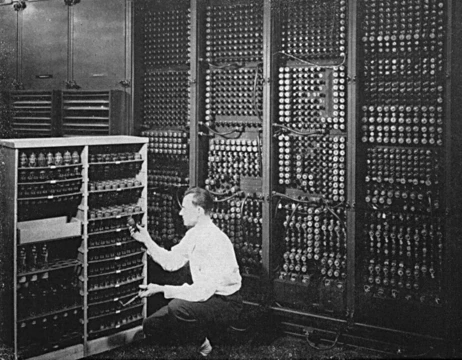
Computing
Goal-oriented activity involving computing machinery and algorithmic processes.

Computing refers to any purposeful activity that involves, is aided by, or results in computing machinery. This field covers the investigation and testing of algorithmic processes, along with the creation of hardware and software. It draws from scientific, engineering, mathematical, technological, and social domains. Key areas within computing include computer engineering, computer science, cybersecurity, data science, information systems, information technology, and software engineering. The word computing has also been used to mean counting and calculating. Historically, it described the work done by mechanical calculating machines, and even earlier, by people who performed calculations manually.
The history of computing goes back further than the history of computing hardware. It includes methods designed for pen and paper (or chalk and slate), sometimes aided by tables. Computing is closely linked to how numbers are represented, though mathematical ideas needed for computing existed before number systems. The oldest known tool for computation is the abacus, believed to have been invented in Babylon between 2700 and 2300 BC. More modern versions of the abacus are still used for calculations today. The first recorded suggestion to use digital electronics for computing appeared in a 1931 paper by C. E. Wynn-Williams. Claude Shannon's 1938 paper then introduced the concept of using electronics for Boolean algebra operations. The idea of a field-effect transistor was proposed by Julius Edgar Lilienfeld in 1925. In 1947, John Bardeen and Walter Brattain, working under William Shockley at Bell Labs, built the first working transistor, a point-contact type. The University of Manchester built the first transistorized computer, the Manchester Baby, in 1953. Early junction transistors were large and hard to mass-produce, so they were only used in specialized applications. In 1957, Frosch and Derick at Bell Labs manufactured the first silicon dioxide field effect transistors, where the drain and source were adjacent on the surface. A working MOSFET was demonstrated at Bell Labs in 1960. This device enabled high-density integrated circuits, leading to what is called the computer revolution or microcomputer revolution.
A computer is a machine that processes data based on a set of instructions known as a computer program. The program has an executable form that the computer can run directly. The same program, in its human-readable source code, allows a programmer to study and develop a sequence of steps called an algorithm. Since instructions can be executed on different types of computers, a single set of source instructions is converted into machine instructions depending on the CPU type. The execution process carries out the instructions in a program. These instructions express the computations the computer performs and trigger simple actions on the machine, producing effects according to the instructions' semantics.
Computer hardware consists of the physical parts of a computer, such as the central processing unit, memory, and input/output devices. Computational logic and computer architecture are important topics in hardware.
Computer software, often just called software, is a collection of computer programs and related data that gives instructions to a computer. It refers to one or more programs and data stored in the computer's memory. Software includes programs, procedures, algorithms, and documentation related to operating a data processing system. Program software performs the function of the program it implements, either by directly instructing the hardware or by serving as input to another piece of software. The term was created to contrast with hardware, which refers to physical devices. Unlike hardware, software is intangible. Sometimes software is used in a narrower sense to mean only application software.
System software is designed to operate and control computer hardware and provide a platform for running application software. It includes operating systems, utility software, device drivers, window systems, and firmware. Commonly used development tools like compilers, linkers, and debuggers are also classified as system software. System software and middleware manage and integrate a computer's capabilities but typically do not directly perform tasks that benefit the user, unlike application software.
Application software, also called an application or app, is designed to help the user perform specific tasks. Examples include enterprise software, accounting software, office suites, graphics software, and media players. Many application programs mainly work with documents. Apps may come bundled with the computer and its system software, or they may be published separately. Some users are satisfied with bundled apps and never need to install additional ones. The system software manages the hardware and serves the application, which in turn serves the user. Application software uses the power of a particular computing platform or system software for a specific purpose. Some apps, like Microsoft Office, are developed in multiple versions for different platforms; others have narrower requirements and are referred to by the platform they run on. For example, a geography application for a specific platform.
- field
- Computing
- known_for
- Goal-oriented activity involving computing machinery, algorithmic processes, and hardware/software development
Lore & Background
The history of computing predates the history of computing hardware and includes methods intended for pen and paper with or without the aid of tables. Computing is intimately tied to the representation of numbers, though mathematical concepts necessary for computing existed before numeral systems. Abaci of a more modern design are still used as calculation tools today. The first recorded proposal for using digital electronics in computing was the 1931 paper 'The Use of Thyratrons for High Speed Automatic Counting of Physical Phenomena' by C. E. Wynn-Williams. Claude Shannon's 1938 paper 'A Symbolic Analysis of Relay and Switching Circuits' introduced the idea of using electronics for Boolean algebraic operations. The concept of a field-effect transistor was proposed by Julius Edgar Lilienfeld in 1925. John Bardeen and Walter Brattain, working under William Shockley at Bell Labs, built the first working transistor in 1947. In 1953, the University of Manchester built the first transistorized computer, the Manchester Baby. In 1957, Frosch and Derick manufactured the first silicon dioxide field effect transistors at Bell Labs. A team demonstrated a working MOSFET at Bell Labs in 1960. The MOSFET made possible high-density integrated circuits, leading to the computer revolution or microcomputer revolution.
Reader's Guide
Computing is a broad field that encompasses the study and development of algorithmic processes, hardware, and software. Its history includes early tools like the abacus, the introduction of digital electronics for computing in the 1930s, and the development of the transistor in the 1940s and 1950s. The MOSFET, demonstrated in 1960, enabled high-density integrated circuits, which drove the computer revolution. Computing includes multiple disciplines such as computer engineering, computer science, cybersecurity, data science, information systems, information technology, and software engineering. It also covers computer hardware (physical parts like CPU, memory, input/output), computer software (programs and data), system software (operating systems, utilities, device drivers), application software (programs for specific tasks), computer networks (interconnected hardware for sharing resources), the Internet (global system using TCP/IP), and computer programming (writing, testing, debugging, and maintaining source code). The term computing is synonymous with counting and calculating, and earlier referred to actions performed by mechanical computing machines or human computers.
Did You Know?
- The first recorded proposal for using digital electronics in computing was the 1931 paper by C. E. Wynn-Williams.
- John Bardeen and Walter Brattain built the first working transistor in 1947 at Bell Labs.
- The MOSFET, demonstrated at Bell Labs in 1960, made possible high-density integrated circuits.
More in Computing & Digital 1-24
Spotted an error? Know more?
This is a living reference — every entry is fact-audited, and reader corrections feed straight into our audit queue. Suggest an edit · See this site's audit record