Computer architecture
Conceptual design defining how computer components interact.

Computer architecture is the blueprint for a computer system, describing how its components are organized and interact to run programs efficiently. It typically focuses on the overall design rather than exact implementation details, covering the instruction set architecture, CPU microarchitecture, memory, and input/output systems. It also involves balancing tradeoffs among performance, cost, power, reliability, and security.
The earliest documented computer architecture appears in correspondence between Charles Babbage and Ada Lovelace about the analytical engine. In 1936, while building the Z1 computer, Konrad Zuse described in patent applications the idea that machine instructions could be stored in the same memory as data—the stored-program concept. Two other foundational examples are John von Neumann's 1945 paper on the EDVAC, which outlined an organization of logical elements, and Alan Turing's 1945 proposal for the Automatic Computing Engine, which cited von Neumann's work.
The term "architecture" in computing was introduced by Lyle R. Johnson and Frederick P. Brooks, Jr. in 1959 at IBM's main research center. Johnson, writing about the Stretch supercomputer, used "system architecture" to describe formats, instruction types, hardware parameters, and speed enhancements, finding it more useful than "machine organization." Brooks, a Stretch designer, later wrote that computer architecture is the art of determining user needs and designing to meet them within economic and technological constraints. Brooks helped develop the IBM System/360 line, where "architecture" became a noun defining what a user needs to know. The System/360 line was succeeded by compatible lines, including the current IBM Z line, though the term later came to be used in many less precise ways.
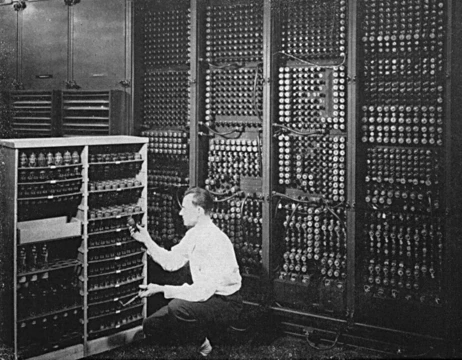
Early computer architectures were designed on paper and built directly into hardware. Later, prototypes were physically built as transistor–transistor logic (TTL) computers—such as for the 6800 and PA-RISC—tested, and tweaked before final hardware. Since the 1990s, new architectures are typically simulated inside another computer, implemented inside an FPGA as a soft microprocessor, or both, before being committed to hardware.
The discipline has three main subcategories. Instruction set architecture (ISA) defines the machine code a processor reads, including word size, memory address modes, registers, and data types. Microarchitecture, or computer organization, describes how a processor implements the ISA; for example, CPU cache size is generally unrelated to the ISA. Systems design covers all other hardware components, such as direct memory access, virtualization, and multiprocessing.
Other technologies, estimated in 2002 to account for 1% of all computer architecture and used in larger companies like Intel, include: macroarchitecture (layers more abstract than microarchitecture); assembly instruction set architecture (a smart assembler converting an abstract assembly language into different machine languages for different implementations); programmer-visible macroarchitecture (higher-level language tools like compilers defining a consistent interface, abstracting differences between ISAs and microarchitectures, as with C, C++, or Java standards); microcode (software that translates instructions to run on a chip, presenting a preferred instruction set interface and giving designers flexibility—for instance, a new chip version can use microcode to present the same instruction set as an older version, or microcode can present multiple instruction sets for the same chip); and pin architecture (the hardware functions a microprocessor must provide to a hardware platform, such as x86 pins A20M, FERR/IGNNE, or FLUSH, as well as messages for invalidating external caches—these functions are more flexible than ISA functions because external hardware can adapt to new encodings).
- field
- Computer science and computer engineering
- known_for
- Conceptual design and operational structure of computer systems, including instruction set architecture, microarchitecture, and systems design
- subcategories
- Instruction set architecture (ISA), microarchitecture (computer organization), systems design
Lore & Background
The first documented computer architecture was in correspondence between Charles Babbage and Ada Lovelace describing the analytical engine. While building the Z1 in 1936, Konrad Zuse described in patent applications that machine instructions could be stored in the same storage used for data, the stored-program concept. Two other early examples are John von Neumann's 1945 paper 'First Draft of a Report on the EDVAC' and Alan Turing's 'Proposed Electronic Calculator for the Automatic Computing Engine', also 1945. The term 'architecture' in computer literature traces to Lyle R. Johnson and Frederick P. Brooks, Jr., members of IBM's Machine Organization department in 1959. Johnson used 'system architecture' to describe the Stretch supercomputer. Earliest computer architectures were designed on paper and built directly into hardware. Later, prototypes were built as transistor–transistor logic (TTL) computers, tested, and tweaked before final hardware. As of the 1990s, new architectures are typically built, tested, and tweaked inside a computer architecture simulator or inside an FPGA as a soft microprocessor, or both, before committing to final hardware.
Reader's Guide
Computer architecture is significant as the foundational discipline that defines how hardware and software interact in computing systems. Its three main subcategories—instruction set architecture (ISA), microarchitecture, and systems design—provide a structured approach to balancing performance, efficiency, cost, and reliability. The ISA serves as the interface between software and hardware, defining machine code, word size, memory address modes, registers, and data types. Microarchitecture describes how a particular processor implements the ISA, including details like CPU cache size that are independent of the ISA. Systems design encompasses all other hardware components, such as direct memory access, virtualization, and multiprocessing. The field has evolved from paper designs to TTL prototypes to modern simulation and FPGA-based development. Additional technologies such as macroarchitecture, assembly instruction set architecture, programmer-visible macroarchitecture, microcode, and pin architecture provide further layers of abstraction and flexibility, allowing chip designers to present consistent interfaces across hardware generations and to support multiple instruction sets on the same underlying chip.
Did You Know?
- The first documented computer architecture was in correspondence between Charles Babbage and Ada Lovelace describing the analytical engine.
- Konrad Zuse described the stored-program concept in patent applications while building the Z1 in 1936.
- The term 'architecture' in computer literature was introduced by Lyle R. Johnson and Frederick P. Brooks, Jr. at IBM in 1959.
- As of the 1990s, new computer architectures are typically built, tested, and tweaked inside a computer architecture simulator or inside an FPGA as a soft microprocessor before final hardware.
From Tally Sticks to Transistors
The story of computation stretches back thousands of years, beginning with simple tally sticks and progressing through clay calculi sealed in hollow containers in the Fertile Crescent. The abacus, descended from Babylonian devices dating to roughly 2400 BCE, became a staple of arithmetic for millennia. In medieval European counting houses, merchants would slide markers across a checkered cloth to tally sums of money. The Antikythera mechanism, recovered from a shipwreck near the Greek island of Antikythera in 1901 and dated to around 100 BCE, stands as the earliest known mechanical analog computer, designed to compute astronomical positions. No device of comparable complexity would reappear until the fourteenth century. The Industrial Revolution brought mechanical automation of tedious tasks like loom pattern-guiding, and early twentieth-century electrical machines handled specialized analog calculations. True digital electronic computing emerged during World War II, progressing through electromechanical systems in the 1930s, thermionic valves, semiconductor transistors in the 1940s, MOS transistors in the 1950s, and monolithic integrated circuits from the 1950s onward. Each step produced smaller, more efficient circuit designs, culminating in the microprocessor and the microcomputer revolution of the 1970s.
The Anatomy of a Modern Machine
A conventional modern computer rests on a deceptively simple foundation: at least one processing element, usually a central processing unit built around a microprocessor, paired with some form of computer memory, typically semiconductor memory chips. The processing element handles arithmetic and logical operations, while a sequencing and control unit can alter the order of those operations based on stored information, giving the machine its programmable flexibility. Surrounding this core are peripheral devices that bridge the computer to the outside world. Input devices such as keyboards, mice, and joysticks feed information into the system from external sources. Output devices like monitors and printers deliver the results of operations to users. Some peripherals, such as touchscreens, perform both roles simultaneously. Together, these components allow a computer to retrieve data from the outside, process it through stored programs, and save or display the outcomes. This architecture underpins everything from a single-purpose key fob to a factory floor of industrial robots, and it is the same fundamental structure that powers the billions of devices linked together across the Internet.
The Word and the People Behind It
The term computer did not always refer to a machine. The Oxford English Dictionary traces its first known use to a 1613 book, The Yong Mans Gleanings, by Richard Brathwait, where it described a person skilled in calculations. The Online Etymology Dictionary places the earliest attested use in the 1640s as an agent noun derived from the verb compute, meaning one who calculates. For centuries the word carried that human meaning. During the mid-twentieth century, the role of human computer was often filled by women, who could be hired at lower wages than their male counterparts; by 1943, most human computers were women. The shift in meaning came in stages: the Online Etymology Dictionary records calculating machine as a sense dating from 1897, while the modern usage—programmable digital electronic computer—appears from 1945, with a theoretical sense traceable to 1937 and the concept of the Turing machine. The name stuck, even as the machines it describes grew far beyond simple calculation into general-purpose programmable systems capable of an enormous range of tasks.
From Scarcity to Ubiquity
In the 1930s, computers numbered only a few. Today they are woven into virtually every layer of industrial and consumer life, serving as control systems in products ranging from microwave ovens and remote controls to key fobs, up through personal computers, smartphones, and factories staffed with industrial robots. The price, size, and complexity of these machines span an extraordinary spectrum. At the heart of this expansion lies a relentless increase in speed, computing power, and versatility, driven by transistor counts that, as Moore's law observed, doubled roughly every two years. This exponential growth fueled the Digital Revolution across the late twentieth and early twenty-first centuries. Computers now power the Internet, a vast network linking billions of machines and users worldwide. A computer system can mean a single nominally complete unit—hardware, operating system, software, and peripherals working together—or a collection of linked computers functioning as a network or cluster. What began as a handful of specialized calculating devices has become the invisible infrastructure of modern civilization.
Frequently Asked Questions
What exactly is computer architecture?
It is the blueprint-level design of a computer system, specifying how the CPU, memory, and I/O components are laid out and communicate so that programs execute efficiently. Think of it as the set of rules and structural choices that govern everything inside the machine.
What are the main subcategories of computer architecture?
The field splits into instruction set architecture (the programmer-facing vocabulary of operations), microarchitecture (how hardware physically implements those operations), and broader systems design (memory hierarchy, I/O paths, and interconnect decisions).
How is computer architecture different from computer organization?
Architecture describes the abstract, programmer-visible contract—what instructions exist and how addresses map to memory—while organization (microarchitecture) covers the concrete hardware realization, such as pipeline depth and cache layout. The distinction separates what software sees from how the silicon actually performs the work.
Why does computer architecture matter in everyday computing?
Every tradeoff an architect strikes among speed, power draw, cost, and security ripples into the devices you touch daily, from a phone's battery life to a server's throughput and how well encryption resists side-channel attacks. It is the layer where physical constraints meet software expectations.
Which academic fields does computer architecture belong to?
It sits at the intersection of computer science and computer engineering, pulling from both formal theoretical models and hands-on hardware design like VLSI. Most universities house it within a computer-engineering or EECS department rather than a pure CS one.
More in Computing & Digital 1-24
Spotted an error? Know more?
This is a living reference — every entry is fact-audited, and reader corrections feed straight into our audit queue. Suggest an edit · See this site's audit record