Central processing unit
Primary processor executing computer program instructions.

The brain of a computer is its central processing unit, or CPU—also called the main processor or simply the processor. This component’s circuitry handles the instructions that make up a computer program, covering tasks like arithmetic, logic, control, and input/output operations. That job sets it apart from other parts of the system, such as main memory, input/output circuitry, and specialized helpers like graphics processing units (GPUs). While the physical shape, design, and construction of CPUs have evolved over the years, the core way they work has stayed largely the same.
A CPU’s main parts include the arithmetic-logic unit (ALU), which does the math and logic; processor registers, which feed numbers to the ALU and hold its results; and a control unit, which manages the whole process of fetching instructions from memory, decoding them, and executing them by coordinating the ALU, registers, and other components. To boost performance, modern CPUs dedicate a lot of chip space to caches and instruction-level parallelism, and they use CPU modes to help operating systems and virtualization run smoothly.
Today, most CPUs are built as integrated circuit microprocessors, with one or more CPUs on a single chip. Chips that contain multiple CPUs are called multi-core processors. Each individual physical CPU, known as a processor core, can also support multithreading, allowing it to handle several instruction streams at once. An integrated circuit that holds a CPU might also include memory, peripheral interfaces, and other computer parts; such devices are called microcontrollers or systems on chip (SoCs).
**History**
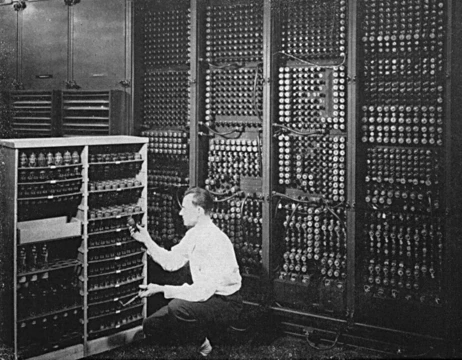
Early machines like ENIAC had to be physically rewired to change what they did, earning them the label “fixed-program computers.” The term “central processing unit” has been in use since at least 1955. Since a CPU is defined as a device that runs software, the first true CPUs appeared with the stored-program computer. The idea of a stored-program machine was already in the design of ENIAC by John Presper Eckert and John William Mauchly, but it was left out initially so the machine could be finished sooner. On June 30, 1945, before ENIAC was completed, mathematician John von Neumann distributed a paper called *First Draft of a Report on the EDVAC*, which outlined a stored-program computer that was finished in August 1949. EDVAC was built to execute a fixed set of instruction types, and crucially, its programs were stored in high-speed memory instead of being determined by physical wiring. This solved a major problem with ENIAC: the huge time and effort needed to reconfigure it for a new task. With von Neumann’s design, changing EDVAC’s program meant simply changing the memory contents. EDVAC wasn’t the first stored-program computer, though. The Manchester Baby, a small experimental machine, ran its first program on June 21, 1948, and the Manchester Mark 1 followed on the night of June 16–17, 1949.
Early CPUs were custom-built for specific, often unique, computers. Over time, that approach gave way to mass-produced, general-purpose processors. This shift toward standardization started with discrete-transistor mainframes and minicomputers and sped up dramatically with the rise of the integrated circuit. ICs allowed CPUs to become far more complex and be manufactured with nanometer-level precision. The miniaturization and standardization of CPUs have spread digital devices far beyond dedicated computing machines, putting microprocessors into cars, cellphones, and even toys.
Although von Neumann is most often credited with the stored-program design (now called the von Neumann architecture) because of his work on EDVAC, others like Konrad Zuse had suggested and built similar ideas earlier. The Harvard Mark I, completed before EDVAC, used a stored-program design too, but with punched paper tape instead of electronic memory. The key difference is that the Harvard architecture keeps CPU instructions and data in separate storage, while the von Neumann architecture uses the same memory space for both. Most modern CPUs follow the von Neumann design, but Harvard-architecture chips—like Atmel AVR microcontrollers—are common in embedded systems.
Before transistors, relays and vacuum tubes served as switching elements. A useful computer needed thousands or tens of thousands of these switches, and system speed depended on how fast they switched. Vacuum-tube computers like EDVAC averaged about eight hours between failures, while slower relay computers like the Harvard Mark I failed very rarely. Tube-based CPUs eventually won out because their speed advantage outweighed the reliability issues. Most early synchronous CPUs ran at low clock rates—typically between 100 kHz and 4 MHz—limited by the speed of their switching components.
**Transistor CPUs**
The complexity of CPU design increased significantly with the introduction of transistors.
- First use of term
- 1955
- Key components
- Arithmetic-logic unit (ALU), processor registers, control unit
- Early stored-program computer
- Manchester Baby (first program 21 June 1948)
- Notable early architecture
- von Neumann architecture (EDVAC design)
- Common implementation
- Integrated circuit (IC) microprocessors
- Modern variant
- Multi-core processors (MCPs)
Lore & Background
Early computers such as the ENIAC had to be physically rewired to perform different tasks, which caused these machines to be called 'fixed-program computers.' The term 'central processing unit' has been in use since as early as 1955. The idea of a stored-program computer was present in the design of ENIAC but initially omitted; mathematician John von Neumann distributed a paper on the EDVAC on June 30, 1945, outlining a stored-program computer that was not fully operational until 1951. The Manchester Baby ran its first program on 21 June 1948, and the Manchester Mark 1 ran its first program during the night of 16–17 June 1949. Early CPUs were custom designs, but standardization began in the era of discrete transistor mainframes and minicomputers, accelerating with the integrated circuit. Prior to transistors, relays and vacuum tubes were used; vacuum-tube computers like ENIAC averaged eight hours between failures, while relay computers were generally less reliable due to mechanical wear. Transistorized CPUs in the 1950s and 1960s offered increased reliability, lower power consumption, and higher speeds.
Reader's Guide
The central processing unit is the core component enabling software execution in computers, a role that has remained fundamentally unchanged despite dramatic technological evolution. From physically rewired machines like ENIAC to stored-program designs pioneered by von Neumann and others, the CPU transitioned from vacuum tubes to transistors, then to integrated circuits, allowing miniaturization and standardization. This shift from custom designs to mass-produced multi-purpose processors has embedded digital devices into nearly every aspect of modern life, from automobiles to cellphones. The development of multi-core processors and systems on chip (SoCs) further expanded CPU capabilities, while architectural concepts like von Neumann and Harvard designs continue to influence modern computing. The CPU's significance lies in its universal function as the executor of instructions, enabling the versatility and ubiquity of digital technology.
Did You Know?
- The term 'central processing unit' has been in use since as early as 1955.
- The Manchester Baby, a small-scale experimental stored-program computer, ran its first program on 21 June 1948.
- Vacuum-tube computers such as ENIAC tended to average eight hours between failures.
Frequently Asked Questions
Who is Central processing unit?
The CPU is the primary processor inside a computer, responsible for executing the instructions of a running program. It handles arithmetic, logic, control flow, and input/output operations through its internal circuitry. The term 'central processing unit' first appeared in 1955.
What are Central processing unit's powers/role?
A CPU's core job is to fetch and execute program instructions, performing calculations, making logical decisions, and coordinating data flow. It does this through three key internal parts: an arithmetic-logic unit, a set of registers, and a control unit. Essentially, it is the component that turns software into action.
How does Central processing unit's story end?
The CPU hasn't reached an ending—its fundamental operation of executing instructions has stayed remarkably stable since the early stored-program machines like the Manchester Baby in 1948. Modern CPUs have evolved into multi-core processors, but the core principle of fetching and executing instructions remains unchanged.
Why is Central processing unit important?
Without a CPU, a computer cannot run any program, since it is the component that actually interprets and carries out every instruction. Its design, rooted in the von Neumann architecture from the EDVAC era, underpins virtually all digital computing to this day.
What are Central processing unit's key components?
A CPU is built around three main parts: the arithmetic-logic unit (ALU) for calculations, processor registers for fast temporary storage, and a control unit that directs the flow of operations. In modern systems, these components are typically fabricated together as an integrated circuit microprocessor.
More in Computing & Digital 1-24
Spotted an error? Know more?
This is a living reference — every entry is fact-audited, and reader corrections feed straight into our audit queue. Suggest an edit · See this site's audit record