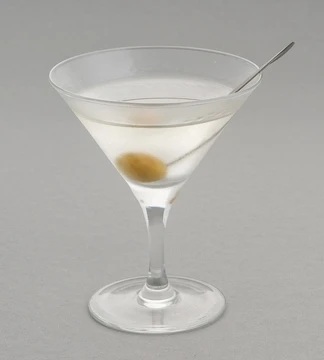
Bacon martini
A bacon-infused vodka cocktail invented at the Double Down Saloon before 1998.

The bacon martini, also known as a bacontini, pig on the rocks, or bloody bacon martini, is a cocktail made with bacon-infused vodka and garnished with bacon strips, bacon bits, or olives. It was independently invented by P. Moss, owner of the Double Down Saloon in Las Vegas, Nevada, and later popularized by Sang Yoon, owner of the gastropub Father's Office in Santa Monica, California, in 1998.
Quick Facts
- Ingredients
- 50ml bacon vodka / strip of bacon, olive (garnish)
- Served
- Straight up: chilled, without ice
- Garnish
- bacon, olive
- Drinkware
- Cosmopolitan or cocktail glass
Facts from the source article.
Lore & Background
The bacon martini was created by P. Moss of the Double Down Saloon in Las Vegas, Nevada, before 1998, and later independently recreated by Sang Yoon of Father's Office in Santa Monica, California, in 1998. Yoon's version was inspired by the Bacon of the Month Club run by the Grateful Palate in Fairfield, California, and uses juniper-cured bacon. Moss's method calls for hickory-smoked bacon. The drink is prepared by fat washing, a process where cooked bacon strips are soaked in vodka and the fat is strained off, leaving the liquid filmy and opaque. At the Double Down Saloon in the East Village, New York City, the bacon martini is strained through shaken ice and served without a piece of bacon at the bottom of the glass.
Reader's Guide
The bacon martini represents a notable example of the trend of calling any straight liquor served in a martini glass a 'martini,' as seen with the saketini and other variations. Although not a true vodka martini (which includes vermouth), the drink has gained recognition for its unique preparation method—fat washing—and its bold flavor profile. Reviews have been mixed: one drinker compared it to Castrol motor oil, while a bacon enthusiast found it satisfying and delicious on many levels. Variants may include the addition of Bloody Mary mix, and some establishments have experimented with bourbon instead of vodka (a drink called a Mitch Morgan), arguing that vodka absorbs too much charcoal smokiness. The bacon martini's legacy lies in its fusion of savory bacon with cocktail culture, sparking both curiosity and debate among drinkers.
Did You Know?
- The bacon martini was invented by P. Moss at the Double Down Saloon in Las Vegas before 1998, and later independently created by Sang Yoon in 1998.
- Sang Yoon's version uses juniper-cured bacon, while P. Moss's uses hickory-smoked bacon.
- The drink is prepared by fat washing, where cooked bacon is soaked in vodka and the fat is strained off.
Origins and the Mystery of the Name
The exact birth of the martini remains shrouded in uncertainty, with multiple competing claims to its naming. One theory traces the name to the Italian Martini brand of vermouth, while another points to the small California town of Martinez, where residents claim a local bartender created the drink. A third possibility links it to a cocktail called the Martinez, reportedly served at San Francisco's Occidental Hotel in the early 1860s to patrons heading to the nearby town by evening ferry. The earliest documented recipe resembling a modern martini appears in Jerry Thomas's 1887 Bartender's Guide, describing a Martinez Cocktail built on Old Tom gin, sweet vermouth, Maraschino, and bitters. Harry Johnson's 1888 manual offered a similar Martini Cocktail with equal parts Old Tom gin and Italian vermouth. By 1907, William Boothby credited a Los Angeles bartender named Charlie Shaw with a Dry Martini Cocktail recipe that closely mirrors the drink we know today, using dry English gin, French vermouth, and orange bitters.
The Drying Century
By 1922, the martini had crystallized into its most recognizable configuration: London dry gin and dry vermouth combined at a two-to-one ratio, stirred with ice in a mixing glass, optionally touched with orange or aromatic bitters, and strained into a chilled cocktail glass. Yet this was merely the starting point of a long, steady march toward drier territory. During the 1930s, the accepted ratio shifted to three parts gin to one of vermouth. The 1940s pushed it to four-to-one. By the latter decades of the twentieth century, five-to-one or six-to-one had become the expected norm for a dry martini. Enthusiasts could push the ratio even further—eight-to-one, twelve-to-one, or the extreme fifteen-to-one known as the Montgomery, named after British Field Marshal Bernard Montgomery's reputed preference for overwhelming numerical superiority in battle. Ordering extra dry simply meant requesting even less or no vermouth at all.
Prohibition, Popularity, and the Standard's Joke
The martini's trajectory as a cultural icon was deeply shaped by American prohibition. Between 1920 and 1933, the relative ease of producing gin illegally made the martini the dominant cocktail in the United States. When prohibition ended and quality gin became freely available, the drink evolved further toward drier expressions. The Roaring Twenties had already established the martini as a common bar order, and its popularity only deepened. However, by the 1970s and 1980s, the martini fell out of fashion, dismissed as old-fashioned and supplanted by more elaborate cocktails and wine spritzers. A revival came in the mid-1990s, spawning numerous new interpretations. The drink's cultural entrenchment was also captured in 1966, when the American Standards Association published K100.1-1966, a tongue-in-cheek Safety Code and Requirements for Dry Martinis. Its successor, the American National Standards Institute, issued a revised edition in 1974, though the document is no longer an active standard.
The Spectrum of Variations
The martini's core formula—gin and vermouth, garnished with an olive, a lemon twist, or both—serves as a canvas for a wide range of modifications. A perfect martini balances equal measures of sweet and dry vermouth, while a wet martini leans toward more vermouth, and a fifty-fifty version uses equal parts gin and vermouth. An upside-down or reverse martini inverts the ratio, favoring vermouth over gin. The dirty martini introduces a splash of olive brine or juice, typically paired with an olive garnish, while an extra dirty version doubles that brine. A direct or naked martini skips the ice-stirring step entirely: the gin is stored in a freezer and poured straight into the serving glass with the vermouth, delivering an intensely cold drink without the dilution that traditional stirring produces. The vodka martini simply swaps the base spirit. Playwright Noël Coward famously quipped that a perfect martini should be made by filling a glass with gin and waving it in the general direction of Italy, capturing the spirit of the drink's drier extremes.
Frequently Asked Questions
What is a Bacon Martini?
A Bacon Martini is a vodka-based cocktail built around bacon-infused vodka and typically finished with a garnish of bacon strips, bacon bits, or olives. It sits in the savory-tart end of the martini family.
Who invented the Bacon Martini?
P. Moss, who ran the Double Down Saloon in Las Vegas, Nevada, is credited with the original creation. Sang Yoon, owner of the Santa Monica gastropub Father's Office, later brought the drink to wider attention in 1998.
What are the core ingredients of a Bacon Martini?
The base is vodka that has been infused with bacon, giving the spirit a smoky, salty character. It is then garnished with bacon strips, crumbled bacon bits, or olives, depending on the bartender's preference.
What other names does the Bacon Martini go by?
You'll also see it listed as a bacontini, a pig on the rocks, or a bloody bacon martini on various menu boards and cocktail books. All four names refer to the same bacon-forward vodka drink.
Where was the Bacon Martini first served?
The drink originated at the Double Down Saloon in Las Vegas, Nevada, before 1998. It gained broader recognition after Sang Yoon featured it at Father's Office in Santa Monica, California, in 1998.
More in Cocktails with vodka 1-24
Spotted an error? Know more?
Reader corrections go straight into our review queue. Suggest an edit · How this site is sourced