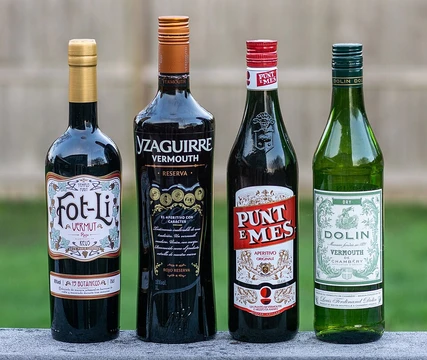
Old pal
Equal parts rye, dry vermouth, and Campari.

The Old Pal is a cocktail consisting of equal parts rye whiskey, French vermouth (dry), and Campari. It first appeared in print in MacElhone (1927), by Harry MacElhone, the proprietor of Harry's New York Bar in Paris, in an essay by Arthur Moss. The drink is credited to William 'Sparrow' Robinson, a sports editor for The New York Herald in Paris, and was dedicated to Moss as 'My Old Pal.'
Quick Facts
- Base
- Rye whiskey
- Ingredients
- One part rye whiskey / One part dry vermouth / One part Campari
- Served
- Stirred
- Garnish
- Slice orange
- Prep
- Fill a cocktail glass with ice cubes. Add all ingredients. Stir then strain into a cocktail glass. / Garnish with orange.
- Drinkware
- Cocktail glass
Facts from the source article.
Lore & Background
The Old Pal cocktail first appeared in the 1927 book MacElhone, by Harry MacElhone, in an essay titled 'Cocktails About Town' by Arthur Moss. The essay describes cocktails created by men-about-town, and the Old Pal is credited to William 'Sparrow' Robinson, a sports editor for The New York Herald in Paris. The name 'Old Pal' refers to Moss, to whom the drink was dedicated. The original recipe, as humorously recounted by Robinson, called for equal parts Canadian Club, Italian (sweet) vermouth, and Campari, with a joking reference to 1878.
Reader's Guide
The Old Pal is significant as an early equal-parts cocktail that evolved from a sweet-vermouth base to a dry-vermouth base, reflecting changing tastes. It appeared in Boothby (1934) with French vermouth, and later editions of Harry's ABC of Mixing Cocktails (1952) standardized the modern recipe with Canadian whisky, French vermouth, and Campari. The drink was popular enough to be included in the inaugural 1961 list of IBA official cocktails, though it was removed in the 1987 revision. It is closely related to the boulevardier, which also appeared in the same 1927 essay, and to the Negroni, but with rye whiskey instead of gin and dry vermouth instead of sweet. The Old Pal's legacy lies in its role as a classic whiskey-based aperitif, demonstrating how a simple ratio can yield a balanced, enduring cocktail.
Did You Know?
- The Old Pal first appeared in print in 1927 in MacElhone, by Harry MacElhone.
- The original recipe used Italian (sweet) vermouth, not the modern French (dry) vermouth.
- The drink was dedicated to Arthur Moss by William 'Sparrow' Robinson.
- Despite some claims, the Old Pal was not on the first IBA official cocktail list in 1961.
Origins & Personal Attribution
The Old Pal cocktail traces its written origins to a 1927 volume published by Harry MacElhone, the man behind the celebrated Harry's New York Bar in Paris. Rather than appearing in the standard recipe section, the drink was embedded in a lighthearted essay titled 'Cocktails About Town,' authored by Arthur Moss. The recipe is credited to William 'Sparrow' Robinson, a sports editor for The New York Herald who was based in Paris at the time. The name itself is a personal gesture: Robinson dedicated the drink to Moss, calling him his 'old pal.' Robinson's colorful narrative, as filtered through Moss's pen, invokes a deliberately absurd date—February 30, 1878—and a tale of firing a pistol at 'Powderhall foot races' before concocting the mixture. This theatrical, self-aware backstory firmly roots the cocktail in the world of American expatriate men-about-town in interwar Paris, where personal rivalries and friendships were settled over well-shaken glasses.
Evolution of the Recipe Across Decades
The Old Pal's formulation has shifted noticeably over the years. In its earliest printed appearance within MacElhone's 1927 book, the recipe specified Canadian Club by name, Italian (sweet) vermouth, and Campari in equal thirds. By the time Dick Bradsell's Boothby's Book of Cocktails was published in 1934, the vermouth had switched to French (dry), and the spirit was listed generically as 'whisky' without a brand. The 1952 'New' edition of Harry's ABC of Mixing Cocktails settled on Canadian whisky paired with French vermouth and Campari, still in equal parts, and attributed the recipe to 'Sparrow' Robertson, sporting editor of the New York Herald in Paris. The modern standard typically calls for rye whiskey rather than Canadian, reflecting broader shifts in American cocktail culture. Across every version, the equal-thirds structure and the Campari component have remained constant, anchoring the drink's distinctive bitter-sweet character.
IBA Recognition & Enduring Legacy
The Old Pal reached a significant milestone in 1961 when it was selected as one of the fifty cocktails on the International Bartenders Association's inaugural official list. This inclusion placed the drink among the most recognized classics in the global cocktail canon, a testament to its sustained popularity across international bars and speakeasies. However, the cocktail's standing was not permanent; the IBA revised its official roster in 1987, and the Old Pal was dropped from the list. Despite this removal, the drink continued to appear in major bartending references and remained a fixture in well-stocked bars worldwide. Its trajectory—from a personal dedication between two American expatriates in Paris, through multiple editions of classic mixing manuals, to international official recognition and eventual removal—mirrors the broader pattern of many early-twentieth-century cocktails that rose and fell in public favor while retaining a devoted following among enthusiasts and serious bartenders.
Relationship to the Boulevardier and Negroni
The Old Pal occupies a distinctive niche among classic cocktails, sitting close to two well-known neighbors. The boulevardier, which first appeared in the very same Arthur Moss essay in MacElhone's 1927 book, is its closest relative. Both drinks originally featured Italian (sweet) vermouth and equal parts of all three ingredients, but the boulevardier calls for bourbon while the Old Pal uses Canadian or rye whiskey. Over time, the Old Pal's vermouth shifted to French (dry), and the boulevardier's proportions often skew toward more whiskey—the IBA lists it at 1½:1:1, and a 2:1:1 ratio is also common in practice. The Negroni presents another point of comparison: where the Negroni pairs gin with sweet vermouth and Campari in equal parts, the Old Pal substitutes rye whiskey and dry vermouth. This makes the Old Pal something of a drier, more whiskey-forward cousin to both drinks, with a sharper bite from the rye and the herbal complexity of French vermouth.
Frequently Asked Questions
What is the Old Pal cocktail made of?
The Old Pal is a three-ingredient stirred drink built on equal parts rye whiskey, dry French vermouth, and Campari. Its character comes from the bittersweet Campari sitting between the warm rye and the dry, herbal vermouth.
Who created the Old Pal and who was it named after?
The cocktail is credited to William 'Sparrow' Robinson, a sports editor at The New York Herald who was living in Paris. He dedicated the drink to Arthur Moss, a writer, with the affectionate title 'My Old Pal.'
Where did the Old Pal first appear in print?
The recipe was published in 1927 in a book by Harry MacElhone, the owner of Harry's New York Bar in Paris. The entry appeared within an essay written by Arthur Moss himself, making it the earliest known printed reference to the drink.
How does the original 1927 recipe differ from what bars serve today?
The printed version called for Canadian Club whiskey and Italian vermouth in equal parts with Campari. The modern standard substitutes rye whiskey and French dry vermouth, but the equal-thirds structure remains unchanged.
Is the Old Pal on the IBA official cocktail list?
No, the Old Pal was left off the IBA's inaugural catalogue of official cocktails released in 1961. Despite its well-documented Parisian origin, it has never been adopted into the IBA's canonical set.
More in Cocktails with vermouth 1-24
Spotted an error? Know more?
Reader corrections go straight into our review queue. Suggest an edit · How this site is sourced