Turritopsis dohrnii
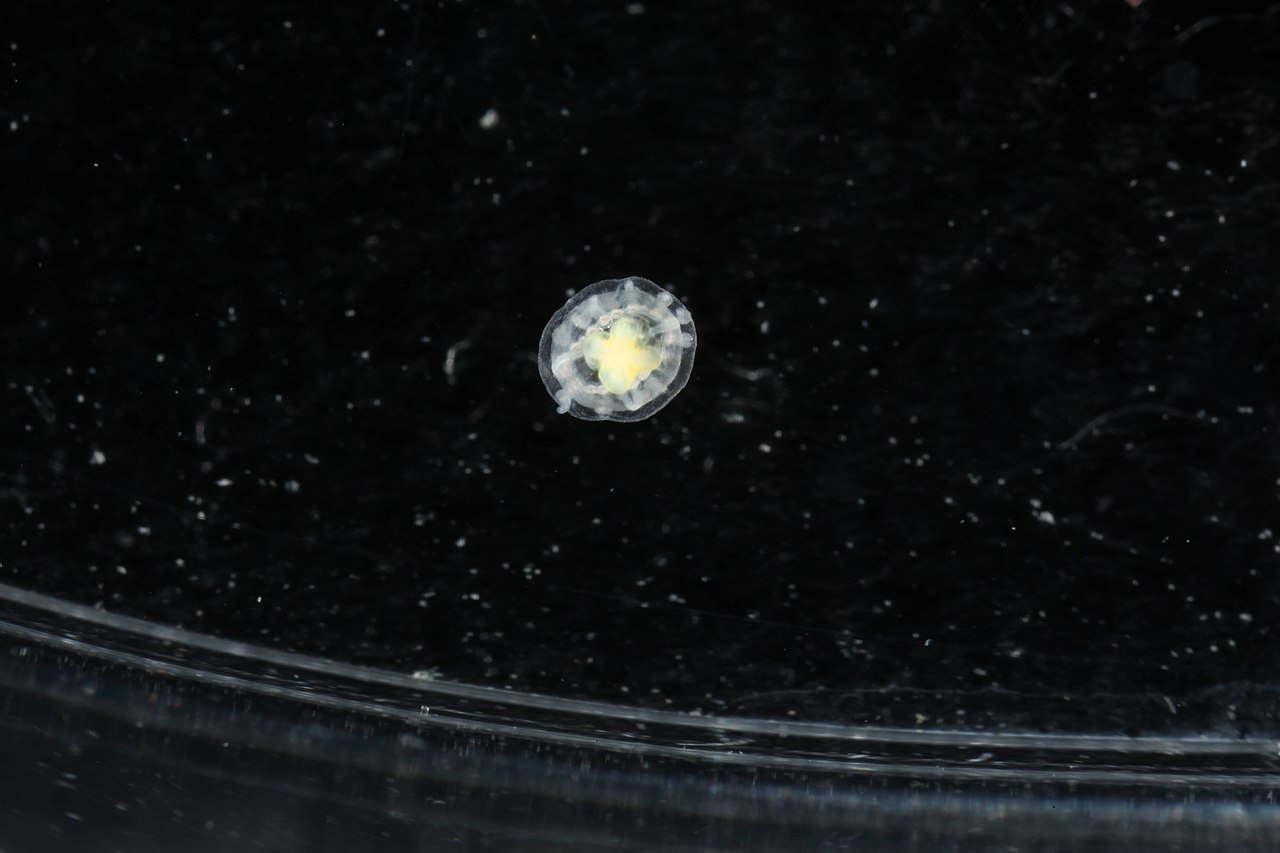
A small jellyfish capable of reverting to its polyp stage.

Unknown author · Public domain
Turritopsis dohrnii, better known as the immortal jellyfish, is a tiny species of Medusozoa that can be found in temperate and tropical waters around the globe. It stands out as one of the very few animals known to be able to fully reverse its life cycle: after reaching sexual maturity as a solitary, free-swimming medusa, it can transform back into a sexually immature, stationary polyp colony. This reversal is achieved through transdifferentiation, a process where cells change from one specialized type to another. In theory, this cycle could repeat forever, making the jellyfish biologically immortal, though in reality individuals often die from predation or disease before they ever revert.
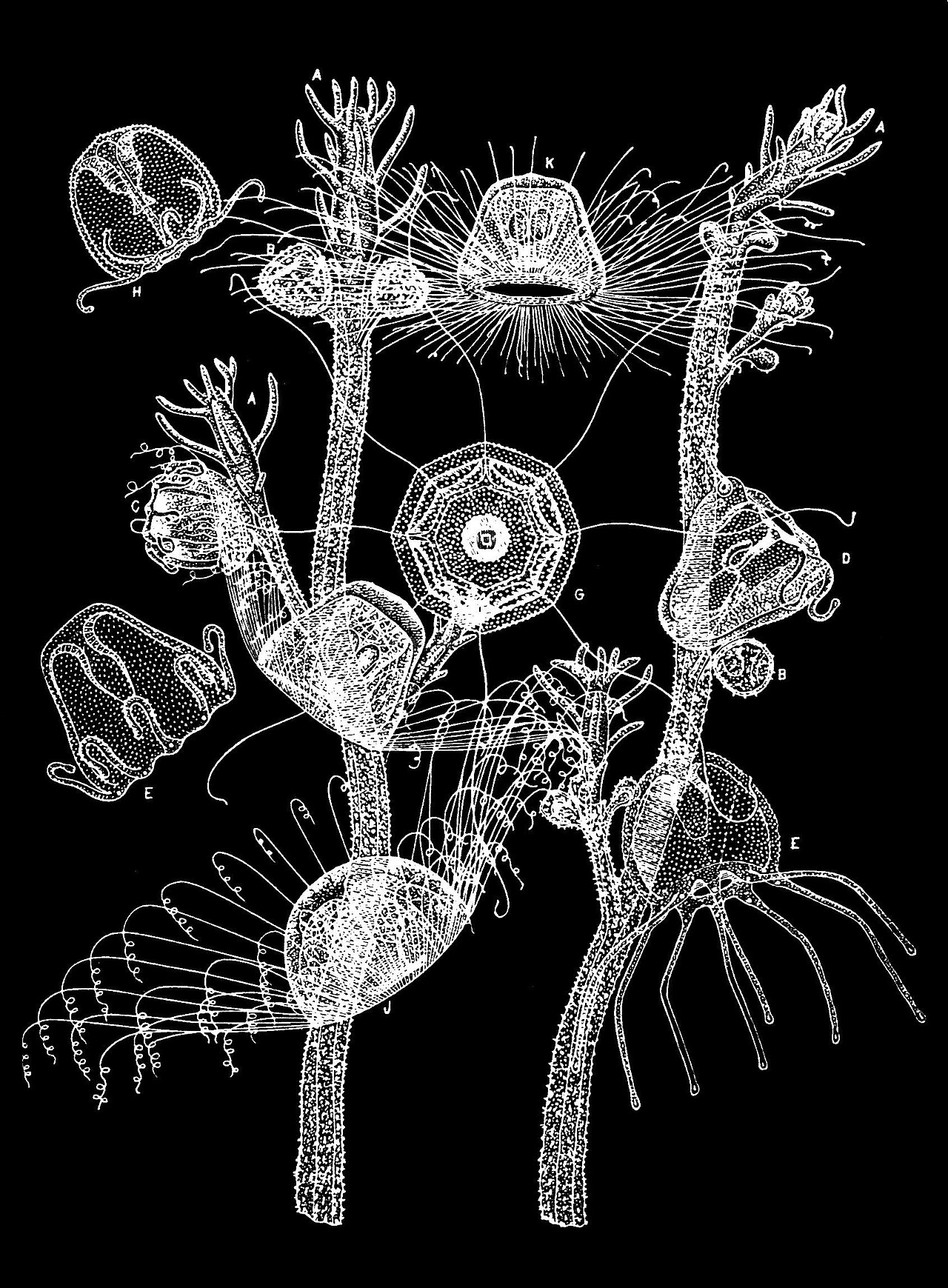
The species begins life as a tiny, free-swimming larva called a planula. Once it settles, the planula grows into a colony of polyps anchored to the seafloor. All polyps and medusae that come from a single planula are clones. The polyps form an unusually branched structure, not typical of most jellyfish. From these polyps, medusae bud off and begin their free-swimming existence, eventually reaching sexual maturity. At that stage, they hunt and consume other jellyfish species rapidly. If a T. dohrnii medusa faces environmental stress, physical injury, illness, or old age, it can revert to the polyp stage and form a new colony.
Taxonomically, the species was once considered the same as T. nutricula but was later reclassified as separate. It was named in 1883 after Anton Dohrn, who founded the Stazione Zoologica Anton Dohrn in Naples, Italy. Until a 2006 study, it was thought that T. rubra and T. nutricula were identical to T. dohrnii. It remains unknown whether T. rubra medusae can also transform back into polyps.
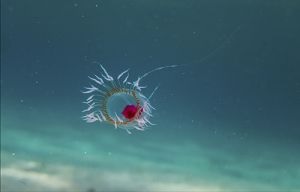
The medusa itself is bell-shaped, made of mesoglea, and reaches a maximum diameter of about 4.5 millimeters, with roughly equal height and width. The bell walls are uniformly thin except for some thickening at the top. Its stomach is bright red and cruciform in cross-section. Young medusae just 1 millimeter across have only eight tentacles around the rim, while adults have 80 to 90. The medusa lives freely in the plankton. Dense nerve net cells in the cap’s epidermis form a large ring-like structure above the radial canal, a feature common in cnidarians. The species also has a bottom-dwelling polyp form (hydroid), consisting of stolons that run along the substrate and upright branches with feeding polyps that produce medusa buds. These buds develop into tiny 1-millimeter medusae over a few days, then detach and swim free.
Turritopsis is believed to have originated in the Pacific Ocean but has spread worldwide through trans-Arctic migrations, speciating into several populations that are morphologically similar but genetically distinct, as confirmed by mitochondrial ribosomal gene sequencing. It now inhabits temperate to tropical waters in all oceans. The spread is thought to occur via ballast water discharge. Unlike many invasive species that cause major economic or ecological damage, T. dohrnii’s global invasion has gone largely unnoticed because of its tiny size and harmlessness. Smithsonian Tropical Marine Institute scientist Maria Miglietta described it as “a worldwide silent invasion.” The species can withstand extreme conditions like starvation and harsh environments, reverting into a cluster of cells that may be carried by currents, making it ecologically efficient and competitive.
In the life cycle, eggs develop in the gonads of female medusae, located in the walls of the manubrium (stomach). Mature eggs are likely spawned and fertilized in the sea by sperm from males, as is typical for most hydromedusae. However, the related T. rubra may retain fertilized eggs until the planula stage. Fertilized eggs become planula larvae, which settle on the seafloor or on floating dock communities, and develop into polyp colonies. These hydroids bud new medusae about 1 millimeter in size, which then grow and feed in the plankton, reaching sexual maturity after a few weeks—25 to 30 days at 20°C, or 18 to 22 days at 22°C. Medusae can survive temperatures between 14 and 25°C.
Most jellyfish species have a fixed lifespan, ranging from hours to many months. The medusa of T. dohrnii is the only form known to be able to return to a polyp state through a specific transdifferentiation process that requires certain cell types, including tissue from both the bell surface and the circulatory canal system. Experiments have shown that all stages of the medusa, from newly released to mature, can undergo this reversal.
- field
- Marine biology, zoology
- known_for
- Biological immortality through transdifferentiation
- maximum_diameter
- about 4.5 mm
- diet
- Carnivorous; zooplankton, fish eggs, small mollusks
- temperature_range
- 14 to 25 °C
Lore & Background
Turritopsis dohrnii begins its life as a tiny, free-swimming larva called a planula. The planula settles and gives rise to a colony of polyps attached to the sea floor, which form an extensively branched structure. Medusae (jellyfish) bud off these polyps and become free-swimming, eventually reaching sexual maturity. When sexually mature, they prey on other jellyfish species at a rapid pace. If exposed to environmental stress, physical assault, sickness, or old age, the medusa can revert to the polyp stage through transdifferentiation, a process that alters the differentiated state of cells into new types. This reversal can theoretically occur indefinitely, though in practice most individuals die from predation or disease.
Reader's Guide
Turritopsis dohrnii is significant primarily for its biological immortality, a rare trait in the animal kingdom. Its ability to reverse its life cycle via transdifferentiation has made it an important subject in basic biological aging and pharmaceutical research. The species also demonstrates unique telomere maintenance mechanisms that reset cellular aging during life cycle reversal. Its global spread, likely through ballast water discharge, has been described as a 'worldwide silent invasion' due to its tiny size and innocuity. The species' cell development method has inspired scientists to explore using transdifferentiation to renew damaged or dead tissue in humans. Despite its theoretical immortality, most individuals in nature succumb to predation or disease without reverting to the polyp form.
Did You Know?
- The medusa of T. dohrnii has a maximum diameter of about 4.5 mm and a bright red, cruciform stomach.
- About 20–40% of mature medusae revert to stolons and polyps without passing through a cyst-like stage.
- The species is believed to have originated in the Pacific and spread worldwide through trans-Arctic migrations and ballast water discharge.
Gallery
Frequently Asked Questions
Who is Turritopsis dohrnii?
Turritopsis dohrnii, nicknamed the immortal jellyfish, is a tiny Medusozoa species that inhabits temperate and tropical seas around the globe. It measures roughly 4.5 mm at its widest and is one of the most talked-about entries in the Cnidarians catalog.
What are Turritopsis dohrnii's powers or special abilities?
Its signature trait is transdifferentiation: once it has matured into a free-swimming medusa, it can collapse its adult cells and rebuild itself as a sedentary, sexually immature polyp colony. Because this reset can theoretically repeat without limit, the organism is considered biologically immortal.
How does Turritopsis dohrnii's story end?
In the canonical sense, it doesn't have a fixed ending. The medusa-to-polyp-to-medusa cycle can loop indefinitely, so the only way the individual truly stops is through predation, disease, or environmental stress rather than aging.
Why is Turritopsis dohrnii important in the Cnidarians series?
It is one of the very few documented animals that can fully revert to a juvenile colonial form after reaching sexual maturity, making it a cornerstone subject in marine biology and aging research. Its existence challenges the usual assumption that senescence is unavoidable in multicellular life.
What does Turritopsis dohrnii eat and where does it live?
It is a small carnivore that snags zooplankton, fish eggs, and tiny mollusks from the water column. It thrives in waters between roughly 14 °C and 25 °C, which is why it shows up in both temperate and tropical marine habitats worldwide.
More in Cnidarians 1-18
Spotted an error? Know more?
This is a living reference — every entry is fact-audited, and reader corrections feed straight into our audit queue. Suggest an edit · See this site's audit record