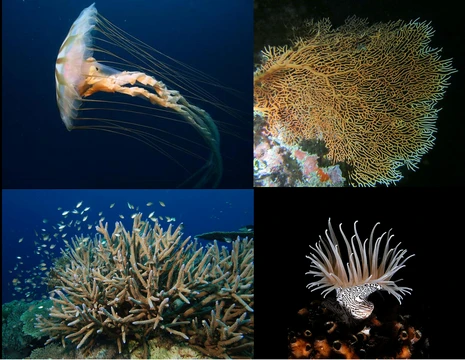
Anthozoa
Flower-like marine animals that build and enhance reef systems.
The name "Anthozoa" means "flower animals," from Greek words for "flower" and "animals," referring to the floral appearance of their perennial polyp stage.[1] Sea anemones, stony corals, soft corals, and sea pens are examples of sessile invertebrates found in marine and brackish environments that belong to Anthozoa.[2]
Last updated 2026-10-07 from the source article.
Quick Facts
- Phylum
- Cnidaria
- Classes
- Hexacorallia
- Octocorallia
- Rugosa †
- Tabulata †
- Habitat
- Marine and brackish water
- Diversity
- Over 6,000 described species
Facts from the source article.
Key facts and history
Only marine and brackish water environments are inhabited by anthozoans.[3] Within the cnidarians, the Anthozoa taxon is the largest, containing more than six thousand described species that can be either solitary or colonial.[4] An anthozoan's fundamental structure is the polyp, which has a tubular column, an oral disc with a central mouth at the top, and a ring of tentacles around it.[5] Vertical partitions called mesenteries or septa divide the coelenteron.[5]
Prey that drifts into the range of their tentacles is caught by most anthozoans, which are opportunistic predators.[5] The ancestral Anthozoa is reconstructed as a solitary, bilaterally symmetrical polyp that lacked a skeleton and photosymbiosis, and existed during the Tonian period.[6]
What the cited sources add
The 2004 textbook "Invertebrate Zoology" describes that the body wall consists of an epidermal layer, a jellylike mesogloea layer, and an inner gastrodermis, with septa being infoldings of the body wall.[5][7] The 1985 volume "Advances in Marine Biology" states that a number of sea anemone species are commensal with other organisms.[8][9] That same source reports that certain crabs and hermit crabs seek out sea anemones and place them on their shells for protection.[8][9] According to the same source, the count and configuration of septa, along with the retractor muscles' arrangement, are key features for classifying anthozoans.[5][7]
References
- Wikipedia, "Anthozoa" (CC BY-SA 4.0), which cites: "Anthozoa: Etymology", Fine Dictionary (original not read by us) en.wikipedia.org
- Wikipedia, "Anthozoa" (CC BY-SA 4.0), which cites: Hoeksema, Bert, "Anthozoa. Ehrenberg, 1834", 2024-02-29; WoRMS, "Cnidaria", 2025 (original not read by us) en.wikipedia.org
- Wikipedia, "Anthozoa" (CC BY-SA 4.0), which cites: Hoeksema, Bert, "Anthozoa. Ehrenberg, 1834", 2024-02-29 (original not read by us) en.wikipedia.org
- Wikipedia, "Anthozoa" (CC BY-SA 4.0), which cites: Ruppert, "Invertebrate Zoology", Cengage Learning, 2004, p. 112–148; Crowther, "Class Anthozoa Ehrenberg, 1834. In: Zhang, Z.-Q. (Ed.) Animal biodiversity: An outline of higher-level classification and survey of taxonomic richness", Zootaxa, 2011, p. 19–23; "Diseases of Coral", John Wiley & Sons, 2016, p. 416 (we also read that source) en.wikipedia.org
- Wikipedia, "Anthozoa" (CC BY-SA 4.0), which cites: Ruppert, "Invertebrate Zoology", Cengage Learning, 2004, p. 112–148 (we also read that source) en.wikipedia.org
- Wikipedia, "Anthozoa" (CC BY-SA 4.0), which cites: McFadden, "Phylogenomics, Origin, and Diversification of Anthozoans (Phylum Cnidaria)", Systematic Biology, 2021, p. 635–647 (original not read by us) en.wikipedia.org
- Open Library record, ISBN 9788131501047 ("Invertebrate Zoology"). CC0 (metadata); book content not read. openlibrary.org
- Wikipedia, "Anthozoa" (CC BY-SA 4.0), which cites: Van-Praët, M., "Advances in Marine Biology", Academic Press, 1985, p. 92–93 (we also read that source) en.wikipedia.org
- Open Library record, ISBN 9780080579450 ("Advances in Marine Biology"). CC0 (metadata); book content not read. openlibrary.org
Each numbered sentence above was checked against the source it cites before publication. Sentences citing Wikipedia adapt text from the English Wikipedia article Anthozoa (contributors), used under CC BY-SA 4.0; this entry is available under the same licence. Other sources were used for facts only; no text or images are copied from them.
More in Cnidarians
Spotted an error? Know more?
Reader corrections go straight into our review queue. Suggest an edit · How this site is sourced