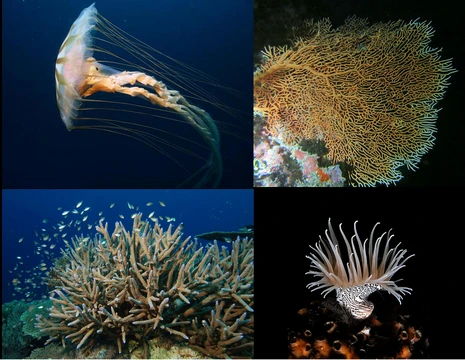
Hydrozoa
Small predatory cnidarians, often colonial, with complex life cycles.

Auckland Museum Collections from Auckland, Aotearoa New Zealand · CC BY 2.0
Hydrozoa, or hydroids, are a class of tiny, predatory animals within the phylum Cnidaria, making them relatives of jellyfish and corals. Most live in saltwater, though a few genera are found in freshwater. They can be solitary or colonial; in colonial species, the colony may grow large, and some specialized individuals cannot survive apart from it. Examples include the freshwater jelly (Craspedacusta sowerbii), freshwater polyps (Hydra), Obelia, the Portuguese man o' war (Physalia physalis), chondrophores (Porpitidae), and pink-hearted hydroids (Tubularia).
**Anatomy** Most hydrozoans have both a polyp and a medusa stage in their life cycle, but some species skip one or the other. For instance, Hydra lacks a medusa stage, while Liriope has no polyp stage.
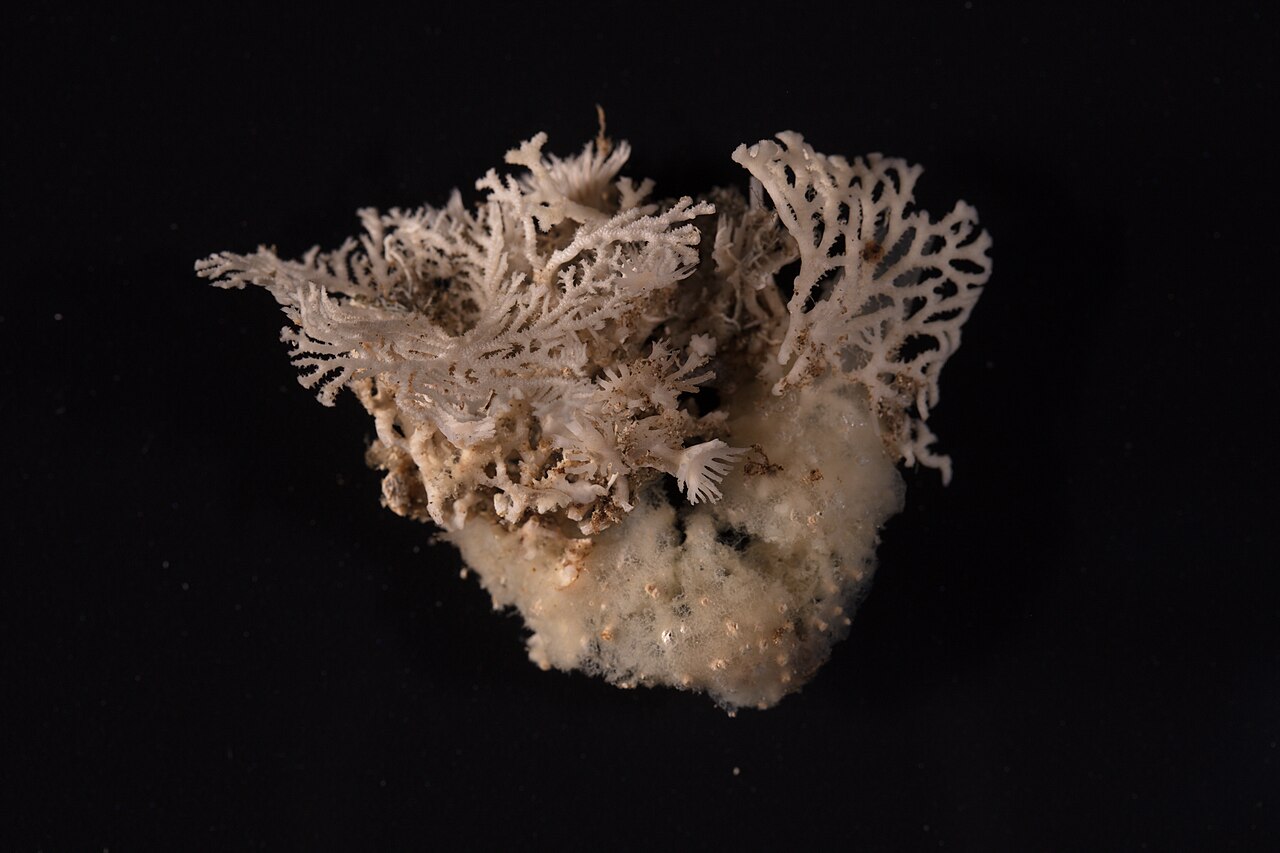
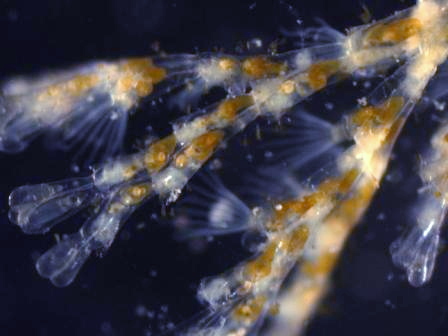
**Polyps** The polyp form, called a hydroid, is usually colonial. Multiple polyps connect through tube-like hydrocauli, and the hollow cavity inside each polyp extends into the hydrocaulus, linking all colony members intimately. Where the hydrocaulus runs along the seafloor, it forms a root-like stolon that anchors the colony. Colonies are typically small—a few centimeters across—but some in the group Siphonophorae reach several meters. They may look tree-like or fan-like. Polyps themselves are tiny, though a few noncolonial species grow to 6–9 cm, and the deep-sea *Branchiocerianthus* can reach 2 m. A sheath of chitin and proteins called the perisarc often surrounds the hydrocaulus; in some species, it extends upward to enclose part of the polyp, sometimes with a closable lid. Most polyps in a colony are feeding specialists. They have a cylindrical body with a mouth on a raised hypostome, surrounded by tentacles. Digestion begins in the polyp’s central cavity, and partially digested food can pass into the hydrocaulus for distribution. Unlike some cnidarians, the central cavity lining lacks stinging nematocysts—those are only on tentacles and outer surfaces. All colonial hydrozoans also have reproductive polyps, which lack tentacles and produce buds that give rise to the medusa stage. The arrangement of these polyps varies widely. A few species have additional specialized polyps: defensive ones armed with stinging cells, or a single polyp that becomes a float, allowing the colony to drift rather than anchor.
**Medusae** Hydrozoan medusae are smaller than typical jellyfish, measuring 0.5 to 6 cm across. Though most hydrozoans have a medusa stage, it is not always free-living; in many species, it exists only as a bud on the hydroid colony. In some cases, these buds are so reduced they lack tentacles and mouths, essentially just a gonad. The medusa body is a dome-like umbrella ringed by tentacles, with a tube-like structure hanging down that ends in a mouth. Most have only four tentacles, though exceptions exist. Stinging cells appear on the tentacles and around the mouth. The mouth leads to a central stomach, and four radial canals connect it to a circular canal around the bell’s base, just above the tentacles. Striated muscle fibers line the bell rim, enabling movement by contracting and relaxing. A shelf of tissue inside the rim narrows the bell’s opening, strengthening the water jet expelled. The nervous system is advanced for cnidarians: two nerve rings near the bell margin send fibers to muscles and tentacles. The genus *Sarsia* even has organized ganglia. Sense organs, including statocysts and primitive light-sensitive ocelli, are closely linked to these nerve rings.
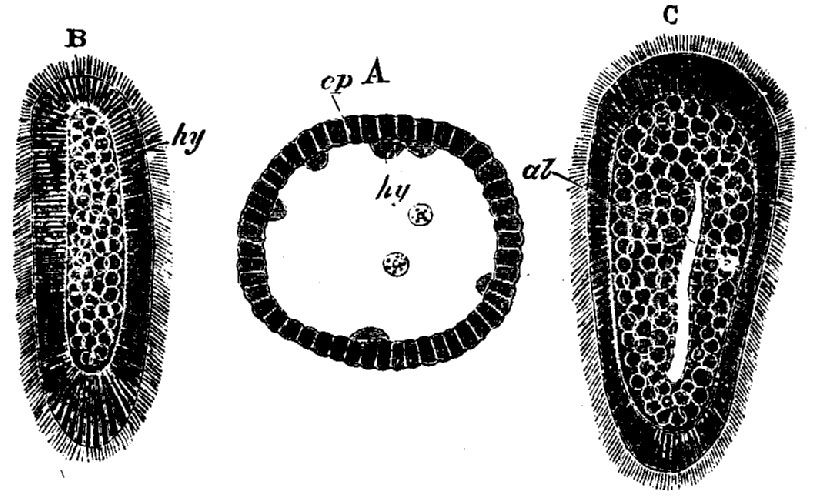
**Life Cycle** Hydroid colonies are usually dioecious—each colony has either all male or all female polyps. In some species, reproductive polyps (gonozooids or gonothecae) bud off asexually produced medusae. These tiny medusae mature and spawn, releasing gametes into the sea. Zygotes become free-swimming planula or actinula larvae. Planulae settle on a suitable surface, while actinulae may swim and develop directly into another medusa or polyp. Colonial hydrozoans include siphonophores, *Hydractinia*, *Obelia*, and many others. In species with both polyp and medusa generations, the medusa is the sexually reproductive phase; these medusae are called hydromedusae. Most hydromedusae have shorter lifespans than larger scyphozoan jellyfish. Some release gametes soon after detaching from the colony.
- field
- Taxonomic class of predatory animals
- known_for
- Small size, colonial forms, and life cycles including both polypoid and medusoid stages
- habitat
- Mostly saline water; a few genera live in freshwater
- examples
- Freshwater jelly (Craspedacusta sowerbii), Hydra, Obelia, Portuguese man o' war (Physalia physalis), chondrophores (Porpitidae), pink-hearted hydroids (Tubularia)
Lore & Background
Most hydrozoan species include both a polypoid and a medusoid stage in their life cycles, although a number have only one or the other. For example, Hydra has no medusoid stage, while Liriope lacks the polypoid stage. The hydroid form is usually colonial, with multiple polyps connected by tubelike hydrocauli. The hollow cavity in the middle of the polyp extends into the associated hydrocaulus, so that all individuals of the colony are intimately connected. Colonies are generally small, no more than a few centimeters across, but some in Siphonophorae can reach sizes of several meters. Polyps themselves are usually tiny, though some noncolonial species reach 6 to 9 cm, and the deep-sea Branchiocerianthus can reach 2 m. The medusae of hydrozoans are smaller than those of typical jellyfish, ranging from 0.5 to 6 cm in diameter. Although most hydrozoans have a medusoid stage, this is not always free-living; in many species it exists solely as a sexually reproducing bud on the surface of the hydroid colony. The nervous system is unusually advanced for cnidarians, with two nerve rings and, in the genus Sarsia, organized ganglia. Hydroid colonies are usually dioecious, with polyps in each colony being either all male or all female. Some hydrozoan species, particularly in the genus Turritopsis, have an unusual life cycle—they can transform from their sexually mature medusa stage back to their juvenile polyp stage.
Reader's Guide
Hydrozoans are significant as a diverse class within Cnidaria, illustrating a wide range of colonial organization and life-cycle strategies. Their study has contributed to understanding of animal development, regeneration, and the evolution of complex life cycles. The ability of some species, such as those in Turritopsis, to reverse their life cycle has drawn particular scientific interest. Hydrozoan systematics are highly complex and have been heavily contested since the late 19th century, though a consensus is emerging. Historically divided into orders like 'Hydroida', these groups are now tentatively split into two subclasses: Leptolinae and Trachylinae. Their legacy includes serving as model organisms in developmental biology and providing insights into the ecology of marine and freshwater environments. The presence of specialized polyps for feeding, reproduction, and defense in colonies highlights the evolutionary innovation within the group.
Did You Know?
- Some hydrozoan species, such as those in the genus Turritopsis, can transform from their sexually mature medusa stage back to their juvenile polyp stage.
- The deep-sea hydrozoan Branchiocerianthus can reach a remarkable 2 m (6.6 ft) in size.
- Hydrozoan medusae are smaller than typical jellyfish, ranging from 0.5 to 6 cm in diameter.
- The nervous system of hydrozoans is unusually advanced for cnidarians, with organized ganglia reported in the genus Sarsia.
Diversity Across Habitats
Hydrozoa stands out among the four principal cnidarian classes as the one spanning the broadest range of aquatic environments. While other groups such as Anthozoa are confined largely to warm, shallow marine waters, hydrozoans claim every freshwater habitat on Earth and also populate marine settings from polar seas to great oceanic depths. This class encompasses both solitary, sessile organisms like Hydra, which anchor themselves to substrates, and spectacular colonial swimmers such as the Portuguese man o' war, which drift through open water as a single functional unit composed of many specialized individuals. Within the broader phylum of over eleven thousand cnidarian species, hydrozoans represent the most morphologically and ecologically varied assemblage, bridging the gap between the simplest freshwater forms and complex marine colonial structures. Their presence in both fresh and salt water, in both attached and free-living lifestyles, makes them arguably the most ecologically versatile of the cnidarian classes.
Two Lives, One Organism
Many hydrozoan species live a dual existence, cycling between a stationary polyp stage and a free-swimming medusa stage within a single generation. The polyp form is typically tube-shaped with a thin, soft layer of mesoglea between its two cell layers, while the medusa form possesses a thick, springy mesoglea that snaps back into shape after muscular contractions at its margins expel water in a jet-propulsion burst. Both forms are radially symmetrical, with tentacles bearing stinging cells arranged around a single oral opening. In colonial hydroids the picture grows even more intricate: a single organism may be composed of numerous zooids, each dedicated to a specific role—some built for defence, others for reproduction, still others optimized for capturing prey. This trimorphic flexibility, where one colony can house both polyp-like and medusa-like units simultaneously, gives hydrozoan colonies a functional complexity that belies their individual simplicity.
The Stinging Cell and the Single Opening
What sets cnidarians apart from every other animal on Earth is the cnidocyte, a specialized cell that fires a harpoon-like organelle primarily to subdue prey, though in some species it doubles as an anchor. Hydrozoans, like all cnidarians, carry these stinging cells along the fringes of their tentacles, and their decentralized nerve net, spread throughout a gelatinous body, coordinates the strike without any central brain. Digestion and respiration share a single body cavity with one opening that serves as both mouth and exit for waste, a design that distinguishes them from the three-layered, two-opening bilaterians. Prey ranges from tiny plankton to creatures several times the animal's own size, and many species supplement their diet through symbiotic dinoflagellates living within their tissues. A few hydrozoan lineages have even evolved into parasitic forms, though the highly derived parasitic classes Myxozoa and Polypodiozoa were only firmly confirmed as cnidarians in 2007.
Ancient Lineage and Shifting Classification
The cnidarian phylum, of which Hydrozoa is a part, is extraordinarily old. Fossils embedded in Ediacaran-period rocks date back roughly 580 million years, and molecular clock analyses of mitochondrial genes push the origin of the crown group to approximately 741 million years ago, nearly two hundred million years before the Cambrian Explosion and well before any known fossil record. Phylogenetic studies consistently place cnidarians as the sister group to bilaterians, the clade that contains nearly all other animals. Taxonomically, hydrozoans have not always occupied their current position. Cnidarians were once lumped together with comb jellies under the umbrella name Coelenterata, but growing recognition of fundamental differences between the two groups led to their separation into distinct phyla. Within Cnidaria, hydrozoans sit alongside Anthozoa, Scyphozoa, and Cubozoa as one of four major classes, with the newly elevated Staurozoa and the parasitic Myxozoa and Polypodiozoa adding further depth to the family tree.
Gallery
Frequently Asked Questions
Who is Hydrozoa?
Hydrozoa is a taxonomic class of small, predatory cnidarians that includes both solitary and colonial organisms. They sit alongside jellyfish and corals as close relatives within the phylum Cnidaria.
What are Hydrozoa's signature abilities?
Hydrozoans are defined by their tiny body size and a life cycle that alternates between polypoid and medusoid stages. In colonial species, specialized individuals are so dependent on the group that they simply cannot survive on their own.
Where does Hydrozoa operate?
The overwhelming majority of Hydrozoa thrive in saline (saltwater) environments, though a small number of genera have adapted to freshwater. Their colonial forms can grow into impressively large structures within those aquatic habitats.
Who are Hydrozoa's most recognizable members?
Fans often point to the freshwater jelly Craspedacusta sowerbii, the solitary Hydra, the colonial Obelia, and the Portuguese man o' war (Physalia physalis). Chondrophores (Porpitidae) and the pink-hearted hydroids (Tubularia) round out the well-known roster.
Why is Hydrozoa important to the Cnidaria roster?
Hydrozoa showcases the full spectrum of cnidarian life strategies, from lone freshwater polyps to vast marine colonies with distinct specialized castes. Their dual polyp-and-medusa cycle makes them essential for understanding how cnidarian biology and evolution work.
More in Cnidarians 1-18
Spotted an error? Know more?
This is a living reference — every entry is fact-audited, and reader corrections feed straight into our audit queue. Suggest an edit · See this site's audit record