Hilary Wayment
British author and historian of stained glass.
Last updated
Hilary Godwin Wayment OBE, FSA (23 April 1912 – 20 March 2005) was a British author and historian of stained glass. He is best known for his systematic study of the 16th-century windows in King's College Chapel, Cambridge, which he conducted from 1968 to 1969 while the chapel was scaffolded for cleaning. His resulting folio volume, The Windows of King's College Chapel, Cambridge (1972), became a standard for the Corpus Vitrearum Medii Aevi project. Wayment also served with the British Council in multiple countries, and his periods of residence furthered his research on 16th-century glass.
Early life
Wayment was born in Woolwich, London on 23 April 1912, the son of Alfred Wayment, headmaster of the local church school. His godfather, Eric Milner-White, a curate at St Mary Magdalen Woolwich who later became Dean of King's College, Cambridge from 1918 to 1941, strongly influenced his lifelong study of stained glass, particularly the windows of King's College. He was educated at Charterhouse School, then from 1931 to 1935 at King's College, Cambridge, where he took a first in Part I of the Classical Tripos before reading English for Part II, and was a chorister.
At King's he formed a lifelong friendship with Oliver Churchill, and their paths crossed during World War 2 in Cairo, where Wayment was working from 1937 to 1944 and Churchill was posted to SOE Headquarters, Middle East from 1942 to 1945. Wayment was godfather to Churchill's eldest son, Toby. In 1952 he married Lilah Sykes (née Dixon) and had a son and a daughter.
Career
From 1937 to 1944, Wayment served as Assistant Lecturer and then Lecturer in English at Fuad I University in Cairo, Egypt. During this period he published a collection of poems and stories, Egypt Now: a miscellany (1943), translated Henry Habib Ayrout's Moeurs et coutumes des fellahs as The Fellaheen (1945), and translated Taha Hussein's autobiography The Stream of Days: a student at the Azhar (1943). In 1944 he returned to England and joined the British Council, serving in London, then Cambridge from 1948 to 1952, in Brussels from 1952 to 1954, as Director of the British Institute in Paris from 1954 to 1959, in Amsterdam from 1963 to 1968, and in Turkey from 1970 to 1973.
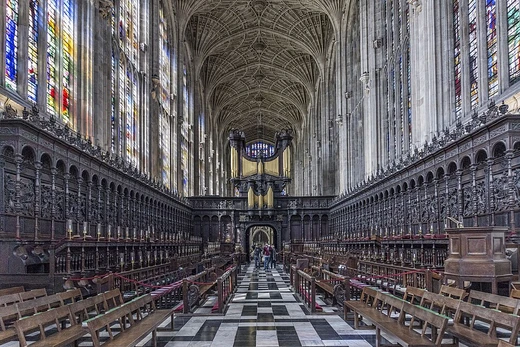
These postings furthered his research on 16th-century glass. In 1967 King's College Chapel underwent an extensive cleaning operation for which scaffolding was erected. From 1968 to 1969, Wayment took sabbatical leave from his British Council post and was elected a Fellow of King's College, Cambridge to systematically study and photograph the chapel's stained glass cycle according to the precise standards of the Corpus Vitrearum Medii Aevi project.
His folio volume The Windows of King's College Chapel, Cambridge (1972) became a standard for the Great Britain CVMA volumes. After retiring from the British Council he was elected a Fellow of Wolfson College, Cambridge from 1973 to 1977 to study the windows of St Mary's Church, Fairford, and wrote The Stained Glass of the Church of St Mary, Fairford, Gloucestershire (1984). Four years later he wrote King's College Chapel Cambridge: The Side-chapel Glass. He died in Cambridge on 20 March 2005, aged 92.
More in Choristers of the Choir of King's College, Cambridge
Test yourself
Three questions drawn from this entry’s sources. Pick an answer to check it.
Answers checked against the source article
Sources
Compiled from Wikipedia and the sources listed below. Text from Wikipedia is available under CC BY-SA 4.0; this entry is adapted from it.
- Wikipedia: Hilary Wayment (CC BY-SA 4.0).
Spotted an error? Know more?
Reader corrections go straight into our review queue. Suggest an edit · How this site is sourced