Orlando Gibbons
English composer and organist of the late Renaissance and early Baroque.
Last updated

via Wikipedia: Orlando Gibbons · see source
Orlando Gibbons was an English composer and keyboard player, one of the last masters of the English Virginalist School and English Madrigal School. By the 1610s he was the leading composer and organist in England, with a career cut short by his untimely death in 1625. Musicologists characterize his music as exemplifying the transition from the Renaissance to the Baroque periods.
Life and career
Orlando Gibbons was born in Oxford, though for centuries it was believed he was born in Cambridge. This error was recorded on his memorial in Canterbury Cathedral and may have been accepted by Gibbons himself, as he spent most of his life in Cambridge. The Gibbons family can be traced to Richard Gibbons, a glover in Oxford.
Orlando was probably the seventh of nine surviving children of William and Mary. No record of his birth date survives, but he was baptised on Christmas Day 1583, likely within a week of birth. Around 1588, when Orlando was four or five, the family moved back to Cambridge, where William resumed his post as head of the town waits.
Character
Little is known about Gibbons's personality. The period between his time in the Choir of King's and his appointment at the Chapel Royal (1599–1603) is one of the largest gaps in modern understanding of him. Compared to contemporaries like Byrd and Bull, his life appears uneventful. Byrd faced court disputes over property and accusations of Catholicism, while Bull fled the country on adultery charges.
One incident described as the most bizarre of Gibbons's career occurred in 1620, when Henry Eveseed, a yeoman of the vestry, assaulted him, throwing him onto a standard and tearing his band from his neck. Otherwise, Gibbons's life suggests he maintained good relations with employers and fellow musicians. His patron Sir Christopher Hatton became a close friend, and Hatton and his wife were probably the namesakes of Gibbons's two children. Other close acquaintances included Wray, his father-in-law John Patten, and his older brother Edward.
Gibbons may have had a particularly close relationship with Prince Charles; the formal investigation into his death perhaps indicates how close he was to the new king. His career centred on court, and his early appointments at the Chapel Royal at ages 19 and 21 were impressive. Contemporary accounts praised his keyboard skill: John Hacket called him 'the best finger of that age', and John Chamberlain said he had 'the best hand in England'.
Music
Gibbons's oeuvre suggests he was comfortable in established genres and rarely ventured into unexplored ones. He wrote many keyboard works, around thirty fantasias for viols, several madrigals (notably 'The Silver Swan'), and numerous verse anthems, including 'Great Lord of Lords' and 'This is the Record of John', which sets an Advent text for solo countertenor or tenor alternating with full chorus. He produced two major Evensong settings: the Short Service and the Second Service.
His full anthems include 'O Lord, in thy wrath' and the eight-voice 'O clap your hands together'. His surviving keyboard output comprises about 45 pieces, with polyphonic fantasias and dance forms best represented. His writing shows command of three- and four-part counterpoint, and his fantasias are complex, multi-sectional works treating multiple subjects imitatively. His melodies feature extensive development of simple ideas, as in the Pavane in D minor and Lord Salisbury's Pavan and Galliard.
Legacy
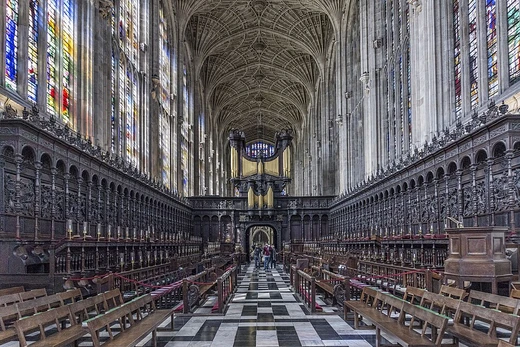
In the 20th century, Canadian pianist Glenn Gould championed Gibbons's music, naming him his favourite composer. Gould wrote that Gibbons's hymns and anthems moved him more deeply than any other sound experience. Gibbons's death on 5 June 1625 is regularly marked in King's College Chapel by the singing of his music at Evensong. Several of his anthems appear in the Oxford Book of Tudor Anthems.
Gibbons paved the way for future English composers by perfecting Byrd's foundations of the English madrigal and anthems, and by teaching his son Christopher, who taught John Blow, Pelham Humfrey, and Henry Purcell. Critic John Rockwell said Gibbons's oeuvre attests to a composer who can still speak directly to the present. English actor Orlando Bloom was named after Gibbons.
Did You Know?
- Gibbons was baptised at St Martin's Church, Oxford on Christmas Day 1583, and was likely born no more than a week before that.
- At age 12, on 14 February 1596, Gibbons became a member of the Choir of King's College, Cambridge, and later enrolled as a sizar at King's College.
- Gibbons was appointed a Gentleman Extraordinary of the Chapel Royal by at least 19 May 1603, and secured the full position of Gentleman and junior organist on 21 March 1605.
More in Choristers of the Choir of King's College, Cambridge
Sources
Compiled from Wikipedia and the sources listed below. Text from Wikipedia is available under CC BY-SA 4.0; this entry is adapted from it.
- Wikipedia: Orlando Gibbons (CC BY-SA 4.0).
Spotted an error? Know more?
Reader corrections go straight into our review queue. Suggest an edit · How this site is sourced