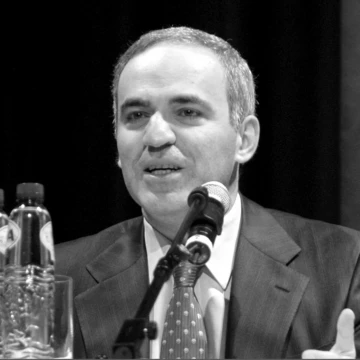
Garry Kasparov
World chess champion, political activist, and writer.

via Wikipedia: Garry Kasparov · see source
Garry Kimovich Kasparov was born Garik Kimovich Weinstein on 13 April 1963 in Baku, Azerbaijan SSR. He is a Russian chess grandmaster, political activist, and writer. Kasparov held the World Chess Championship title from 1985 until 2000. His peak FIDE rating of 2851, set in 1999, stood as the highest ever until Magnus Carlsen surpassed it in 2013. From 1984 until his retirement from regular competitive chess in 2005, he occupied the world No. 1 spot for a record total of 255 months. He also holds the records for the most consecutive professional tournament victories (15) and the most Chess Oscars (11).
At age 22, Kasparov became the youngest undisputed world champion by defeating Anatoly Karpov in 1985, a record that lasted until 2024. He successfully defended the title against Karpov in 1986, 1987, and 1990. He held the official FIDE world title until 1993, when a dispute led him to form the rival Professional Chess Association. In 1997, he became the first world champion to lose a match to a computer under standard time controls, falling to IBM’s Deep Blue in a widely publicized event. He retained the "Classical" world title until Vladimir Kramnik defeated him in 2000. Even after losing the PCA title, Kasparov continued winning tournaments and remained the world’s highest-rated player at his official retirement. He coached Magnus Carlsen in 2009–2010, during which Carlsen rose to world No. 1. Kasparov ran unsuccessfully for FIDE president in 2013–2014.
After retiring from chess, Kasparov focused on writing and politics. His book series *My Great Predecessors*, first published in 2003, covers the history and games of earlier world champions. He founded the United Civil Front movement and was a member of The Other Russia, a coalition opposing Vladimir Putin’s administration. In 2008, he announced his candidacy for the Russian presidency but withdrew after logistical problems he blamed on official obstruction. Following the Russian mass protests that began in 2011, he left Russia in June 2013, citing fear of persecution. He then lived in New York City with his family. In 2014, he obtained Croatian citizenship and maintains a residence in Podstrana near Split. Russia designated him a "foreign agent" in 2022.
Kasparov served as chairman of the Human Rights Foundation from 2011 to 2024. In 2017, he founded the Renew Democracy Initiative (RDI), an American political organization promoting liberal democracy in the U.S. and abroad, and serves as its chairman.
**Early life**
Kasparov was born Garik Kimovich Weinstein in Baku, Azerbaijan SSR. His father, Kim Moiseyevich Weinstein, was Jewish; his mother, Klara Shagenovna Kasparova, was Armenian. Both of his maternal grandparents were Armenians from Karabakh. Kasparov has said he was named after U.S. President Harry S. Truman, whom his father admired for opposing communism. He describes himself as a "self-appointed Christian" who is "very indifferent" and identifies as Russian, stating, "Although I'm half-Armenian, half-Jewish, I consider myself Russian because Russian is my native tongue, and I grew up with Russian culture." His father died of leukemia when Kasparov was seven. At age twelve, at his mother’s request and with family consent, he adopted her surname, Kasparov. In January 1990, Kasparov and his family fled anti-Armenian pogroms in Baku.
**Introduction to chess**
Kasparov began studying chess seriously after encountering a problem his parents had set and proposing a solution. From age seven, he attended the Young Pioneer Palace in Baku. At ten, he started training at Mikhail Botvinnik’s chess school under coach Vladimir Makogonov. When Kasparov was 11, Botvinnik wrote, "The future of chess lies in the hands of this young man." Makogonov developed Kasparov’s positional skills and taught him the Caro–Kann Defence and the Tartakower System of the Queen’s Gambit Declined. At age 13, Kasparov won the Soviet Junior Championship in Tbilisi with a score of 7/9. He repeated this victory the following year, scoring 8.5/9. During this period, he was coached by Alexander Shakarov.
**Chess career**
**Rising up the ranks**
In early 1978, Kasparov received a special invitation to the Sokolsky Memorial tournament in Minsk, normally restricted to established masters and local players, and took first place. He later said this victory made him believe he had a "very good shot" at the world championship. At age 15 in 1978, he became the youngest-ever player to qualify for the USSR Chess Championship, doing so by winning a 64-player Swiss system tournament in Daugavpils. He scored 8.5/17 in that championship. His first international tournament was in Banja Luka, Yugoslavia, in April 1979, while he was still unrated. He won the high-class event by 2 points, earning a provisional rating of 2545, which ranked him equal 40th in the world. In 1980, he won the World Junior Chess Championship in Dortmund, West Germany. Later that year, he debuted as the second reserve for the Soviet Union at the Chess Olympiad in Valletta, Malta, and became a Grandmaster. His world ranking rose quickly: equal 15th in January 1980, sixth in January 1981, equal fourth in July 1981, fourth in January 1982, and second behind Karpov in July 1982. As a teenager, Kasparov shared the USSR Chess Championship in 1981 with Lev Polugaevsky.
- born
- 13 April 1963
- field
- Chess grandmaster, political activist, writer
- nationality
- Russian (also holds Croatian citizenship)
- known_for
- World Chess Champion 1985–2000; highest FIDE rating of 2851 in 1999; first world
Verified Timeline
Lore & Background
Kasparov was born in Baku, Azerbaijan SSR, to a Jewish father and Armenian mother. After his father died of leukemia when he was seven, he adopted his mother's surname Kasparov at age twelve. He began serious chess study at age seven, trained at Mikhail Botvinnik's chess school, and won the Soviet Junior Championship at age 13. He became the youngest undisputed world champion in 1985 at age 22 by defeating Anatoly Karpov, a record he held until 2024. He defended the title against Karpov three times (1986, 1987, 1990) and held the official FIDE world title until 1993, when a dispute led him to form the Professional Chess Association. He lost the Classical world title to Vladimir Kramnik in 2000 and retired from regular competitive chess in 2005.
Reader's Guide
Kasparov's significance extends beyond his chess achievements. He held the world No. 1 ranking for a record 255 months and achieved a peak FIDE rating of 2851 in 1999, the highest until surpassed by Magnus Carlsen in 2013. His 1997 loss to IBM's Deep Blue marked a milestone in human-computer interaction. After retiring, he became a prominent political activist, forming the United Civil Front and opposing Vladimir Putin's administration. He fled Russia in 2013 fearing persecution, later obtaining Croatian citizenship. He chaired the Human Rights Foundation from 2011 to 2024 and founded the Renew Democracy Initiative in 2017. His book series My Great Predecessors (2003) chronicles earlier world champions. Russia designated him a 'foreign agent' in 2022.
Did You Know?
- Kasparov was named after U.S. President Harry S. Truman, whom his father admired for taking a strong stand against communism.
- He became the youngest undisputed world champion in 1985 at age 22, a record he held until 2024.
- Kasparov coached Magnus Carlsen in 2009–2010, during which time Carlsen rose to world No. 1.
- He obtained Croatian citizenship in 2014 and has maintained a residence in Podstrana near Split.
- Russia designated Kasparov as a 'foreign agent' in 2022.
Origins and the Long Road to Relaunch
In 1999, Garry Kasparov partnered with Israeli investors to create a commercial online chess club branded as Kasparov Chess Online. The platform officially went live in January 2000, and to mark the occasion, Kasparov conducted a simultaneous exhibition game against roughly thirty junior players from various parts of the globe, many of whom connected through his own server. Later that same year, the site hosted a dedicated tournament for young players.
Financing and the Freemium Model
The platform operates on a freemium model: a tier of basic chess content is accessible at no cost, while a premium subscription unlocks the full library of materials. This dual-structure approach is designed to lower the barrier to entry for casual players while generating recurring revenue from dedicated enthusiasts. The involvement of a major European media group signals that Kasparov Chess was conceived not merely as a hobbyist forum but as a serious commercial enterprise competing in the broader digital entertainment and education markets.
Content Library and Kasparov's Educational Vision
The platform's offerings span chess puzzles, live online play, structured tutorials, written articles, documentaries, podcasts, and a dedicated master class personally taught by Kasparov himself. Some of these features are reserved exclusively for premium subscribers, creating a tiered experience. Kasparov framed the project's mission in broader philosophical terms, emphasizing that chess extends far beyond strategy and tactics into a way of life and a lens for understanding the world. His stated goal was to welcome people who had never touched a chessboard before, believing the game could help them become everything they aspire to be. This positioning elevates the platform from a simple training tool to a cultural and personal-development brand anchored in the former World Champion's voice and perspective.
A Crowded Competitive Landscape
Kasparov Chess enters a crowded digital chess market where it must contend with both free and paid rivals. On the free end, platforms like Lichess and the Free Internet Chess Server offer unrestricted online play without any subscription fee, setting a baseline expectation that casual users may never need to pay. On the commercial side, established communities such as Chess.com, FIDE Online Arena, the Internet Chess Club, and Playchess all offer freemium subscriptions with similar structures of free basic access plus paid premium content. For Kasparov Chess to carve out a sustainable niche and achieve profitability, it must differentiate itself against these entrenched competitors. The platform's unique selling proposition lies in its direct association with Kasparov's name, his personal master class, and its curated educational library. Yet the sheer number of well-funded, well-known alternatives means that user acquisition and retention will be significant challenges in a market where switching costs are minimal.
Frequently Asked Questions
Who is Garry Kasparov?
Garry Kasparov is a Russian-born chess grandmaster, political activist, and author who held the world championship title for fifteen years starting in 1985. Born in 1963 under the name Garik Weinstein, he later became one of the most recognizable figures in both competitive chess and Russian opposition politics.
What are Garry Kasparov's powers/role?
Kasparov's defining strength was his extraordinary tactical and strategic mastery, which carried him to a record 255 months at the top of the world rankings. His peak FIDE rating of 2851 in 1999 remains one of the highest ever recorded, cementing his status as the dominant force of his era.
How does Garry Kasparov's story end?
His reign as world champion concluded in 2000, but his most iconic "ending" came in 1997 when he lost a match to IBM's Deep Blue supercomputer under standard time controls. After stepping away from competitive play, he redirected his energy into political activism opposing Vladimir Putin's government.
Why is Garry Kasparov important?
Kasparov is widely regarded as the most dominant world champion of the modern chess era, holding the title for a record fifteen consecutive years. Beyond the board, his high-profile defiance of the Putin administration made him a symbol of intellectual resistance in Russian politics.
What is Garry Kasparov's highest rating?
Kasparov reached a peak FIDE rating of 2851 in 1999, a figure that stood as the all-time record for many years. This number reflects the extraordinary consistency and level of play he maintained throughout his competitive career.
More in Chess Masters 1-17
Related in Chess Masters
Links follow this subject's own source article.
Spotted an error? Know more?
This is a living reference — every entry is fact-audited, and reader corrections feed straight into our audit queue. Suggest an edit · See this site's audit record