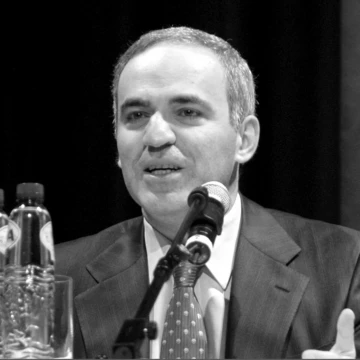
Mikhail Botvinnik
Sixth World Chess Champion and pioneer in computer chess.

via Wikipedia: Mikhail Botvinnik · see source
Mikhail Moiseyevich Botvinnik was a Soviet and Russian chess grandmaster who became the sixth World Chess Champion, winning the title five times across three separate reigns. Besides chess, he worked as an electrical engineer and computer scientist, and he was an early innovator in computer chess, an achievement that earned him an honorary degree in mathematics. He is widely regarded as the founding figure of the Soviet chess school and is respected for his methodical, analytical style.
Botvinnik was born on August 17, 1911, in Kuokkala, then part of Finland, now Repino in Saint Petersburg. His parents were Russian Jews: his father Moisei was a dental technician, and his mother Shifra (Serafima) was a dentist. Because of her profession, the family could live outside the Pale of Settlement, and Botvinnik grew up on Nevsky Prospect in Saint Petersburg. His father banned Yiddish at home, and Mikhail and his older brother Isaak attended Soviet schools. Botvinnik later described his nationality as complicated: Jewish by blood, Russian by culture, and Soviet by upbringing. He called himself an atheist.
In 1920, his mother fell ill and his father left the family, though he stayed in touch with the children even after remarrying a Russian woman. Around this time, Botvinnik began reading newspapers and became a committed communist. At age twelve, in autumn 1923, a school friend of his brother taught him chess with a homemade set, and he immediately loved the game. He finished mid-table in the school championship, then took advice from another of his brother’s friends, deciding it was better to think out concrete concepts and derive general principles from them—after which he easily beat that friend. In winter 1924, he won his school championship and exaggerated his age by three years to join the Petrograd Chess Assembly, whose president overlooked the deception. He won his first two tournaments there. Soon after, Nikolai Krylenko, a devoted chess player and leading Soviet legal figure, began building a nationwide chess organization, and the Assembly was replaced by a club in the Palace of Labour.
To test Soviet masters, Krylenko organized the Moscow 1925 chess tournament. On a rest day, world champion José Raúl Capablanca gave a simultaneous exhibition in Leningrad, and Botvinnik was chosen as an opponent and won. In 1926, he reached the final stage of the Leningrad championship and later played for Leningrad’s team in a match against Stockholm in Sweden, scoring one win and one draw against future grandmaster Gösta Stoltz. On returning, he entertained schoolmates with stories of the rough sea voyage. He was asked to annotate two games from the match, and knowing his analyses would be published made him aware of the need for objectivity. In December 1926, he became a candidate member of his school’s Komsomol branch. Around then, his mother worried about his poor physique, so he began a daily exercise routine he kept for most of his life.
When Botvinnik finished school, he was too young for university entrance exams. While waiting, he qualified for his first USSR Championship final in 1927 as the youngest player ever, tied for fifth and sixth, and earned the master title. He wanted to study electrical technology at the Leningrad Polytechnical Institute and passed the entrance exam, but the course had too many applicants and the Proletstud admissions body favored children of engineers and industrial workers. After a local chess official appealed, he was admitted in 1928 to Leningrad University’s Mathematics Department. In January 1929, he played for Leningrad in a student team chess championship against Moscow. Leningrad won, and the team manager, also deputy chairman of the Proletstud, arranged for Botvinnik to transfer to the Polytechnic’s Electromechanical Department, where he was one of only four students admitted straight from school. This forced him to complete a year’s work in five months, and he failed one exam. Earlier that year, he placed joint third in the USSR Championship semi-final and did not reach the final.
His early progress was fairly rapid, mostly under the training of Soviet Master and coach Abram Model in Leningrad. Model taught him the Winawer Variation of the French Defence, then considered inferior for Black, but Botvinnik analyzed it deeply and played it with great success. In 1930, he won the Leningrad Masters’ tournament with a score of 6½ out of 8.
- born
- August 17, 1911 (O.S. August 4) in Kuokkala, Vyborg Governorate, Grand Duchy of
- died
- May 5, 1995
- field
- Chess grandmaster, electrical engineer, computer scientist
- nationality
- Soviet and Russian
- known_for
- Sixth World Chess Champion; pioneer in computer chess; patriarch of the Soviet c
Verified Timeline
Lore & Background
Botvinnik was born on August 17, 1911, in Kuokkala, then part of the Grand Duchy of Finland, to Russian Jewish parents. His father, Moisei Botvinnik, was a dental technician; his mother, Shifra (Serafima) Rabinovich, was a dentist, which allowed the family to live outside the Pale of Settlement. He grew up in Saint Petersburg's Nevsky Prospect. His father forbade speaking Yiddish at home, and Mikhail attended Soviet schools. Botvinnik later said, 'I am a Jew by blood, a Russian by culture, Soviet by upbringing.' He called himself an atheist. In 1920, his mother became ill and his father left the family, but maintained contact. At about the same time, Botvinnik started reading newspapers and became a committed communist. In autumn 1923, at age twelve, he was taught chess by a school friend of his older brother using a home-made set, and instantly fell in love with the game. He won his school championship in winter 1924, then exaggerated his age by three years to join the Petrograd Chess Assembly. In 1925, on a rest day during the Moscow 1925 chess tournament, world champion José Raúl Capablanca gave a simultaneous exhibition in Leningrad; Botvinnik was selected as an opponent and won. In 1927, he qualified for his first USSR Championship final stage as the youngest player ever at that time, tied for fifth and sixth places, and gained the title of master. He graduated with a degree in electrical engineering in late summer 1931 from the Leningrad Polytechnical Institute. In 1935, he married Gayane Davidovna Ananova, of Armenian descent, a student at the Vaganova Academy of Russian Ballet and later a ballerina in the Bolshoi Theatre. They had one daughter, Olga, born in 1942.
Reader's Guide
Botvinnik was the first world-class player to develop within the Soviet Union and played a major role in the organization of chess, making a significant contribution to the design of the World Chess Championship system after World War II. He became a leading member of the coaching system that enabled the Soviet Union to dominate top-class chess during that time. His pupils include World Champions Anatoly Karpov, Garry Kasparov, and Vladimir Kramnik. He also worked as an electrical engineer and computer scientist and was a pioneer in computer chess, for which he was awarded an honorary mathematics degree. His early progress was fairly rapid, mostly under the training of Soviet Master and coach Abram Model in Leningrad; Model taught him the Winawer Variation of the French Defence, which Botvinnik analyzed more deeply and played with great success. Botvinnik won his first Soviet Championship in 1931 at age 20, scoring 13½ out of 17. He repeated the win in 1933 in Leningrad with 14/19. In 1934–35, he drew a match with Czech grandmaster Salo Flohr, then regarded as a credible contender for the world title. In Moscow's second International Tournament in 1935, Botvinnik placed first equal with Flohr, ½ point ahead of Emanuel Lasker and one point ahead of José Raúl Capablanca. In 1936, he finished second in a double round-robin tournament in Moscow, one point behind Capablanca and 2½ ahead of Flohr.
Did You Know?
- Botvinnik exaggerated his age by three years to join the Petrograd Chess Assembly in 1924, and its president turned a blind eye.
- He won his game against world champion José Raúl Capablanca during a simultaneous exhibition in Leningrad in 1925.
- In 1931, at age 20, he won his first Soviet Championship with a score of 13½ out of 17.
- Botvinnik's father forbade speaking Yiddish at home, and Mikhail later described himself as 'a Jew by blood, a Russian by culture, Soviet by upbringing.'
- He was awarded an honorary mathematics degree for his pioneering work in computer chess.
Frequently Asked Questions
Who is Mikhail Botvinnik?
Mikhail Moiseyevich Botvinnik (1911–1995) was a Soviet and Russian grandmaster who became the sixth person ever to hold the World Chess Championship. In the Chess Masters canon he is the central figure of entry 1-17 and is widely regarded as the founding patriarch of the Soviet chess school.
What are Mikhail Botvinnik's powers or signature abilities?
His defining strength is an almost mechanical depth of calculation and preparation, allowing him to outwork opponents in long, complex positions rather than relying on flash. Outside the board he also worked as an electrical engineer and computer scientist, earning an honorary mathematics degree for his pioneering research into computer chess.
How does Mikhail Botvinnik's story end?
Botvinnik died in Moscow on May 5, 1995, long after he had stepped back from active tournament play. His final years were spent continuing to influence chess theory and computer-chess development, cementing a legacy that outlived his competitive career by decades.
Why is Mikhail Botvinnik important in the Chess Masters canon?
He is the only champion in the series to hold the world title across three separate reigns (five crowns in total), a record that highlights his remarkable longevity at the summit. His systematic, scientific style became the template for the entire Soviet school, shaping virtually every grandmaster who followed in the timeline.
What makes Mikhail Botvinnik different from other Chess Masters?
Where many of his peers were celebrated for brilliant tactical combinations, Botvinnik built his reputation on exhaustive preparation and positional understanding, treating each game like an engineering problem to be solved. His dual identity as both a top-level world champion and a working computer scientist is unique across the entire series.
More in Chess Masters 1-17
Related in Chess Masters
Links follow this subject's own source article.
Spotted an error? Know more?
This is a living reference — every entry is fact-audited, and reader corrections feed straight into our audit queue. Suggest an edit · See this site's audit record