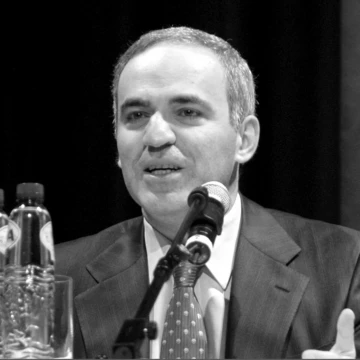
Mikhail Tal
Eighth World Chess Champion, known as 'The Magician from Riga'.

via Wikipedia: Mikhail Tal · see source
Mikhail Tal, a Soviet Latvian grandmaster born on 9 November 1936, became the eighth World Chess Champion and is remembered as a creative genius whose influence on the game remains immense. His style was aggressive and combinatorial, built on improvisation and a knack for the unexpected. As Vladislav Zubok put it, "Every game for him was as inimitable and invaluable as a poem." Known affectionately as "Misha," he also carried the nickname "The Magician from Riga." His games appear more frequently than any other player's in both *The Mammoth Book of the World's Greatest Chess Games* and *Modern Chess Brilliancies*.
Tal grew up in Riga, Latvia, in a Jewish family. According to his friend Gennadi Sosonko, his biological father was a family friend called "Uncle Robert," though Tal's third wife Angelina strongly denied this. Uncle Robert had driven a taxi in Paris during the 1920s and lost his entire family in World War II. Tal's mother, Ida Grigoryevna, was the eldest of four sisters; he often visited an aunt named Riva in the Netherlands, and another aunt settled in the United States but returned to Riga occasionally. As a child, Tal joined the chess club at the Riga Palace of Young Pioneers. At age 13, he faced the young master Ratmir Kholmov in a simultaneous exhibition and won with an imaginative combination.
Tal's first notable result came at the 1956 USSR Chess Championship, where he tied for 5th–7th place with Lev Polugaevsky and Ratmir Kholmov. Grigory Levenfish called him "the most colourful figure of the championship" and a "great talent" who aimed for "sharp and complicated play." The media, however, criticized him for unnecessary risks and limited creative views. He then played board three at the students' championship in Sweden, scoring 6 out of 7. In 1957, at age 20, he became the youngest winner of the USSR Chess Championship. Because he lacked enough international tournaments for the Grandmaster title, FIDE waived the usual requirements at its 1957 Congress and awarded it to him based on his Soviet Championship victory, which had come against many of the world's top players. Between 1956 and 1958, he played for the USSR at three Student Olympiads, winning three team gold medals and three board gold medals, with a record of 19 wins, 8 draws, and no losses (85.2 percent). He retained the Soviet title in 1958, then won the 1958 Interzonal in Portorož, and helped the Soviet Union secure its fourth consecutive victory at the 13th Chess Olympiad in Munich.
In 1959, Tal won a strong tournament in Zurich. At the Candidates' Tournament in Yugoslavia that same year, he finished first with 20 out of 28 points, ahead of Paul Keres (18½), Tigran Petrosian, Vasily Smyslov, Bobby Fischer, Svetozar Gligorić, Friðrik Ólafsson, and Pal Benko. His success came from dominating the lower half of the field: he scored only one win and three losses against Keres, but won all four individual games against Fischer, and took 3½ points out of 4 from each of Gligorić, Ólafsson, and Benko. When Benko arrived for his match wearing dark glasses to avoid Tal's intimidating gaze, Tal borrowed large sunglasses from a spectator and wore them as a joke. In 1960, at age 23, Tal defeated the strategically-minded Mikhail Botvinnik in a Moscow world championship match, 12½–8½ (six wins, two losses, thirteen draws), becoming the youngest world champion at the time—a record later surpassed by Garry Kasparov at 22 and then Gukesh Dommaraju at 18. Botvinnik, who had never faced Tal before, won the return match in 1961, also in Moscow, by 13–8 (ten wins to five, with six draws). In the interim, Botvinnik had thoroughly studied Tal's style and turned most games into slow positional battles or endgames, avoiding the tactical chaos Tal thrived on. Tal's chronic kidney problems contributed to his loss; his doctors in Riga advised postponing the match, but Yuri Averbakh claimed Botvinnik would only agree if Moscow doctors certified Tal unfit, so Tal chose to play. His brief reign made him one of the two "winter kings" who interrupted Botvinnik's long championship run from 1948 to 1963 (the other was Smyslov, champion 1957–58). Tal's highest Elo rating was 2705, achieved in 1980. According to Chessmetrics, he was world number one for 32 months, from October 1958 through April 1961.
Tal died on 28 June 1992 in Moscow, Russia. The Mikhail Tal Memorial chess tournament took place annually in Moscow from 2006 to 2014, with two additional events in 2016 and 2018. He also held the record for the longest unbeaten streak in competitive chess—95 games (46 wins, 49 draws) from 23 October 1973 to 16 October 1974—until Ding Liren surpassed it with 100 games (29 wins, 71 draws) between 9 August 2017 and 11 November 2018.
- born
- 9 November 1936, Riga, Latvia
- died
- 28 June 1992, Moscow, Russia
- field
- Chess
- nationality
- Soviet Latvian
- known_for
- World Chess Champion (1960); attacking and combinatorial play; record 95-game un
Verified Timeline
Lore & Background
Mikhail Tal was born in Riga, Latvia, into a Jewish family. According to his friend Gennadi Sosonko, his true father was a family friend identified only as "Uncle Robert"; however, this was vehemently denied by Tal's third wife Angelina. Uncle Robert had been a taxi driver in Paris in the 1920s and had lost all his family in World War II. As a child, Tal joined the Riga Palace of Young Pioneers chess club. In 1949, at age 13, he played Ratmir Kholmov in a simultaneous exhibition and used an imaginative combination to win. He made his first significant appearance at the 1956 USSR Chess Championship, sharing 5th–7th place. Grigory Levenfish called him "the most colourful figure of the championship" and a "great talent" who strove for "sharp and complicated play". Tal became the youngest player to win the 1957 USSR Chess Championship at age 20, and FIDE awarded him the Grandmaster title. He retained the title in 1958, then won the 1958 Interzonal at Portorož and helped the Soviet Union win the 13th Chess Olympiad in Munich.
Reader's Guide
Mikhail Tal's significance lies in his brief but brilliant reign as World Champion and his enduring influence on chess style. In 1960, at age 23, he defeated Mikhail Botvinnik 12½–8½ (six wins, two losses, thirteen draws) to become the youngest-ever World Champion, a record later broken by Garry Kasparov and Gukesh Dommaraju. Botvinnik won the return match in 1961 by 13–8 (ten wins to five, six draws), having analyzed Tal's style and turned games into slow wars of maneuver or endgames. Tal's chronic kidney problems contributed to his defeat; his doctors in Riga advised postponement, but Tal decided to play. He never again earned a world title match, but remained a formidable opponent. He won the 1961 Bled supertournament by one point over Fischer. He tied for first at the 1964 Amsterdam Interzonal and won the 1979 Riga Interzonal with an undefeated 14/17. He tied for first with Anatoly Karpov at the 1979 Montreal "Tournament of Stars", the only undefeated player. Tal played in 21 Soviet Championships, winning six times (1957, 1958, 1967, 1972, 1974, 1978). His two longest unbeaten streaks—86 games (47 wins, 39 draws) from July 1972 to April 1973, and 95 games (46 wins, 49 draws) from 23 October 1973 to 16 October 1974—stood for over four decades until Ding Liren's 100-game streak. At age 51, he won the second official World Blitz Championship in 1988 at Saint John, Canada, defeating Rafael Vaganian 3½–½ in the final. On 28 May 1992, at a Moscow blitz tournament he left the hospital to play, he defeated Kasparov. He died one month later. The Mikhail Tal Memorial tournament was held in Moscow annually between 2006 and 2014, with two more tournaments in 2016 and 2018.
Did You Know?
- Tal held the record for the longest unbeaten streak in competitive chess history with 95 games (46 wins, 49 draws) between 23 October 1973 and 16 October 1974, until Ding Liren's streak of 100 games.
- At age 13, Tal used an imaginative combination to win a game against master Ratmir Kholmov in a simultaneous exhibition.
- When Pal Benko arrived for his Candidates' match with Tal wearing dark glasses to avoid Tal's intimidating gaze, Tal borrowed large sunglasses from the crowd and wore them as a joke.
- Tal won the second official World Blitz Championship in 1988 at age 51, defeating reigning world champion Garry Kasparov and ex-champion Anatoly Karpov.
- On 28 May 1992, Tal left the hospital to play a Moscow blitz tournament and defeated Kasparov; he died one month later.
Frequently Asked Questions
Who is Mikhail Tal?
Mikhail Tal was a Soviet Latvian chess grandmaster from Riga who claimed the world title in 1960, becoming the eighth World Chess Champion. He earned the nickname 'The Magician from Riga' for his dazzling, unpredictable attacking play.
What made Mikhail Tal's playing style so distinctive?
Tal favored bold sacrifices and long tactical combinations over solid positional maneuvering, often improvising lines that no one had seen before. His willingness to take enormous risks made him nearly impossible to prepare against at the board.
What is Mikhail Tal's record unbeaten streak?
Tal posted a 95-game unbeaten run during his career, one of the most impressive consecutive results in the history of the game.
When and where did Mikhail Tal die?
Tal passed away on 28 June 1992 in Moscow, Russia, at the age of 55. He had been born on 9 November 1936 in Riga, Latvia.
Why is Mikhail Tal considered so important in chess history?
He is widely regarded as one of the most influential players ever, having redefined how the attacking and tactical side of chess could be exploited at the highest level. His creative genius left a lasting mark on how subsequent generations approach complex positions.
More in Chess Masters 1-17
Related in Chess Masters
Links follow this subject's own source article.
Spotted an error? Know more?
This is a living reference — every entry is fact-audited, and reader corrections feed straight into our audit queue. Suggest an edit · See this site's audit record