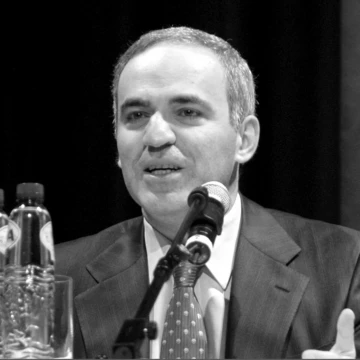
Viswanathan Anand
Indian chess grandmaster and five-time world champion.

via Wikipedia: Viswanathan Anand · see source
Viswanathan Anand, often called Vishy, was born on 11 December 1969 in Mayiladuthurai, Tamil Nadu, into a Tamil Hindu family. His father, Krishnamurthy Viswanathan, was a general manager for Southern Railways who had studied in Jamalpur, Bihar, and later moved the family to Chennai, where Anand grew up. His mother, Sushila, was a housewife, a chess enthusiast, and an influential socialite. Anand is the youngest of three children, with a brother, Shivakumar, who works as a manager at Crompton Greaves in India, and a sister, Anuradha, who is a professor at the University of Michigan. He learned chess at age six from his mother and sharpened his skills while living in Manila from 1978 to the early 1980s, where his father consulted for the Philippine National Railways. He attended Don Bosco Matriculation Higher Secondary School in Chennai and earned a Bachelor of Commerce degree from Loyola College, Chennai.
Anand’s early chess career took off quickly. At 14, in 1983, he won the sub-junior national championship with a perfect 9/9 score. The next year, he won the Asian Junior Championship in Coimbatore, earning his first International Master norm, and then scored 7½ points in 11 games at the 26th Chess Olympiad in Thessaloniki for his second IM norm. In 1985, at age 15, he became the youngest Indian to achieve the International Master title by winning the Asian Junior Championship again, this time in Hong Kong. At 16, he became national champion, a title he won two more times. In 1987, he became the first Indian to win the World Junior Chess Championship, and later that year, at 18, he became India’s first grandmaster by winning the Shakti Finance International tournament in Coimbatore, which included a notable victory over Russian grandmaster Efim Geller. He was awarded the Padma Shri at age 18.
In the 1993 World Championship cycle, Anand qualified for his first Candidates Tournament, winning his first match but narrowly losing his quarterfinal to former runner-up Anatoly Karpov. During 1994–95, he and Gata Kamsky dominated the qualifying cycles for both the FIDE and PCA world championships. In the FIDE cycle, Anand lost his semifinal match to Kamsky after leading early. In the 1995 PCA cycle, he defeated Oleg Romanishin and Michael Adams without a loss, then avenged his FIDE loss by beating Kamsky in the Candidates final. That year, he played the PCA World Championship against Garry Kasparov at the World Trade Center in New York City. After a record eight consecutive draws to open the match, Anand won game nine with a powerful exchange sacrifice, but then lost four of the next five games, losing the match 10½–7½.
In the 1998 FIDE cycle, FIDE controversially seeded reigning champion Karpov directly into the final, a decision that led Vladimir Kramnik to withdraw. Anand won the seven-round single-elimination Candidates tournament, defeating Adams in the final, and then faced Karpov. Despite describing himself as being "brought in a coffin" to play Karpov, the regular match ended 3–3, but Karpov won the rapid playoff 2–0 to retain the title.
Anand defeated Alexei Shirov in a six-game match to win the 2000 FIDE World Chess Championship, a title he held until 2002. He became the undisputed world champion by winning the 2007 World Championship tournament, then defended his title in matches against Vladimir Kramnik in 2008, Veselin Topalov in 2010, and Boris Gelfand in 2012. In 2013, he lost the title to Magnus Carlsen, and after winning the 2014 Candidates Tournament, he lost a rematch to Carlsen in 2014.
Known for his rapid playing speed as a child, Anand earned the nickname "Lightning Kid" in the 1980s. He won the FIDE World Rapid Chess Championship in 2003 and 2017, the Grenkeleasing Rapid World Championship 11 times, and the Amber chess tournament rapid event 9 times, leading many to consider him the greatest rapid chess player of all time. He also won the World Blitz Chess Cup in 2000, the Chess World Cup in 2000 and 2002, and numerous other top-level events. He won the Mainz Chess Classic, a Category 21 championship, a record 11 times.
Anand became the first grandmaster from India in 1988. In April 2006, he became the fourth player in history to pass the 2800 Elo mark on the FIDE rating list. He held the number-one position for 21 months, the sixth-longest period on record, and has the eighth-highest peak FIDE rating of all time. He was the first recipient of the Khel Ratna Award in 1991–92, India’s highest sporting honour. In 2007, he received the Padma Vibhushan, India’s second-highest civilian award, becoming the first sportsperson to do so. In August 2022, he was elected deputy president of FIDE, and became acting president after Arkady Dvorkovich was added to the international sanctions list against Russia in July 2026. Anand has played a significant role in popularizing chess in India.
- born
- 11 December 1969
- field
- Chess
- nationality
- Indian
- known_for
- Five-time World Chess Champion, first Indian grandmaster, rapid chess specialist
Verified Timeline
Lore & Background
Viswanathan Anand was born on 11 December 1969 in a Tamil Hindu family in Mayiladuthurai, Tamil Nadu, India. He learned to play chess at age six from his mother and further developed his skills while living in Manila from 1978 to the early 1980s. He was educated at Don Bosco Matriculation Higher Secondary School, Chennai, and holds a Bachelor of Commerce degree from Loyola College, Chennai. Anand earned the sobriquet 'Lightning Kid' during his early career in the 1980s due to his rapid playing speed. Anand defeated Alexei Shirov in a six-game match to win the 2000 FIDE World Chess Championship, a title he held until 2002. He became undisputed world champion in 2007 and defended his title against Vladimir Kramnik in 2008, Veselin Topalov in 2010, and Boris Gelfand in 2012. He lost the title to Magnus Carlsen in 2013 and lost a rematch to Carlsen in 2014 after winning the 2014 Candidates Tournament. In April 2006, he became the fourth player to pass the 2800 Elo mark, after Kramnik, Topalov, and Garry Kasparov. He occupied the number-one position for 21 months, the sixth-longest period on record. Anand married Aruna in 1996 and has a son born on 9 April 2011, named Anand Akhil. He is a Hindu who visits temples for tranquility and credits daily prayers with helping him achieve a 'heightened state of mind' that helps him focus better when playing chess. He joined the board of directors of Olympic Gold Quest in August 2010. His hobbies include reading, swimming, and listening to music. Anand has been regarded as an unassuming person who refrains from political and psychological ploys, making him a well-liked figure in the chess world. He was the only sportsperson invited to the dinner Indian Prime Minister Manmohan Singh hosted for US President Barack Obama on 7 November 2010.
Reader's Guide
Viswanathan Anand's significance lies in his role as a pioneering figure in Indian chess and a dominant world champion across multiple formats. He became the first Indian grandmaster in 1988 and later the first sportsperson to receive India's Padma Vibhushan award in 2007. His five world championship titles, including an undisputed reign from 2007 to 2013, place him among the elite in chess history. Anand's rapid and blitz achievements, such as winning the FIDE World Rapid Chess Championship in 2003 and 2017 and the World Blitz Chess Cup in 2000, underscore his versatility. He was the first player to win each of the Big Three supertournaments—Corus (1989, 1998, 2003, 2004, 2006), Linares (1998, 2007, 2008), and Dortmund (1996, 2000, 2004)—and holds a record 11 Mainz Chess Classic titles. His election as deputy president of FIDE in August 2022 and subsequent role as acting president in July 2026 highlight his ongoing influence in chess governance. Anand's legacy includes popularizing chess in India and maintaining a reputation for sportsmanship, as evidenced by rivals Kasparov, Kramnik, and Carlsen each aiding his preparation for the 2010 World Chess Championship.
Did You Know?
- Anand learned to play chess at age six from his mother and further developed his skills while living in Manila from 1978 to the early 1980s.
- He earned the sobriquet 'Lightning Kid' during his early career in the 1980s due to his rapid playing speed.
- Anand was the first recipient of the Khel Ratna Award in 1991–92, India's highest sporting honour.
- He was the only sportsperson invited to the dinner Indian Prime Minister Manmohan Singh hosted for US President Barack Obama on 7 November 2010.
- Anand became acting president of FIDE in July 2026 after Arkady Dvorkovich was added to the international sanctions list against Russia.
Frequently Asked Questions
Who is Viswanathan Anand?
Viswanathan Anand is an Indian chess grandmaster born on 11 December 1969, best known for claiming the World Chess Championship title five separate times. He is widely regarded as one of the most decorated players in the history of the game.
How many World Chess Championship titles has Viswanathan Anand won?
Anand has won the World Chess Championship five times, making him one of the most successful players in the title's history. His repeated victories across different eras cemented his legacy as a dominant force in top-level chess.
What milestone did Viswanathan Anand achieve for Indian chess in 1988?
In 1988, Anand earned the grandmaster title, becoming the first player from India to reach that rank. His breakthrough opened the door for a new generation of Indian chess talent and helped establish the country as a serious force in the sport.
What is Viswanathan Anand's peak FIDE rating?
Anand holds the eighth-highest peak FIDE rating ever recorded in the history of the game. This rating places him among the most highly rated players of all time and underscores his sustained excellence at the elite level.
Did Viswanathan Anand hold any leadership role in FIDE?
Yes, Anand served as acting president of FIDE in 2026, taking on a governing role in the international chess federation. His involvement in FIDE leadership reflects his broader influence beyond the chessboard in shaping the game's future.
More in Chess Masters 1-17
Related in Chess Masters
Links follow this subject's own source article.
Spotted an error? Know more?
This is a living reference — every entry is fact-audited, and reader corrections feed straight into our audit queue. Suggest an edit · See this site's audit record