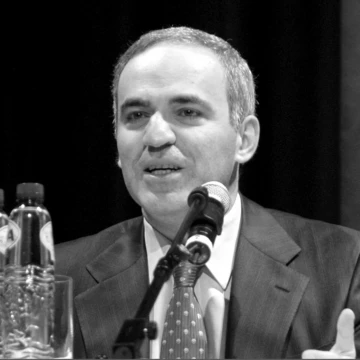
Bobby Fischer
American chess prodigy and 11th World Chess Champion.

Bobby Fischer was the 11th World Chess Champion, whose 1972 title match against Boris Spassky of the USSR, held in Reykjavík, Iceland, was publicized as a Cold War confrontation and attracted more worldwide interest than any chess championship before or since. The film *Searching for Bobby Fischer* (released in the UK as *Innocent Moves*) is a 1993 American drama that uses Fischer's name and legacy as a backdrop, though Fischer himself never saw the film and claimed it violated his privacy by using his name without his permission.
- field
- Chess
- known_for
- 1972 title match vs. Boris Spassky
Verified Timeline
Lore & Background
The source does not provide details about Fischer's early life, his learning chess at age six, his clubs, his mentor John W. Collins, or his blitz games at the Hawthorne Chess Club. It does state that in 1972, American chess champion Bobby Fischer traveled to Reykjavík, Iceland, for a match in the World Chess Championship 1972 with Boris Spassky. Fred Waitzkin was inspired by Fischer's charisma at that time. The source also notes that Fischer never saw the film and claimed it violated his privacy by using his name without his permission. No information is given about Fischer's later disappearance, arrest warrant, émigré life, or antisemitic statements.
Reader's Guide
Fischer's significance in the source is limited to his role as a cultural icon and the inspiration for the film. The 1972 World Championship match between Fischer and Spassky is described as having been publicized as a Cold War confrontation and attracted more worldwide interest than any chess championship before or since. Fred Waitzkin was swept up in the nationwide excitement at the time and inspired by Fischer's charisma. The film uses Fischer's name in its title, but Fischer himself never saw it and claimed it violated his privacy. The source does not cover Fischer's patented chess timing system, Fischer random chess, or any of his later controversies.
Did You Know?
- Bobby Fischer never saw the film *Searching for Bobby Fischer* and claimed it violated his privacy by using his name without his permission.
- The film's title was changed to *Innocent Moves* for its United Kingdom release.
- The real Joshua Waitzkin, Bruce Pandolfini, and Vincent Livermore all appear as themselves in the film.
- The character Jonathan Poe in the film is based on real chess prodigy Jeff Sarwer, who rejected a draw offer in their actual 1986 match but ended up drawing the game with bare kings.
- The film's climactic endgame position was contrived by Waitzkin and Pandolfini and did not occur in the real Sarwer–Waitzkin game.
Production, Release & Critical Reception
The project, released by Paramount Pictures on August 11, 1993, carried the title *Searching for Bobby Fischer* domestically but was rebranded as *Innocent Moves* for its United Kingdom release. The ensemble cast featured Max Pomeranc in his very first film role alongside veteran actors Joe Mantegna, Joan Allen, Ben Kingsley, and Laurence Fishburne. Adapted from Fred Waitzkin's memoir of the same name, the picture drew consistently favorable notices from critics. Yet audience response proved far less enthusiastic: the film collected roughly $7,266,383 against a production budget of $12 million, a clear box-office disappointment. Its most notable industry recognition came in the form of a Best Cinematography nomination at the 66th Academy Awards, a nod that underscored the film's visual craftsmanship even as its commercial performance fell short of expectations.
The Story of a Chess Prodigy
At the heart of the narrative is seven-year-old Josh Waitzkin, whose eyes are first drawn to the chess tables of New York's Washington Square Park. His mother Bonnie resists the idea at first, wary of the illegal gambling and the disheveled regulars who populate the scene, yet she is stunned when Josh demonstrates a complete grasp of the rules without ever having been formally instructed. Park veteran Vinnie Livermore quickly recognizes the boy's raw gift and becomes an informal mentor, teaching him flashy, intuitive tactics that a later formal coach, Bruce Pandolfini, will view with alarm. Pandolfini objects to Josh's habit of deploying the queen far too early and warns that such reckless play will sabotage his tournament prospects. Meanwhile, Josh's father Fred spirals into an unhealthy fixation on his son's results, straining the family and the boy's school life. When Bruce's rigid, cold coaching culminates in a humiliating incident where he showers Josh in 'meaningless Xeroxes' of a certificate that Bruce had previously told Josh was a special award, Bonnie finally intervenes and kicks Bruce out of the house. The family mends, Josh resumes playing with Vinnie, and his love of the game is restored just in time for the National Chess Championship, where a tense final against rival prodigy Jonathan Poe becomes the emotional climax.
The Real Chess World on Screen
The film is peppered with appearances from the genuine chess community, lending it an authenticity that elevates it beyond a simple sports drama. Grandmasters Anjelina Belakovskaia, Joel Benjamin, Roman Dzindzichashvili, and Kamran Shirazi all make brief on-screen appearances, while the real Joshua Waitzkin, coach Bruce Pandolfini, park regular Vincent Livermore, and Russell Garber also appear. Austin Pendleton portrays chess master Asa Hoffmann, a role that reportedly left the real Hoffmann dissatisfied with his depiction. Poe McClinton, still an active figure in the park scene, is visible throughout, and Pal Benko was originally cast but his segment was ultimately excised from the final cut. The Russian player in the park (played by Vasek Simek) who holds up the sign 'Game or Photograf Of Man Who Beet Tal 1953 • Five Dollars' was based on the real life of Israel Zilber, who would regularly sleep in the park, awakening only for a 'five dollar game' that he would demand in a Russian accent and which he would invariably win. Zilber, Latvian Chess Champion in 1958, defeated the teenage Mikhail Tal in 1952, and during most of the 1980s was homeless and regarded as one of the top players in Washington Square Park. Bobby Fischer himself surfaces only in archival newsreel footage, a ghostly reminder of the world the young prodigies aspire to join.
The Sarwer–Waitzkin Rivalry, Real and Reimagined
The film's climactic tournament match pits Josh against Jonathan Poe, a character drawn from the life of real chess prodigy Jeff Sarwer. In actual life, Josh's opponent was Jeff Sarwer, who was younger. In September 1985, Josh first played and was defeated by Jeff at the Manhattan Chess Club. A rematch in November of that year saw Waitzkin exact his revenge. The film depicts their third match in the 1986 US Primary Championship. Near the end of the game, where Josh offers Poe a draw, Poe rejects the offer, the play continues and Poe loses. In reality, Sarwer did reject the draw offer, but the game continued to a draw with bare kings. Under tournament tie-breaking rules, Waitzkin was credited with having faced more challenging opponents across the event and was awarded first place, though the two were ultimately declared US Primary School co-champions. Sarwer went on to win the 1986 World Championship Under-10 (Boys), with his sister Julia winning the World Championship Under-10 (Girls).
Frequently Asked Questions
How does Bobby Fischer's story end?
After his 1972 triumph, Fischer became increasingly reclusive and embroiled in public controversies, eventually acquiring Icelandic citizenship. He died in Reykjavík, Iceland, on January 17, 2008.
Why is Bobby Fischer important to chess history?
His 1972 match against Spassky was publicized as a Cold War confrontation and attracted more worldwide attention than any chess championship before or since. Beyond competition, he also invented Chess960 and patented a new chess timing system, reshaping how the game is played and timed.
What is Fischer Random (Chess960)?
Fischer Random is a chess variant Fischer created in which the back-rank pieces are shuffled according to set rules, yielding 960 distinct starting positions. The design was meant to limit the advantage of memorized opening preparation.
More in Chess Masters 1-17
Spotted an error? Know more?
This is a living reference — every entry is fact-audited, and reader corrections feed straight into our audit queue. Suggest an edit · See this site's audit record