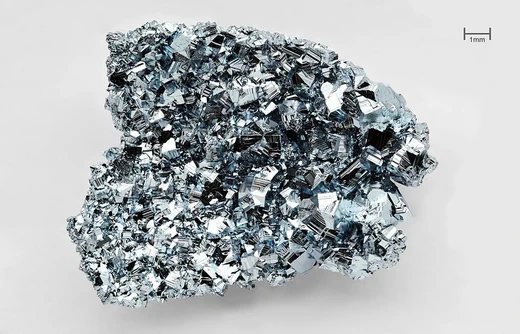
Promethium
A rare, radioactive lanthanide with no stable isotopes.
Last updated
Promethium is a radioactive lanthanide element with atomic number 61 that has no stable isotopes.[1] Only the isotope promethium-147 has industrial applications, primarily in luminous paints and atomic batteries.[2][3][4] Jacob A. Marinsky, Lawrence E. Glendenin, and Charles D. Coryell separated and analyzed fission products from uranium fuel irradiated in the graphite reactor at what was then Clinton Laboratories (later Oak Ridge National Laboratory) in 1945, producing and characterizing promethium for the first time.[5]
Quick Facts
- Atomic number
- 61
- Discovery location
- Oak Ridge National Laboratory
- Element category
- Lanthanide
Facts from the source article.
Key facts and history
In 1902, Czech chemist Bohuslav Brauner predicted an element with properties intermediate between neodymium and samarium.[6] Also in 1926, a group from the University of Illinois named it "illinium"[7][8] Both reported discoveries were shown to be erroneous because the spectrum lines matched impurities.[8] Promethium was first produced and characterized in 1945 by Jacob A. Marinsky, Lawrence E. Glendenin and Charles D. Coryell at Oak Ridge National Laboratory.[5]
Promethium metal was first made in 1963 using promethium(III) fluoride.[9] Luigi Rolla and Lorenzo Fernandes of Florence, Italy, published the first discovery claim for element 61 in 1926, naming it "florentium" after their city.[7] Promethium-145, with a half-life of 17.7 years decaying via electron capture and a specific activity of 139 Ci/g, is the element's most stable isotope.[10] Thermal neutron bombardment of uranium-235 yields promethium-147 in large quantities relative to other promethium isotopes.[10]
References
- Wikipedia, "Promethium" (CC BY-SA 4.0), which cites: Lavrukhina Pozdnyakov 1966, p. 120; Thyssen, "Handbook on the Physics and Chemistry of Rare Earths", Elsevier, 2011, p. 63 (we also read that source) en.wikipedia.org
- Wikipedia, "Promethium" (CC BY-SA 4.0), which cites: Emsley 2011, p. 429; Lavrukhina Pozdnyakov 1966, p. 120; Emsley 2011, p. 429; Lavrukhina Pozdnyakov 1966, p. 120 (original not read by us) en.wikipedia.org
- Wikipedia, "Promethium" (CC BY-SA 4.0), which cites: Hammond, C. R., "CRC Handbook of Chemistry and Physics", CRC Press, 2011, p. 4.28; Emsley 2011, p. 429; Lavrukhina Pozdnyakov 1966, p. 120; Lavrukhina Pozdnyakov 1966, p. 120; Tykva, "Man-made and natural radioactivity in environmental pollution and radiochronology", Springer, 2004, p. 78; Deeter, David P., "Disease and the Environment", Government Printing Office, 1993, p. 187 (we also read that source) en.wikipedia.org
- Wikipedia, "Promethium" (CC BY-SA 4.0), which cites: promethium. Encyclopædia Britannica Online; Hammond, C. R., "CRC Handbook of Chemistry and Physics", CRC Press, 2011, p. 4.28; Emsley 2011, p. 429; Flicker, "Construction of a promethium-147 atomic battery", IEEE Transactions on Electron Devices, 1964, p. 2 (we also read that source) en.wikipedia.org
- Wikipedia, "Promethium" (CC BY-SA 4.0), which cites: Marinsky, "The chemical identification of radioisotopes of neodymium and of element 61", Journal of the American Chemical Society, 1947, p. 2781–5; "Discovery of Promethium", Oak Ridge National Laboratory Review, 2003; Emsley 2011, p. 429; Emsley 2011, p. 429; Wiberg, "Inorganic Chemistry", John Wiley and Sons, 2001, p. 1694; Emsley 2011, p. 429 (original not read by us) en.wikipedia.org
- Wikipedia, "Promethium" (CC BY-SA 4.0), which cites: Laing, "A Revised Periodic Table: With the Lanthanides Repositioned", Foundations of Chemistry, 2005, p. 203–233; Littlefield, "Atomic and Nuclear Physics: An Introduction in S.I. Units", Van Nostrand, 1968, p. 109; Lavrukhina Pozdnyakov 1966, p. 120; Weeks, "The discovery of the elements", Journal of Chemical Education, 1956; Marshall, "Rediscovery of the elements: The Rare Earths–The Last Member", The Hexagon, 2016, p. 4–9 (original not read by us) en.wikipedia.org
- Wikipedia, "Promethium" (CC BY-SA 4.0), which cites: Rolla, "Über das Element der Atomnummer 61", Zeitschrift für Anorganische und Allgemeine Chemie, 1926, p. 371–381; Noyes, "Florentium or Illinium?", Nature, 1927, p. 14; Rolla, "Florentium or Illinium?", Nature, 1927, p. 637; Rolla, "Florentium. II", Zeitschrift für Anorganische und Allgemeine Chemie, 1928, p. 319–320; Rolla, "Florentium", Zeitschrift für Anorganische und Allgemeine Chemie, 1927, p. 40–42; Rolla, "Über Das Element der Atomnummer 61 (Florentium)", Zeitschrift für Anorganische und Allgemeine Chemie, 1927, p. 190–192 (original en.wikipedia.org
- Wikipedia, "Promethium" (CC BY-SA 4.0), which cites: Harris, "The Element of Atomic Number 61; Illinium", Nature, 1926, p. 792; Brauner, "The New Element of Atomic Number 61: Illinium", Nature, 1926, p. 84–85; Meyer, "Über das Element 61 (Illinium)", Naturwissenschaften, 1926, p. 771; Lavrukhina Pozdnyakov 1966, p. 120 (original not read by us) en.wikipedia.org
- Wikipedia, "Promethium" (CC BY-SA 4.0), which cites: Emsley 2011, p. 429; Lavrukhina Pozdnyakov 1966, p. 120 (original not read by us) en.wikipedia.org
- Wikipedia, "Promethium" (CC BY-SA 4.0), which cites: Lavrukhina Pozdnyakov 1966, p. 120 (original not read by us) en.wikipedia.org
Each numbered sentence above was checked against the source it cites before publication. Sentences citing Wikipedia adapt text from the English Wikipedia article Promethium (contributors), used under CC BY-SA 4.0; this entry is available under the same licence. Other sources were used for facts only; no text or images are copied from them.
Also in the Codexery
More in Chemical Elements & Metals
Sources
Compiled from Wikipedia and the sources listed below. Text from Wikipedia is available under CC BY-SA 4.0; this entry is adapted from it.
- Wikipedia: Promethium (CC BY-SA 4.0).
- Word definitions: the , each quoted from its Wikipedia article.
Spotted an error? Know more?
Reader corrections go straight into our review queue. Suggest an edit · How this site is sourced