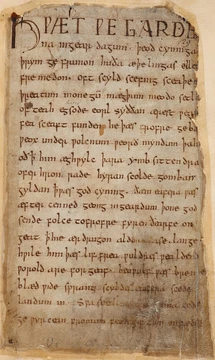
Girart de Vienne
Twelfth-century chanson de geste by Bertrand de Bar-sur-Aube.

Paul Meyer · Public domain
Girart de Vienne is an Old French *chanson de geste* composed around 1180 by an anonymous poet. The poem, which runs to over 6,000 lines of rhymed decasyllables arranged in *laisses*, recounts the story of the sons of Garin de Monglane and their conflicts with Emperor Charlemagne. The work was likely based on an earlier poem that has since been lost.
The plot begins with Garin de Monglane’s four sons—Hernaut, Girart, Renier, and Milon—each receiving a fief; Renier later becomes the father of Olivier. When Hernaut’s son Aymeri hears the Empress insulting Girart’s wife, he rouses the brothers to war. To end the fighting, Olivier is matched against Charlemagne’s nephew Roland in a duel near Vienne. Neither hero can defeat the other, and at nightfall an angel instructs them to save their strength for fighting infidels. The two swear eternal friendship, and Roland asks to marry Olivier’s sister, Aude. Girart is reconciled with the emperor, but before the wedding can take place, a messenger arrives with news of Saracens landing in Gascony.
This work is also famous for its mention of the three *gestes* of the *chansons de geste* (the “Matter of France”), a classification later adopted by scholars. The text itself describes these cycles, noting that at Saint-Denis, in the great abbey, a book records that there have been only three *gestes* in France. The lordliest is that of the kings of France. The second is that of Doon of the white beard, of Mainz, whose lineage included fierce and treacherous people—among them Ganelon, whose treason caused the death of the Twelve Peers in Spain. The third *geste*, much praised, is that of Garin de Monglane, whose descendants were wise, bold knights who never betrayed a king of France, but instead promoted Christendom and fought Saracens. Garin had four sons: Hernaut of Beaulande, Milon of Apulia, Renier of Geneva, and lord Girart the warrior.
- Author
- Anonymous
- Date
- c. 1180
- Genre
- Chanson de geste
- Language
- Old French
- Verses
- More than 6000 rhymed decasyllables
- Known for
- Mentioning the three cycles of chansons de geste, later adopted by scholars
Lore & Background
The poem begins with the four sons of Garin de Monglane—Hernaut, Girart, Renier, and Milon—each coming into possession of a fief. Renier becomes the father of Olivier. The son of Hernaut, Aymeri, becomes enraged when he hears the Empress insulting Girart's wife, and he incites the brothers to battle. In an attempt to end the war, Olivier is pitted against the Emperor's nephew, Roland, in a duel near Vienne, but neither hero prevails. When night comes, an angel tells the two heroes to save their strength for battling infidels. The two swear each other eternal friendship, and Roland proposes to Olivier's sister, Aude.
Reader's Guide
Girart de Vienne is significant for its role in grouping the chansons de geste, or Matter of France, into three cycles: the Geste du roi (concerning Charlemagne and his knights), the Geste de Doon de Mayence (concerned with rebels against royal authority), and the Geste de Garin de Monglane (whose central character was William of Orange). The work was extremely popular up until the Renaissance and was converted into a version with alexandrines in the 14th century, as well as five prose versions, including one by David Aubert, one by Raffaele Marmora, one by Jean d'Outremeuse, and one attached to the prose version of Garin de Monglane. Its legacy includes establishing the friendship of Olivier and Roland, two of the most famous epic heroes in medieval French literature.
Did You Know?
- The poem comprises more than 6000 rhymed decasyllable verses grouped into laisses.
- It was likely based on a now lost earlier poem.
- It groups the chansons de geste into three cycles: Geste du roi, Geste de Doon de Mayence, and Geste de Garin de Monglane.
Origins and Poetic Architecture
Composed around 1180 by the poet Bertrand de Bar-sur-Aube, Girart de Vienne stands as one of the great Old French chansons de geste of the late twelfth century. The poem stretches beyond six thousand lines of rhymed decasyllabic verse, organized into laisses—the traditional stanzaic units of the genre. Scholars believe Bertrand was not working from a blank page; rather, he likely adapted and expanded a now-lost earlier poem, giving the material a more polished literary shape. The narrative centers on the four sons of Garin de Monglane and their prolonged conflict with Emperor Charlemagne, but the poem also performs a crucial genealogical function: it establishes the legendary brotherhood between Olivier and Roland, two of the most beloved figures in the entire Matter of France. By anchoring these heroes in a shared family drama, the text gave later poets a ready-made emotional core around which to build their own epics.
The Duel at Vienne and the Forging of Brotherhood
The emotional heart of the poem arrives in a single, unforgettable sequence. After Aymeri—son of Hernaut—overhears the Empress boasting of a past humiliation she inflicted on his uncle Girart, he stokes his uncles' anger and the brothers rise in open rebellion against Charlemagne. To settle the conflict, a duel is arranged near Vienne: Olivier, Renier's son, faces the Emperor's own nephew Roland. The two warriors fight to a standstill, neither gaining the upper hand, until darkness falls. Then an angel descends and commands them to conserve their strength, for the true enemy is not each other but the infidels beyond the frontier. Struck by the moment, the two heroes swear an oath of eternal friendship, and Roland asks for the hand of Olivier's sister Aude. Just as the wedding seems imminent, a messenger arrives with news of Saracens landing in Gascony, and the personal reconciliation must yield to the larger war.
The Three Cycles of French Epic
One of Girart de Vienne's most influential contributions to medieval literary culture is its explicit taxonomy of the chansons de geste into three great cycles. The first, the Geste du roi, gathers the tales of Charlemagne and his peerage. The second, the Geste de Doon de Mayence, encompasses the rebellious line of Doon of Mainz, whose descendants—Renaud de Montauban, Girart de Roussillon, and the treacherous Ganelon—challenged royal authority; the poem recalls how Ganelon's betrayal in Spain led to the death of the Twelve Peers. The third and, in the poet's telling, most praiseworthy cycle is the Geste de Garin de Monglane, whose central figure is William of Orange. This lineage is described as free of cowards and traitors, composed of wise, bold knights who promoted Christendom and destroyed Saracens, typically younger sons seeking land and glory through combat. The passage, set in a book at the abbey of Saint-Denis, became a standard framework for organizing the entire Matter of France.
Afterlife and Adaptation
The popularity of Girart de Vienne endured far beyond its twelfth-century origins, remaining in active circulation until the Renaissance. By the fourteenth century, the verse original had been recast into alexandrine meter, and the story was retold in no fewer than five prose versions. Among the most notable adapters was David Aubert, who wove the narrative into his Chroniques et conquestes de Charlemagne; others included Raffaele Marmora and Jean d'Outremeuse, while a fifth prose rendition was appended to the prose adaptation of Garin de Monglane. This extraordinary longevity in multiple forms—verse, alexandrine verse, and prose—testifies to the poem's deep roots in both courtly and popular culture across the French-speaking world. In modern scholarship, the text has been made accessible through Wolfgang van Emden's critical edition (SATF, 1977) and Michael A. Newth's English translation published by the Arizona Center for Medieval and Renaissance Studies in 1999, ensuring that the story of the four brothers and their legendary duel continues to reach new readers.
Gallery

Frequently Asked Questions
Who is Girart de Vienne?
Girart is one of the four sons of Garin de Monglane in the Old French epic that bears his name. He holds a fief granted by Emperor Charlemagne, and his family's prolonged feud with the imperial court drives the entire plot.
What is the poem 'Girart de Vienne'?
It is a chanson de geste composed in Old French around 1180, stretching to more than 6,000 lines of rhymed ten-syllable verses organized into laisses. The work is anonymous and appears to be a later expansion of an earlier narrative that has since been lost.
How does the conflict with Charlemagne begin in Girart de Vienne?
The feud is ignited when Aymeri, son of Hernaut, overhears the Empress demeaning Girart's wife. The insult prompts the brothers to unite against the imperial household, setting the central struggle of the poem in motion.
Why is Girart de Vienne significant to scholars of medieval literature?
The text is one of the earliest to name the three cycles of chansons de geste, a classification scheme that later medievalists formalized. It also preserves genealogical links to other epic traditions, notably making Renier the father of Olivier.
Who is the author of Girart de Vienne?
The poem is most commonly credited to an anonymous twelfth-century poet, though some sources attribute it to Bertrand de Bar-sur-Aube. Either way, it was likely composed as a revision or expansion of an older verse narrative that no longer survives.
More in Characters in epic poems 1-18
Spotted an error? Know more?
Reader corrections go straight into our review queue. Suggest an edit · How this site is sourced