Carnivora
An order of placental mammals specialized in eating flesh.

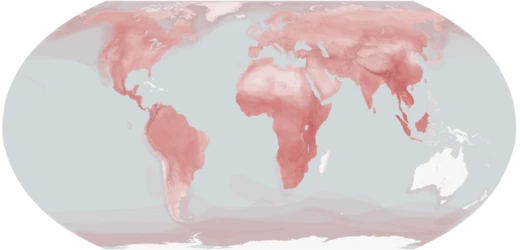
Carnivora is an order of placental mammals whose members, called carnivorans, are mainly adapted to eating meat. It ranks as the sixth largest order of mammals, with at least 293 species. These animals live on every major continent and in many different environments, from the freezing polar regions to the extremely dry Sahara Desert and the open ocean. Carnivorans come in many body types, with a huge range of sizes and shapes.
The order splits into two suborders: Feliformia, which includes true cats and other cat-like animals, and Caniformia, which includes true dogs and many dog-like animals. Feliforms consist of the families Felidae, Viverridae, hyenas, and mongooses; most of these live only in the Old World, except for cats, which also reached the New World via the Bering land bridge. Caniforms include Caninae, Procyonidae, bears, mustelids, skunks, and pinnipeds, and they are found worldwide with great variety in their body forms, diets, and behaviors.
The name Carnivora comes from Latin *carō* (meaning "flesh") and *vorāre* (meaning "to devour").
The earliest known carnivoran-line mammals, called Carnivoramorpha, appeared in North America about six million years after the Cretaceous–Paleogene extinction event. These early ancestors likely looked like small weasels or genets, active at night on the forest floor or in trees, while other mammal groups like mesonychians and later creodonts filled the large predator roles. After the mesonychians and oxyaenid creodonts died out at the end of the Eocene, carnivorans quickly took over those niches. For example, nimravids became the dominant large ambush predators during the Oligocene, alongside the hyaenodont creodonts, which also evolved into larger, open-country forms at the start of that epoch. By the Miocene, nearly all major carnivoran lineages and families had diversified and become the most important group of large land predators in Eurasia and North America, with different lineages succeeding in large predator roles at various times during the Miocene and later.
Carnivora belongs to a group of mammals called Laurasiatheria, which also includes bats and ungulates. Within Laurasiatheria, carnivorans are placed in the clade Ferae. Ferae includes the closest living relatives of carnivorans—pangolins—along with several extinct groups of mostly Paleogene carnivorous placentals, such as creodonts, arctocyonians, and mesonychians. Creodonts were once thought to be the sister group to carnivorans, or even their ancestors, because both groups have carnassial teeth. However, the position of these teeth differs: in carnivorans, carnassials are near the front of the molar row, while in creodonts they are near the back, indicating separate evolutionary histories and a distinction at the order level. Phylogenetic analysis now suggests creodonts are more closely related to pangolins, while mesonychians may be the sister group to carnivorans and their stem-relatives.
The closest stem-carnivorans are the miacoids, which include the families Viverravidae and Miacidae. Together, Carnivora and Miacoidea form the stem-clade Carnivoramorpha. Miacoids were small, genet-like carnivoramorphs that lived in various habitats, both on the ground and in trees. Studies show that viverravids are a monophyletic basal group, while miacids are paraphyletic with respect to Carnivora. Carnivoramorpha as a whole first appeared in the Paleocene of North America about 60 million years ago. Crown carnivorans first appeared around 42 million years ago in the Middle Eocene. Molecular phylogeny shows that living Carnivora form a monophyletic group, the crown group of Carnivoramorpha. From there, carnivorans split into two clades based on the structure of the bony capsules around the middle ear: cat-like feliforms have double-chambered auditory bullae made of two bones joined by a septum, while dog-like caniforms have single-chambered or partially divided bullae made of a single bone. Early carnivorans were small because oxyaenids and mesonychians dominated apex predator roles during the Eocene, but by the Oligocene, carnivorans like nimravids became dominant apex predators, and by the Miocene, most living carnivoran families had diversified and become the primary land predators in the Northern Hemisphere.
In 1758, Carl Linnaeus placed all known carnivorans into the group Ferae (not the same as the modern Ferae, which also includes pangolins) in the tenth edition of *Systema Naturae*. He recognized six genera: *Canis* (canids and hyaenids), *Phoca* (pinnipeds), *Felis* (felids), *Viverra* (viverrids, herpestids, and mephitids), *Mustela* (non-badger mustelids), and *Ursus* (ursids, large mustelids, and procyonids). In 1821, Thomas Edward Bowdich gave the group its modern accepted name. Initially, Carnivora was divided into two suborders: the terrestrial Fissipedia and the marine Pinnipedia. In 1945, George Gaylord Simpson classified the living families as follows: Order Carnivora Bowdich, 1821.
- order
- Carnivora
- number_of_species
- at least 293
- suborders
- Feliformia and Caniformia
- oldest_known_ancestors
- appeared in North America 6 million years after the Cretaceous–Paleogene extinction event
- crown_group_appearance
- around 42 million years ago in the Middle Eocene
- etymology
- from Latin carō 'flesh' and vorāre 'to devour'
Lore & Background
The word Carnivora is derived from Latin carō (stem carn-) 'flesh' and vorāre 'to devour'. The oldest known carnivoran line mammals (Carnivoramorpha) appeared in North America 6 million years after the Cretaceous–Paleogene extinction event. These early ancestors resembled small weasel or genet-like mammals, occupying a nocturnal shift on the forest floor or in trees, while other groups like mesonychians and creodonts occupied the megafaunal faunivorous niche. Following the extinction of mesonychians and oxyaenid creodonts at the end of the Eocene, carnivorans quickly moved into this niche, with nimravids becoming dominant large-bodied ambush predators during the Oligocene alongside hyaenodont creodonts. By the Miocene, most major lineages and families of carnivorans had diversified and become the most dominant group of large terrestrial predators in Eurasia and North America.
Reader's Guide
Carnivora is divided into two suborders: Feliformia, containing true felids and cat-like animals, and Caniformia, containing true canids and dog-like animals. Feliforms include Felidae, Viverridae, hyena, and mongoose families, with cats being the only feliforms occurring in both the Old and New Worlds. Caniforms include Caninae, Procyonidae, bears, mustelids, skunks, and pinnipeds, occurring worldwide with immense diversity in morphology, diet, and behavior. The order belongs to Laurasiatheria and is placed in the clade Ferae, with pangolins as the closest extant relative. The miacoids are the closest stem-carnivorans, and together Carnivora and Miacoidea form the stem-clade Carnivoramorpha. Carnivorans first appeared in the Paleocene of North America about 60 million years ago, with crown carnivorans appearing around 42 million years ago. The classification of extant families has been revised since 1945, with genetic and morphological research revealing that Fissipedia is paraphyletic with respect to Pinnipedia, and that several families like Viverridae, Procyonidae, and Mustelidae are polyphyletic.
Did You Know?
- Carnivora is the sixth largest order of mammals, comprising at least 293 species.
- The oldest known carnivoran line mammals appeared in North America 6 million years after the Cretaceous–Paleogene extinction event.
- Carnivorans are divided into two suborders: Feliformia (cat-like) and Caniformia (dog-like).
- The word Carnivora is derived from Latin carō 'flesh' and vorāre 'to devour'.
More in Carnivorans 1-21
Spotted an error? Know more?
This is a living reference — every entry is fact-audited, and reader corrections feed straight into our audit queue. Suggest an edit · See this site's audit record