Asiatic linsang
Asiatic linsangs are sister taxon to cats.

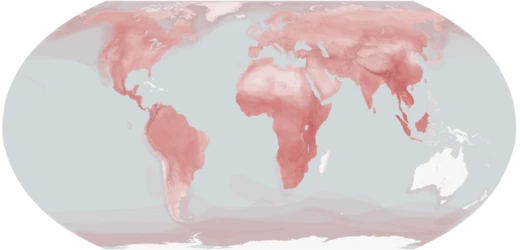
The Asiatic linsang, belonging to the genus *Prionodon*, includes two species found in Southeast Asia: the banded linsang (*Prionodon linsang*) and the spotted linsang (*Prionodon pardicolor*). This genus is closely related to the cat family, Felidae, and genetic studies strongly support this link, prompting suggestions that Asiatic linsangs should be placed in their own single-genus family, Prionodontidae.
These animals have a distinctive coat pattern, with large spots that sometimes merge into broad bands along the sides of the body, and a tail marked with transverse bands. They are small, with a head and body length between 36.6 and 42.5 centimeters, and a tail measuring 30 to 41 centimeters—nearly as long as the head and body combined, and about five to six times the length of the hind foot. The head is elongated with a narrow muzzle; the rhinarium is evenly convex on top, with a wide internarial septum, a shallow infranarial portion, and a narrow, grooved philtrum that extends only to about the lower edge of the nostrils. The skull is delicate, long, low, and narrow, with a well-defined occipital region and a strong crest, but no complete sagittal crest. The teeth are highly specialized and resemble those of Felidae, though more primitive. The dental formula is 3.1.4.1 / 3.1.4.2. The incisors form a straight, not curved, line. The first three upper premolars and all four lower premolars are compressed and sharp, with a high, pointed central cusp and small accessory cusps in front and behind. The upper carnassial has a small inner lobe set far forward, a small cusp in front of the main compressed, high, pointed cusp, and a compressed, blade-like rear cusp. The upper molar is triangular, set transversely, much smaller than the upper carnassial, and wider than it is long, so that the upper carnassial sits nearly at the back of the upper cheek teeth, as in Felidae.
In taxonomic history, Thomas Horsfield first named and described *Prionodon* in 1822, based on a linsang from Java. He placed it under the "section Prionodontidae" of the genus *Felis*, noting similarities to both *Viverra* and *Felis*. In 1864, John Edward Gray grouped *Prionodon* and *Poiana* in the tribe Prionodontina, within Viverridae. Reginald Innes Pocock initially followed Gray’s classification, but the presence of scent glands in *Poiana* led him to tentatively consider it a specialized form of *Genetta*, with its resemblance to *Prionodon* possibly being adaptive. Additionally, the skeletal anatomy of Asiatic linsangs is described as a mosaic of features from other viverrine-like mammals, sharing cranial, postcranial, and dental traits with falanoucs, African palm civets, and oyans, respectively. A third, extinct species, *Prionodon hualongensis*, was described in 2025 from fossils found in China.
DNA analysis of 29 carnivore species, including 13 viverrines and three representing *Paradoxurus*, *Paguma*, and Hemigalinae, confirmed Pocock’s assumption that the African linsang *Poiana* is the sister group of the genus *Genetta*. The placement of *Prionodon* as the sister group of Felidae is strongly supported, and a physical synapomorphy shared between felids and *Prionodon* is the presence of specialized fused sacral vertebrae.
- classification
- Genus Prionodon
- species
- Banded linsang (Prionodon linsang) and spotted linsang (Prionodon pardicolor)
- native_region
- Southeast Asia
- head_and_body_length
- 36.6 to 42.5 cm
- tail_length
- 30 to 41 cm
- dental_formula
- 3.1.4.1 / 3.1.4.2
- taxonomic_relation
- Sister taxon of Felidae
Lore & Background
The Asiatic linsang, comprising the banded and spotted species, is a small carnivoran native to Southeast Asia. Its coat is marked by large spots that may merge into broad bands along the flanks, and the tail is ringed with transverse bands. The body and head together measure a modest length, while the tail is nearly as long as the body and about five to six times the length of the hind foot. The head is elongated, with a narrow muzzle and a rhinarium that is evenly convex above, featuring a wide internarial septum and a shallow infranarial portion. The philtrum is narrow and grooved, with the groove extending only to about the lower edge of the nostrils. The skull is delicate, long, low, and narrow, with a well-defined occipital and a strong crest, but lacks a complete sagittal crest. The teeth are highly specialized, approaching those of cats (Felidae) but more primitive. The incisors form a straight, not curved, line. The first three upper and all four lower premolars are compressed and sharp, with a high, pointed median cusp and small subsidiary cusps. The upper carnassial has a small inner lobe set far forward, a small front cusp, a tall main cusp, and a blade-like rear cusp. The upper molar is triangular, set transversely, much smaller than the carnassial, and wider than long, placing the carnassial near the rear of the upper cheek teeth as in Felidae. The Asiatic linsang is considered a sister taxon to the cat family, a relationship supported by DNA analysis and a shared physical feature of specialized fused sacral vertebrae.
Reader's Guide
The Asiatic linsang holds significance in mammalian systematics due to its close evolutionary relationship with the Felidae. DNA analysis based on 29 species of Carnivora confirmed that Prionodon is the sister-group of the family Felidae, a placement strongly supported by molecular evidence. This has led to the proposal that Asiatic linsangs be placed in the monogeneric family Prionodontidae. A physical synapomorphy shared between felids and Prionodon is the presence of specialized fused sacral vertebrae. The skeletal anatomy of Asiatic linsangs is described as a mosaic of features of other viverrine-like mammals, sharing cranial, postcranial, and dental similarities with falanoucs, African palm civet, and oyans respectively.
Did You Know?
- The Asiatic linsang's coat pattern consists of large spots that sometimes coalesce into broad bands on the sides of the body, with a transversely banded tail.
- The tail of the Asiatic linsang is nearly as long as the head and body, and about five or six times as long as the hind foot.
- The dental formula of the Asiatic linsang is 3.1.4.1 / 3.1.4.2, and its teeth show an approach to those of Felidae, although more primitive.
Physical Form & Dental Architecture
The Asiatic linsang is a small carnivore with a head-and-body length of 36.6 to 42.5 cm and a tail of 30 to 41 cm, the latter nearly matching the torso and measuring about five or six times the hind foot. Its coat is distinctive: large spots that sometimes merge into broad lateral bands, while the tail carries transverse banding. The head is elongated, featuring a narrow muzzle, a rhinarium that is evenly convex above, and a broad internarial septum. The skull is long, low, and narrow, bearing a strong crest but no complete sagittal crest. The dentition is where the linsang most intrigues anatomists. The teeth are more highly specialized than those of typical viverrids, approaching the feline pattern while remaining more primitive. The dental formula is 3.1.4.1 / 3.1.4.2, with incisors arranged in a transverse rather than curved line. The premolars are compressed and trenchant, each bearing a high, sharp median cusp with small subsidiary cusps. The upper carnassial carries a small inner lobe set far forward, a small anterior cusp, and a compressed blade-like posterior cusp. The upper molar is triangular, much wider than long, and far smaller than the carnassial, placing the carnassial nearly at the rear of the upper cheek-teeth—a configuration also seen in Felidae.
A Two-Century Taxonomic Odyssey
The classification of the Asiatic linsang has been contested for nearly two hundred years. Because the animal displayed resemblances to both Viverra and Felis, he tucked it into a section called Prionodontidae within the genus Felis. Reginald Innes Pocock initially followed Gray's framework but grew uneasy upon noticing scent glands in Poiana, leading him to provisionally treat that African genus as a specialized form of Genetta and to suggest its resemblance to Prionodon might be merely adaptive. The skeletal anatomy of Asiatic linsangs compounds the difficulty: their cranial, postcranial, and dental features form a mosaic, sharing traits with falanoucs, the African palm civet, and oyans respectively. This patchwork of borrowed characteristics made it hard for morphologists to slot the linsang cleanly into any single family, setting the stage for the molecular revolution that would eventually resolve the question.
The Molecular Verdict & the Felidae Connection
When researchers turned to DNA, the long-standing taxonomic puzzle began to resolve. A molecular analysis encompassing 29 species of Carnivora—including 13 members of Viverrinae and representatives of Paradoxurus, Paguma, and Hemigalinae—confirmed Pocock's earlier hunch that the African linsang Poiana is the sister-group of Genetta. Far more dramatically, the same data strongly supported placing Prionodon as the sister-group of the entire family Felidae. This was not merely a statistical artifact; a tangible physical synapomorphy underpins the relationship. Both felids and Prionodon possess specialized fused sacral vertebrae, a shared derived trait that links the two lineages at a structural level. On the strength of this evidence, researchers proposed elevating the Asiatic linsangs into their own monogeneric family, Prionodontidae, acknowledging that their evolutionary trajectory, while convergent in some dental and skeletal details, represents a distinct branch adjacent to the cats. The finding reframed the linsang from a puzzling viverrid oddity into a key node for understanding the broader architecture of the Carnivora order.
Two Living Species and a Fossil Surprise
The genus Prionodon currently encompasses two living species, both native to Southeast Asia: the banded linsang (Prionodon linsang) and the spotted linsang (Prionodon pardicolor). Their names reflect the variation in coat patterning within the genus—large spots that may coalesce into broad bands on the flanks, with the tail consistently banded transversely. For over two centuries, these two species represented the full extent of the genus's known diversity. This discovery extends the known geographic range of the genus beyond its living Southeast Asian distribution and opens a window into the paleobiogeography of the lineage. The fossil record, combined with the mosaic of morphological features shared with unrelated viverrine-like mammals, suggests that the Asiatic linsang has a deeper and more geographically complex history than its small, two-species present-day roster might imply.
Frequently Asked Questions
What is Asiatic linsang?
The Asiatic linsang is a small carnivorous mammal in the genus Prionodon, found in the forests of Southeast Asia. It is the closest living relative of all true cats, yet it is not itself a member of the cat family.
How is Asiatic linsang related to cats?
Genetic analyses consistently place Prionodon as the sister group to the entire family Felidae, meaning it diverged from the lineage that gave rise to every cat species. Because of that unique position, some taxonomists have proposed elevating it into its own monogeneric family, Prionodontidae.
How big is Asiatic linsang?
An adult linsang measures roughly 37 to 43 cm from the tip of its nose to the base of its tail, with a further 30 to 41 cm of tail behind that. In practical terms, it is a compact, small-bodied carnivore.
Where does Asiatic linsang live?
Both recognized linsang species are native exclusively to the forests of Southeast Asia, where they occupy relatively small, localized ranges. They are not found naturally anywhere outside that region.
How many species of Asiatic linsang are there?
The genus Prionodon contains exactly two species: the banded linsang (P. linsang) and the spotted linsang (P. pardicolor). They share the same general body plan but are distinguished by their distinct coat patterns.
More in Carnivorans 1-21
Spotted an error? Know more?
This is a living reference — every entry is fact-audited, and reader corrections feed straight into our audit queue. Suggest an edit · See this site's audit record