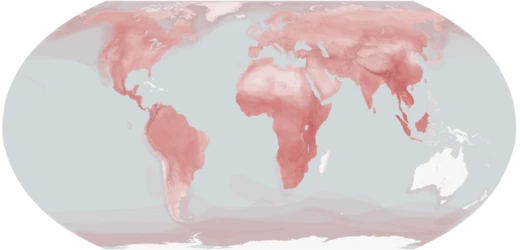
American mink
Semiquatic mustelid native to North America, widely introduced.

The American mink (Neogale vison) is a semiaquatic mustelid originally from North America, but humans have introduced it to parts of Europe, Asia, and South America. Because its range has expanded so widely, the IUCN lists it as a species of least concern. It is the most commonly farmed animal for its fur, surpassing the silver fox, sable, marten, and skunk in economic value.
This species was once considered the only living member of the genus Neovison, after the sea mink (N. macrodon) went extinct. However, recent studies, now accepted by taxonomic authorities, have moved both the American mink and the sea mink into the genus Neogale, which also includes several New World weasels. The American mink is a carnivore that eats rodents, fish, crustaceans, frogs, and birds. Where it has been introduced in Europe, it is considered an invasive species and has been linked to declines in the European mink, Pyrenean desman, and water vole.
**Evolution** Compared to the European mink, the American mink is more specialized for carnivory, as shown by its more developed skull structure. Fossil records of the American mink date back to the Irvingtonian period, though the species is not common among Pleistocene animals. Its fossil range matches its current natural range. Pleistocene American minks were similar in size and shape to modern ones, though there is a slight trend toward larger size from the Irvingtonian through the Illinoian and Wisconsinan periods. Although the American and European mink look alike, studies show the European mink is most closely related to the Siberian weasel (kolonok). American minks have been known to hybridize with European minks and polecats in captivity, but the hybrid embryos from an American and European mink pairing are usually reabsorbed.
**Subspecies** As of 2005, there are 15 recognized subspecies.
**Genomics** A chromosome-level genome assembly of Neogale vison was published in 2022. This gap-free assembly is about 2.7 Gb, with 98.6% of the sequence placed on 15 chromosomes, and it has a BUSCO completeness score of 96.5%. It contains 25,377 predicted genes. A haplotype-resolved chromosome-scale assembly was published in 2025 from a female specimen collected in England. Its two haplotypes each span about 2.7 Gb, with 98.7% of each assigned to 15 chromosomal pseudomolecules, including the X chromosome. The primary haplotype has a BUSCO completeness score of 94.9%, and genome annotation identified 19,566 predicted protein-coding genes.
**Description**
**Build** The American mink is larger and stouter than members of the genus Mustela (stoats and weasels) and other Neogale species, giving it a build close to that of martens. Like martens, it has a uniformly bushy, somewhat tapering tail, unlike the slender, cylindrical tail with an enlarged bushy tip seen in stoats. Its body shape is similar to the European mink’s, but its tail is longer, making up 38–51% of its body length. The long body helps it enter prey burrows, and its streamlined shape reduces water resistance when swimming. Its skull resembles the European mink’s but is more massive, narrower, and less elongated, with stronger projections and a wider, shorter cranium. The upper molars are larger and more massive. The dental formula is 3.1.3.1 / 3.1.3.2. Domestic mink bred on fur farms, which are genetically substandard, have brains 19.6% smaller, hearts 8.1% smaller, and spleens 28.2% smaller than wild mink. The feet are broad with webbed digits. They usually have eight nipples: one pair of inguinal teats and three pairs of abdominal teats. An adult male’s penis is 2.2 inches (5.6 cm) long and covered by a sheath; the baculum is well-developed, triangular in cross section, and curved at the tip. Males measure 13–18 inches (34–45 cm) in body length, females 12–15 inches (31–37.5 cm). The tail is 6–10 inches (15.6–24.7 cm) in males and 6–8 inches (14.8–21.5 cm) in females. Weight varies by sex and season; males are heavier. In winter, males weigh 1–3 pounds (500–1,580 g) and females 1–2 pounds (400–780 g). They are heaviest in autumn.
**Fur** The American mink’s winter fur is denser, longer, softer, and more close-fitting than the European mink’s. Its winter color is generally very dark blackish-tawny to light-tawny, evenly distributed over the body, with the underside only slightly lighter than the back. The guard hairs are bright and dark-tawny, often nearly black along the spine. The underfur on the back is very wavy and greyish-tawny with a bluish tint. The tail is darker than the trunk and sometimes pure black at the tip. The chin and lower lip are white. Captive individuals often develop irregular white patches on their lower body, though escaped individuals from Tartaria gradually lost these patches. Summer fur is shorter, sparser, and duller. The thick underfur and oily guard hairs make the pelage water-resistant; the guard hairs are intermediate in length between those of otters and polecats, showing the American mink is not fully adapted to aquatic life. It molts twice a year, in spring and autumn, and does not turn white in winter. Various color mutations have appeared through experimental breeding on fur farms.
**Locomotion** On land, the American mink moves with a bounding gait, reaching speeds up to 6.5 km/h (4.0 mph). It also climbs trees and swims well. While swimming, it propels itself mainly by undulating its trunk. When diving, it undergoes...
- Scientific name
- Neogale vison
- Native range
- North America
- Introduced range
- Europe, Asia, South America
- IUCN status
- Least-concern
- Economic importance
- Most frequently farmed for fur
Quick Facts
- Genus
- Neogale
- Species
- vison
- Subdivision
- 15, see text
Facts from the source article.
Lore & Background
The American mink is a carnivore that feeds on rodents, fish, crustaceans, frogs, and birds. In its introduced range in Europe it has been classified as an invasive species linked to declines in European mink, Pyrenean desman, and water vole populations. Fossil records of the American mink go back as far as the Irvingtonian, though the species is uncommon among Pleistocene animals. The American minks of the Pleistocene did not differ much in size or morphology from modern populations, though a slight trend toward increased size is apparent from the Irvingtonian through to the Illinoian and Wisconsinan periods. The American mink differs from members of the genus Mustela by its larger size and stouter form. It has a long body, streamlined shape, and webbed digits. The winter fur is denser, longer, softer, and more close-fitting than that of the European mink, and the pelage is water-resistant.
Reader's Guide
The American mink is significant both as a native species in North America and as an invasive species in Europe, Asia, and South America, where it has contributed to declines in native fauna such as the European mink, Pyrenean desman, and water vole. Its economic importance is paramount in the fur industry, being the most frequently farmed animal for fur. The species has been reclassified within the genus Neogale, which also contains the extinct sea mink and a few New World weasel species. Its genome has been sequenced, providing resources for further study. The American mink's adaptations for semiaquatic life, including webbed feet, water-resistant fur, and bradycardia during diving, highlight its specialized niche. Its territorial behavior, scent marking, and vocalizations during encounters with other minks or predators contribute to its ecological role. The species' ability to hybridize with European minks and polecats in captivity, though hybrid embryos are usually reabsorbed, indicates genetic interactions with related mustelids.
Did You Know?
- The American mink is the animal most frequently farmed for its fur, exceeding the silver fox, sable, marten, and skunk in economic importance.
- In its introduced range in Europe, it is classified as an invasive species linked to declines in European mink, Pyrenean desman, and water vole populations.
- The American mink can expel the contents of its anal glands at a distance of 12 inches (30 cm) when stressed.
Taxonomy & Physical Identity
The American mink (Neogale vison) has had a somewhat restless taxonomic history. Originally grouped with its European counterpart under the genus Mustela, it was later elevated to its own genus, Neovison, before being reclassified again alongside several other weasels into Neogale. Distinguishing an individual American mink from a European one by sight alone is notoriously difficult because of overlapping size ranges; a definitive identification often requires examining the skeleton. One reliable visual cue, however, is the upper lip: every European mink bears a prominent white patch there, while only some American mink do. A mink lacking that patch can be confidently assigned to the American species. In the wild, males weigh roughly one kilogram and measure about sixty centimetres in body length, while females come in at around six hundred grams and fifty centimetres. The tail, excluded from those figures, adds another twelve to twenty-three centimetres. Farm-bred males can balloon to over three kilograms. Their natural coat is a deep, rich brown with a dense underfur topped by dark, glossy guard hairs, though farm-bred animals range from white to near-black.
Reproduction & Lifespan
American mink reproduce with a biological quirk that sets them apart from many other mustelids: delayed implantation. Although the true gestation period is only thirty-nine days, the embryo can pause development for a variable stretch, stretching the apparent pregnancy to as long as seventy-six days before kits arrive. Forty-five to fifty-two days is considered the normal window. Mink produce a single litter per year, typically numbering six to ten young, though fur farms have recorded litters as large as sixteen. In the wild, a mink's maximum lifespan hovers around ten years, yet few individuals manage to exceed three years outdoors, where predation and harsh conditions take their toll. Males are noticeably larger than females in both weight and length, and the species shows a curious dietary habit among adults: they may prey on young mink.
Territory & Habitat
American mink are fiercely territorial, and their home ranges tend to be long and narrow, tracing the edges of rivers, lakes, and marshes. A male will not tolerate another male within his boundaries but shows less aggression toward females; female territories are smaller and may occasionally overlap a male's. At the heart of each range lies one or two core areas—often a fish-rich pool or a productive rabbit warren—where the mink can linger for days before making excursions to the far ends of its territory. Those patrols serve a defensive purpose: the mink checks for signs of intruders and deposits its own scented droppings to reassert ownership. Mink rarely strays far from water, following streams and ditches even when roaming. They occasionally venture a few hundred metres inland, particularly when chasing rabbits, one of their favourite prey. In Scotland and Iceland, they settle along seashores, and in some locations they even establish themselves in towns where suitable water is available. They are active at all hours, even in the presence of people.
Human Impact & Ecological Consequences
The American mink's rich, glossy fur made it a prime target of the clothing trade, with hunting eventually giving way to large-scale fur farming. A single farm housing three thousand mink can burn through two tons of food daily—expired cheese, fish, poultry byproducts, and commercial feeds. The industry has drawn sustained criticism from animal rights and welfare activists. In some cases, activists have released mink from farms, establishing feral populations across Europe, including Great Britain and Denmark, and South America; in others, mink simply escaped on their own. These introduced populations have raised ecological alarms. Some researchers believe American mink have contributed to the decline of the less hardy European mink through competition, though hybridisation is not the mechanism, since European mink are more closely related to polecats. Mink oil also finds use in medical products, cosmetics, and leather preservation.
Frequently Asked Questions
What is the American mink?
The American mink (Neogale vison) is a small, semiaquatic member of the mustelid family, originally native to North America. It is a sleek, dark-furred carnivore well adapted to hunting in and around water.
Where is the American mink found?
It is native to North America, but human introduction has established it across parts of Europe, Asia, and South America. This broad, multi-continent footprint is a defining feature of the species today.
Why is the American mink so economically significant?
It is the single most farmed carnivore for its pelts, surpassing silver fox, sable, marten, and skunk in commercial fur production. Its dense, lustrous coat is the primary driver of that demand.
What is the American mink's IUCN conservation status?
The IUCN classifies it as Least Concern. Its wide global range—native North America plus introduced populations on three other continents—keeps it well clear of threatened thresholds.
How does the American mink relate to other mustelids?
It sits in the weasel family (Mustelidae) alongside otters, badgers, and ermine, but its semiaquatic lifestyle and fur-farming prominence set it apart. Among all farmed carnivores, it holds the top economic spot by volume.
More in Carnivorans 1-21
Spotted an error? Know more?
This is a living reference — every entry is fact-audited, and reader corrections feed straight into our audit queue. Suggest an edit · See this site's audit record