Caninae
Only living subfamily of Canidae, originating in North America.

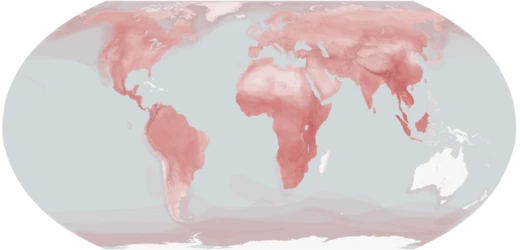
Caninae is the only subfamily of canids with living members; the other two subfamilies, Borophaginae and Hesperocyoninae, are extinct. Animals in this group are called canines. They first evolved in North America about 35 million years ago, during the Oligocene, and later spread to Asia and the rest of the Old World roughly 7 to 8 million years ago, near the end of the Miocene.
The first primitive canine was the genus *Leptocyon*, which contained 11 species. These animals were small, weighing about 2 kilograms, and first appeared in what is now Sioux County, Nebraska, around 34 to 32 million years ago, at the start of the Oligocene. This was the same time the Borophaginae appeared, and the two groups share features, suggesting they are sister groups. Unlike the Borophaginae, whose skulls and teeth were built for a powerful killing bite, *Leptocyon* was adapted for snatching small, fast-moving prey. One species, *L. delicatus*, is the smallest canid ever known. By the time the genus died out 9 million years ago, one lineage of *Leptocyon* resembled modern foxes. The various *Leptocyon* species split into two branches 11.9 million years ago: the Vulpini (foxes) and the Canini (canines).
Canines spent about two-thirds of their evolutionary history in North America before dispersing into Asia, Europe, and Africa around 7 million years ago. One trait that set them apart from the Borophaginae and Hesperocyoninae was having lighter limbs and longer legs, which may have helped them spread. The first canine to reach Eurasia was the coyote-sized *Canis cipio*, known from a few fossils found in Spain. However, it is unclear whether *C. cipio* belongs to the genus *Canis* or *Eucyon*.
Genetic analyses, including allozyme and chromosome studies, have suggested several phylogenetic divisions. DNA evidence shows that the first three groups form monophyletic clades. The wolf-like canines and the South American canines together make up the tribe Canini. Molecular data indicate that living Canidae originated in North America about 10 million years ago, and that wolf-like canines (including *Canis*, *Cuon*, and *Lycaon*) originated in Africa, with jackals being the most basal members of this group. The South American clade is rooted by the maned wolf and bush dog, while the fox-like clade is rooted by the fennec fox and Blanford's fox. The gray fox and island fox are basal to the other clades, though this arrangement is not strongly supported. A cladogram based on the phylogeny of Lindblad-Toh (2005), modified with recent findings on *Canis*, *Vulpes*, *Lycalopex*, and *Dusicyon*, illustrates these relationships.
- First appeared
- North America, Oligocene, ~35 million years ago
- Earliest genus
- Leptocyon (11 species, first in Nebraska, 34-32 million years ago)
- Dispersal to Old World
- End of Miocene, ~7-8 million years ago
- Distinctive trait
- Less weight in limbs, more length in legs
- Subgroups
- Vulpini (foxes) and Canini (canines), branched ~11.9 million years ago
Lore & Background
The subfamily Caninae, the only living group within the family Canidae, encompasses all modern canids, including wolves, foxes, and jackals. Its earliest known genus, *Leptocyon*, first appeared in what is now Sioux County, Nebraska, during the Orellan era of the Oligocene, roughly 34 to 32 million years ago. This emergence coincided with that of the extinct Borophaginae, with which *Leptocyon* shares certain features, indicating they are sister groups. *Leptocyon* species were small, weighing about 2 kg, and their skull and dentition were adapted for snatching small, fast-moving prey, in contrast to the Borophaginae, which possessed a powerful killing bite. The smallest canid known to have existed, *Leptocyon delicatus*, belonged to this genus. Canines spent roughly two-thirds of their evolutionary history in North America before dispersing into Asia, Europe, and Africa around 7 to 8 million years ago. A key defining characteristic that distinguished them from the extinct Borophaginae and Hesperocyoninae was their lighter limb bones and longer legs, an adaptation that likely facilitated their wide geographic spread. The first canine to reach Eurasia was the coyote-sized *Canis cipio*, though its classification within the genera *Canis* or *Eucyon* remains uncertain. By the end of the *Leptocyon* lineage, around 9 million years ago, one line had already come to resemble the modern fox.
Reader's Guide
Caninae spent two-thirds of their history in North America before dispersing into Asia, Europe, and Africa about 7 million years ago. Their longer legs and lighter limbs may have aided this spread. The first canine to reach Eurasia was the coyote-sized Canis cipio, found in Spain, though its classification within Canis or Eucyon remains unclear. Molecular data suggest a North American origin of living Canidae around 10 million years ago and an African origin for wolf-like canines (Canis, Cuon, Lycaon), with jackals as the most basal of that group. The South American clade includes the maned wolf and bush dog, while the fox-like clade includes the fennec fox and Blanford's fox. The gray fox and island fox are basal to other clades, though this is not strongly supported.
Did You Know?
- Leptocyon, the first primitive canine, first appeared in Sioux County, Nebraska 34-32 million years ago.
- The species L. delicatus is the smallest canid to have existed.
- Canines spent two-thirds of their history in North America before dispersing to the Old World.
- The first canine to arrive in Eurasia was the coyote-sized Canis cipio, found in Spain.
More in Carnivorans 1-21
Spotted an error? Know more?
This is a living reference — every entry is fact-audited, and reader corrections feed straight into our audit queue. Suggest an edit · See this site's audit record