Canidae
A diverse family of dog-like carnivorans found worldwide.

Canidae—from the Latin *canis*, meaning "dog"—is a family of dog-like carnivorans that form a single evolutionary branch. Its members are called canids, though they are often simply referred to as dogs. The family is divided into three subfamilies: the living Caninae (the canines, which include domestic dogs, wolves, coyotes, raccoon dogs, foxes, jackals, and others), and two extinct groups, the Borophaginae and Hesperocyoninae.
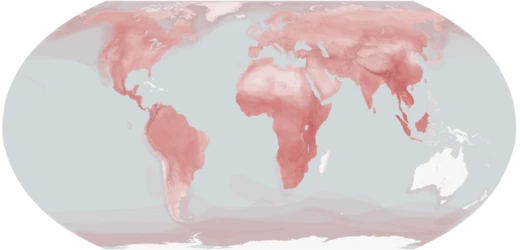
Canids live on every continent except Antarctica. They reached some landmasses on their own, while humans brought them to others over long periods. Their sizes range widely: the gray wolf can reach two meters in length, while the fennec fox measures just 24 centimeters. Despite this range, canids share a similar build—long muzzles, upright ears, teeth built for cracking bone and slicing flesh, long legs, and bushy tails. Most are social, living in family units or small groups and cooperating with one another. Typically, only one breeding pair in a group produces a litter each year, raising the pups in an underground den. They communicate through scent signals and vocalizations. One canid, the domestic dog, originated from a symbiotic relationship with Upper Paleolithic humans and is now one of the most widely kept domestic animals.
In the history of carnivores, the Canidae family includes the extinct Hesperocyoninae and Borophaginae, plus the living subfamily Caninae, which contains all modern canids and their closest fossil relatives. All living canids share a dental feature with the extinct borophagines: a bicuspid (two-pointed) lower carnassial talonid, which improves chewing. This trait, along with a distinct entoconid cusp, a broader talonid on the first lower molar, an enlarged talon on the upper first molar, and a reduced parastyle, sets these late Cenozoic canids apart and defines their evolutionary group.
The cat-like Feliformia and dog-like Caniformia split from each other within the Carnivoramorpha around 45 to 42 million years ago. The Canidae first appeared in North America during the Late Eocene, roughly 37.8 to 33.9 million years ago. They did not reach Eurasia until the Late Miocene, nor South America until the Late Pliocene.
The Canidae are a diverse group of about 37 species, ranging from the long-limbed maned wolf to the short-legged bush dog. Modern canids live in forests, tundra, savannas, and deserts across tropical and temperate regions. Early studies used physical traits to understand their evolutionary relationships, but more recent molecular research has clarified their phylogeny. In some species, genetic differences have been blurred by high gene flow between populations, and where species have hybridized, large hybrid zones have formed.
Carnivorans evolved after the non-avian dinosaurs went extinct 66 million years ago. Around 50 million years ago, or earlier in the Paleocene, the Carnivora split into two main branches: caniform (dog-like) and feliform (cat-like). By 40 million years ago, the first identifiable member of the dog family had appeared. Named *Prohesperocyon wilsoni*, its fossils come from southwest Texas. Key features marking it as a canid include the loss of the upper third molar (part of a trend toward a more shearing bite) and the structure of the middle ear, which has an enlarged bulla. *Prohesperocyon* likely had slightly longer limbs than its predecessors, and its toes were parallel and closely touching, unlike the splayed digits of bears.
Soon after, the Canidae split into three subfamilies during the Eocene: Hesperocyoninae (about 39.74 to 15 million years ago), Borophaginae (about 34 to 32 million years ago), and Caninae (about 34 to 30 million years ago, the only surviving group). Members of each subfamily grew larger over time, and some developed specialized hypercarnivorous diets that led to their extinction.
By the Oligocene, all three subfamilies had appeared in the North American fossil record. The earliest and most primitive branch, Hesperocyoninae, included the coyote-sized *Mesocyon* from the Oligocene (38 to 24 million years ago). These early canids likely evolved for fast pursuit of prey in grasslands and resembled modern viverrids. Hesperocyonines went extinct in the middle Miocene. One early hesperocyonine, *Hesperocyon*, gave rise to *Archaeocyon* and *Leptocyon*, which led to the borophagine and canine radiations.
Around 8 million years ago, the Beringian land bridge allowed members of the genus *Eucyon* to enter Asia from North America, and they continued into Europe.
The genera *Canis*, *Urocyon*, and *Vulpes* developed from canids in North America, where the canine radiation began. Their success was linked to lower carnassials that could both chew and shear. Around 5 million years ago, some Old World *Eucyon* evolved into the first members of *Canis*. In the Pliocene, about 4 to 5 million years ago, *Canis lepophagus* appeared in North America. It was small and sometimes coyote-like, while others were wolf-like. The coyote, *C. latrans*, is thought to descend from *C. lepophagus*.
The formation of the Isthmus of Panama around 3 million years ago joined South America to North America, allowing canids to invade and diversify there.
- field
- Biological family of caniform carnivorans
- known_for
- Including domestic dogs, wolves, coyotes, foxes, and jackals
- time_period
- First appeared in North America during the Late Eocene (37.8-33.9 Mya)
- subfamilies
- Caninae (extant), Borophaginae (extinct), Hesperocyoninae (extinct)
Quick Facts
- Taxon
- Canidae
- Type Genus
- Canis
- Type Genus Authority
- Linnaeus, 1758
- Subdivision
- Prohesperocyon / Hesperocyoninae / Borophaginae / Caninae
Facts from the source article.
Lore & Background
The Canidae first appeared in North America during the Late Eocene. They did not reach Eurasia until the Late Miocene or South America until the Late Pliocene. The earliest identifiable member of the dog family, Prohesperocyon wilsoni, has been found in southwest Texas and dates to around 40 Mya. Canidae soon divided into three subfamilies during the Eocene: Hesperocyoninae, Borophaginae, and Caninae. By the Oligocene, all three subfamilies had appeared in the fossil record of North America. The earliest and most primitive branch was Hesperocyoninae, which included the coyote-sized Mesocyon. Around 8 Mya, the Beringian land bridge allowed members of the genus Eucyon to enter Asia from North America and colonize Europe. The Canis, Urocyon, and Vulpes genera developed from canids in North America. Around 5 million years ago, some Old World Eucyon evolved into the first members of Canis. The formation of the Isthmus of Panama about 3 Mya allowed canids to invade South America, where they diversified.
Reader's Guide
The Canidae family represents a significant group of carnivorans that have adapted to diverse habitats including forests, tundra, savannas, and deserts throughout tropical and temperate parts of the world. Modern canids include some 37 species ranging in size from the 2-metre-long gray wolf to the 24-centimetre-long fennec fox. Their body forms are similar, typically having long muzzles, upright ears, teeth adapted for cracking bones and slicing flesh, long legs, and bushy tails. They are mostly social animals, living together in family units or small groups and behaving co-operatively. One canid, the domestic dog, originated from a symbiotic relationship with Upper Paleolithic humans and is one of the most widely kept domestic animals. The evolutionary relationships between species have been studied using morphological and molecular approaches. In some species, genetic divergence has been suppressed by high levels of gene flow and hybridization. The family's history includes multiple colonizations of Africa from Eurasia during the Pliocene and Pleistocene, and the formation of the Isthmus of Panama allowed canids to diversify in South America.
Did You Know?
- Canids are found on all continents except Antarctica.
- The family includes three subfamilies: Caninae, and the extinct Borophaginae and Hesperocyoninae.
- The earliest identifiable canid, Prohesperocyon wilsoni, has been found in southwest Texas.
- The domestic dog originated from a symbiotic relationship with Upper Paleolithic humans.
More in Carnivorans 1-21
Spotted an error? Know more?
This is a living reference — every entry is fact-audited, and reader corrections feed straight into our audit queue. Suggest an edit · See this site's audit record