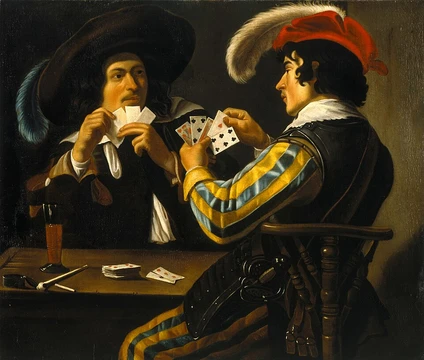
Whist
Classic English trick-taking card game of the 18th and 19th centuries.

Whist is a classic English trick-taking card game that peaked in popularity during the 1700s and 1800s. Its rules are straightforward, but the game rewards careful strategy. The name comes from a 17th-century word, *whist* or *wist*, meaning quiet, silent, and attentive—the same root as the modern word *wistful*.
The game evolved from earlier card games. In 1674, *The Complete Gamester* described Ruff and Honours as the most popular descendant of Triumph in 17th-century England. Whist emerged as a simpler, more restrained version of Ruff and Honours, played with a 52-card pack and a 10-point game, eventually replacing its predecessor in the 18th century. Around 1728, according to Daines Barrington, gentlemen first played Whist seriously at the Crown Coffee House in Bedford Row, London. Edmond Hoyle, likely a member of that group, began tutoring wealthy young men in the game and published *A Short Treatise on the Game of Whist* in 1742. This book became the standard rules text for the next hundred years. Short Whist, played in rubbers of two 5-point games in Britain and a 7-point game in America, grew popular, while the original 10-point version became known as long whist.
In 1862, Henry Jones, writing as "Cavendish," published *The Principles of Whist Stated and Explained*, which became the new standard. Jones traced the game's ancestry to a possible Italian game called Trionf, mentioned by the 16th-century poet Berni, and to Trump (or Triumph), referenced in Shakespeare's *Antony and Cleopatra*. Later editions of his book were simply titled *Cavendish on Whist*. By the late 19th century, Whist was governed by elaborate, rigid rules covering laws, etiquette, and play, requiring time to master. Official rules for Short Whist were maintained by The Portland Club in London and The Whist Club in New York. The superior American system of leads and signals was adopted in the final edition of *Cavendish*. In the early 1890s, Whist was quickly replaced by Bridge in clubs, though it continued as a social game, in duplicate competitions, and at charitable whist drives. Many modern variants exist, and the original rules are still played online.
A standard 52-card pack is used, with cards ranked A K Q J 10 9 8 7 6 5 4 3 2. The ace is the top honour. Four players draw cards to decide partnerships and the dealer. The two lowest cards play together and sit opposite each other. The highest card deals, and the second highest is their partner. The dealer chooses a pack, passes it to the left to be shuffled, then may shuffle again before passing it to the right to be cut. The dealer completes the cut and deals 13 cards to each player one at a time, turning their last card face up to set the trump suit.
The player to the dealer's left leads to the first trick. The dealer picks up the trump card when it is their turn to play. Players must follow suit if possible; otherwise, they may discard or play a trump. The trick is won by the highest card of the suit led, unless a trump is played, in which case the highest trump wins. Before the next trick, a player may ask to see the last trick's cards. The trick winner leads to the next trick.
Scoring awards one point for each odd trick (a trick beyond six) won by a pair. Long Whist originally used a game of 9 or 10 odd tricks, often with honours. American Short Whist used a game of seven odd tricks. British Short Whist used a game of five odd tricks, with the first pair to win two games winning the rubber. Honours were optional: holding three of the top four honours earned a one-trick bonus, and all four earned a two-trick bonus. Modern Short Whist commonly gives two points for three honours and four points for all four. A pair with four points cannot win game by honours and must make an odd trick. For stakes, a game is one point. If opponents score only one or two tricks, it is a double game; if they score none, it is a triple game. Winning the rubber earns a two-point bonus. Scoring can be done with pen and paper or whist markers.
Skilled players try to deduce which cards opponents hold and signal information to their partner through the cards they play. Unlike bridge, there is no bidding, so partners rely entirely on the play. Many conventions govern which card to lead, especially early in the hand, serving both as strategy and as a way to inform a partner. For example, on the first lead, a player conventionally leads their strongest suit, usually their longest. Leading an ace then a king of the same suit signals that those were the only two cards in that suit; leading king then ace indicates the player also held low cards in that suit.
- Origin
- England
- First described
- 1674 in The Complete Gamester as a version of Ruff and Honours
- Peak popularity
- 18th and 19th centuries
- Governing bodies
- The Portland Club (London) and The Whist Club (New York)
- Replaced by
- Bridge in the early 1890s
Lore & Background
Whist evolved from earlier games such as Ruff and Honours, described in 1674 as the most popular descendant of Triumph. By the 18th century, Whist, played with a 52-card pack, superseded Ruff and Honours. Jones outlined a comprehensive history, suggesting ancestors including a game called Trionf mentioned by a sixteenth century Italian poet named Berni, and a game called Trump (or Triumph) mentioned in Shakespeare's Antony and Cleopatra. Many subsequent editions were published using the simpler title Cavendish on Whist. By the later 19th century, official rules of Short Whist were maintained by The Portland Club in London and The Whist Club in New York. In the early 1890s, Whist was quickly replaced by the new game of Bridge in clubs. Whist was still played as a social game, in club individual duplicate cardplay competitions, and later at charitable social events called whist drives.
Reader's Guide
Whist's significance lies in its role as the direct predecessor of modern contract bridge and as a game that formalized trick-taking conventions. These works established elaborate and rigid rules covering the laws of the game, etiquette, and play, which took time to study and master. Whist introduced conventions for leading and signaling that allowed partners to communicate information about their hands without bidding, a system that influenced later games. The game's scoring system, including the concept of odd tricks, games, and rubbers, was carried into bridge. Whist also spawned numerous variants, including Bid whist, Dutch whist, and others classified into auction whist, Boston, classic whist, and exact bidding groups. Although replaced by bridge in clubs by the early 1890s, Whist persisted as a social game and in charitable whist drives, and its basic rules remain playable online today.
Did You Know?
- The name 'whist' comes from a 17th-century word meaning quiet, silent, attentive.
- In the early 1890s, Whist was quickly replaced by the new game of Bridge in clubs.
- The superior American system of leads and signals was adopted in the last edition of Cavendish.
More in Card Games 1-22
Spotted an error? Know more?
This is a living reference — every entry is fact-audited, and reader corrections feed straight into our audit queue. Suggest an edit · See this site's audit record