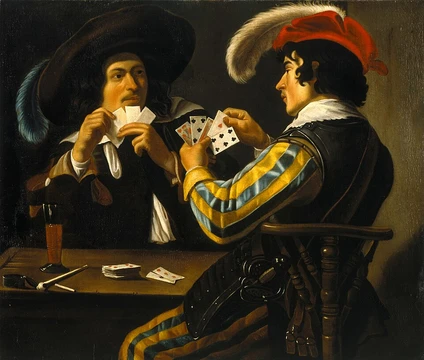
Schnapsen
National card game of Austria and Hungary.

Roland Scheicher · Public domain
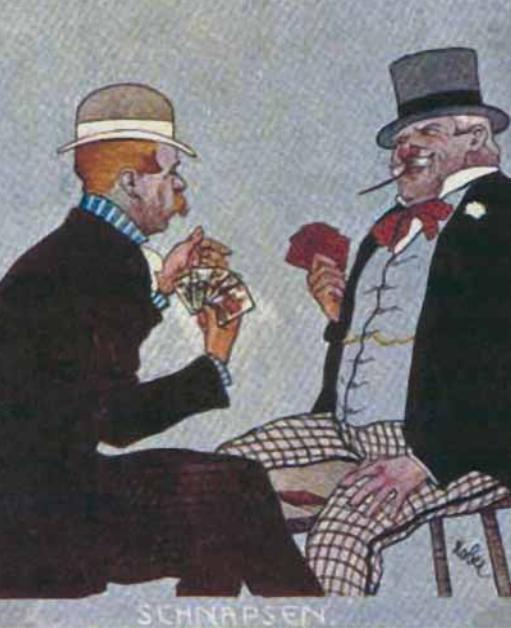
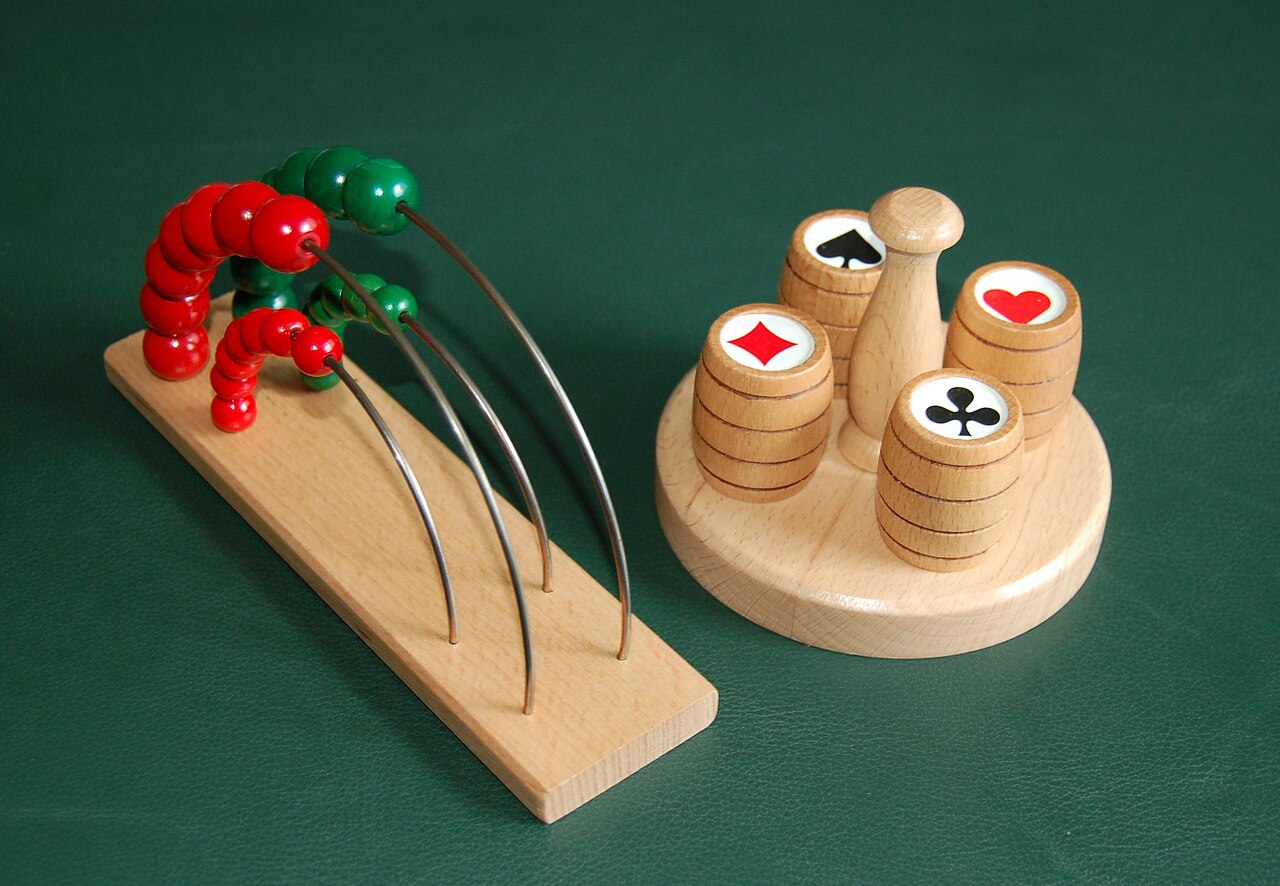
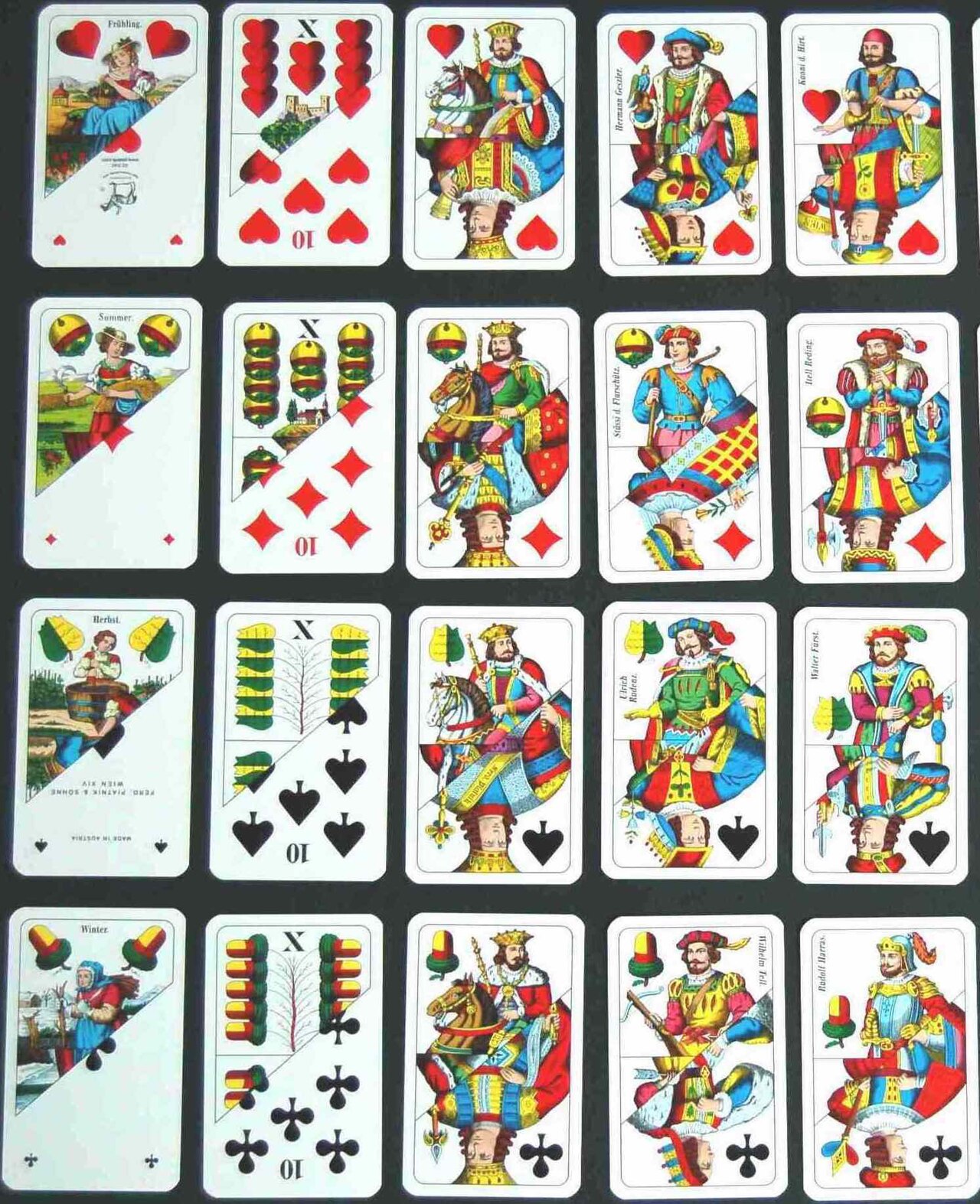
Schnapsen, Schnapser, or Schnapsa is a trick-taking card game belonging to the bézique (ace–ten) family, deeply rooted in Bavaria and the territories of the former Austro-Hungarian Empire, where it serves as the national card game of both Austria and Hungary. The game combines elements of point-trick games, where individual cards within tricks determine points similar to Pinochle, and trick-and-draw mechanics, where a new card is drawn after each trick is won. It closely resembles sixty-six (Sechsundsechzig) but uses a 20-card deck, omitting the 9s found in that game. The name likely derives from *schnappen*, meaning "to trump," though popular tradition holds it originated from playing for drinks, particularly schnaps. Schnapsen descends from Mariage, a 32-card game first described in 1715 and still played in Czechia as Mariáš. The earliest known reference to Schnapsen may be a quotation attributed to Professor Galletti (1750–1828), who reportedly told his students at the Gotha Grammar School that history could be learned in an hour, but Schnaps required years of study. Early rules were recorded by Unger around 1920. The game is played with either French or Double German cards, with special Double German-French cards used for mixed-region tournaments. The objective is to be the first to accumulate 66 or more card points from tricks and marriage melds, with each deal awarding up to three game points toward a total of seven. Play begins with a five-card hand, a trump suit determined by a turned-up card, and a talon of nine cards. Players may initially play without following suit or winning tricks, drawing cards after each trick to maintain a five-card hand. Once the talon is exhausted or closed by a player flipping the turn-up card, strict rules of following suit and winning tricks apply, with revoking penalized by an immediate loss of the deal. A player reaching 66 points may declare "enough," ending the round and scoring points based on the opponent’s total, with three points awarded if the opponent took no tricks, two if they have 32 or fewer points, and one if they have 33 or more. The game is described as inherently intense, demanding high concentration and offering unflagging strategic interest, making it less suited for casual socializing.
- type
- Card game
- family
- Bézique (ace–ten) family
- subtypes
- Point-trick, trick-and-draw
- deck
- 20 cards (French or Double German playing cards)
- players
- 2
- origin
- Bavaria and former Austro-Hungarian Empire
- national_game_of
- Austria and Hungary
Lore & Background
Schnapsen is a trick-taking card game of the bézique family, popular in Bavaria and the former Austro-Hungarian Empire, and is considered the national card game of Austria and Hungary. It combines point-trick scoring, where individual cards in each trick determine points, with a trick-and-draw mechanic, meaning a new card is drawn after each trick. The game uses a 20-card deck, unlike the similar game of Sixty-Six, which uses 24 cards; notably, the 9 is absent from Schnapsen. Depending on the region, play uses either French or Double German playing cards, with a special Double German-French pattern available for tournaments. The game’s name may come from *schnappen*, meaning “to trump,” though popular tradition links it to playing for schnaps. Schnapsen descends from Mariage, a 32-card game first described in 1715 and still played in Czechia as Mariáš. An early reference to Schnapsen is attributed to Professor Galletti (1750–1828), who told his students that history could be learned in an hour, but Schnaps required years of study. The game is known for its intense concentration and challenging strategy, with many rule variations. A defining characteristic is the “closing” of the talon, after which players must follow suit and win tricks if possible, with penalties for revoking.
Reader's Guide
Schnapsen is played with a 20-card deck (no 9s), using either French or Double German cards. The aim is to collect 66 or more card points by taking tricks, with game points awarded up to a total of 7. Players draw from a talon after each trick until it is exhausted or closed. Key features include marriages (king and queen of the same suit) worth 20 or 40 points, the ability to exchange the trump Unter for the turn-up, and closing the talon to force strict following of suit and trick-winning rules. A player who mistakenly declares 66 points loses the deal. The game is played in rounds called Bummerls, with the first to 7 game points winning. Schnapsen is considered an intense, concentration-heavy game not suited for casual socializing, but its strategic depth maintains lasting interest.
Did You Know?
- Schnapsen is the national card game of both Austria and Hungary.
- The game uses a 20-card deck, unlike the similar sixty-six which uses 24 cards.
- A player may close the talon when they believe they can reach 66 points without drawing more cards.
- The name Schnapsen may derive from schnappen ('to trump') or from playing for schnaps drinks.
Roots in the Eighteenth Century and Beyond
The name Schnapsen, rendered as Snapszer in Hungarian, most likely traces back to the German verb schnappen, meaning "to trump." A more colorful folk explanation holds that the title simply reflects the schnaps shots players wagered and consumed at the table. That ancestor survives to this day in Czechia under the name Mariáš.
The 66-Point Sprint and the Talon
Schnapsen is a two-player race to be the first to amass sixty-six or more card points, called Augen, and then declare victory by announcing "Ich habe genug" or simply "genug." The deck contains only twenty cards—five per suit, with the nine excluded—making it leaner than its close relative sixty-six, which uses twenty-four. After dealing, nine cards remain face-down as the talon, draped over a single turned-up card that designates the trump suit, regionally called the Atout. While the talon still holds cards, players enjoy considerable freedom: they may discard any card or refuse to follow suit. Once the talon is exhausted, strict obligations kick in. A player must first follow suit, then win the trick if possible, and only then may they play a trump. Violating this hierarchy is called revoking and costs the player the entire deal, handing three points to the opponent. A trump marriage of King and Ober, melded at the right moment, adds a hefty forty bonus points to the tally.
A National Pastime from Bavaria to Budapest
Schnapsen holds the distinction of being the national card game of both Austria and Hungary, and it remains enormously popular throughout Bavaria and the broader territory of the former Austro-Hungarian Empire. Its cultural footprint is visible in the very language of play: in Austrian German the court cards carry local names, with the Ober called the Manderl and the Unter called the Bauer. Depending on the region, players use either French-suited cards or the Double German pattern known as the William Tell design, and cross-regional tournaments even employ hybrid Double German-French decks to bridge the divide. The game's reputation is one of fierce concentration rather than casual sociability. It has been characterized as an inherently intense experience that demands deep focus, making it less suited to light socializing, yet its strategic depth ensures that a player's interest never wavers. The very name, tied to the spirit drink schnaps, evokes the tavern and kitchen-table settings where the game has thrived for generations.
Duelistic Structure and the Art of the Deal
Schnapsen is a pure two-player duel with no partnerships, no bidding, and no room for a third party to intervene. The dealer is chosen by drawing the higher card, and the two players alternate the dealer and forehand roles each round. Forehand always leads the first trick, and each trick consists of exactly two cards. The scoring at the end of a deal is tiered: three game points if the opponent captured not a single trick, two if the opponent holds thirty-two or fewer card points, and one if the opponent has thirty-three or more. A full match requires seven game points to win, with each individual deal worth at most three. A critical safeguard exists for the "going out" declaration: a player may only announce victory immediately after winning a trick or melding a marriage, never at an arbitrary moment. If a player mistakenly ends the deal while holding fewer than sixty-six points, play halts and the opponent collects the points the erring player would have earned had the declaration been valid. The last-trick rule provides a fallback when neither player goes out, awarding a single point to whoever wins the final card.
Gallery
More in Card Games 1-22
Spotted an error? Know more?
This is a living reference — every entry is fact-audited, and reader corrections feed straight into our audit queue. Suggest an edit · See this site's audit record