Bezique
19th-century French card game still played today.

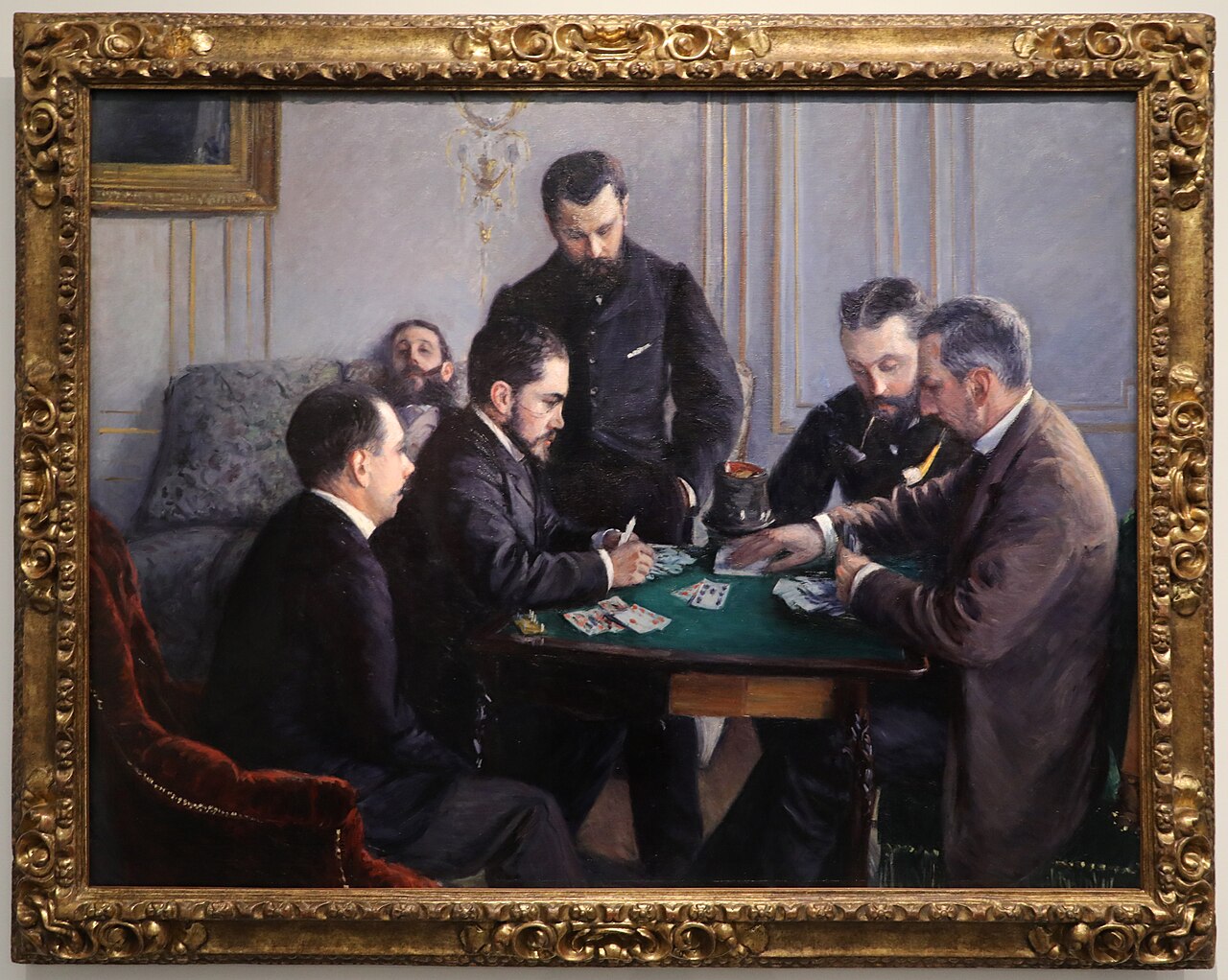
Francesco Bini · CC BY-SA 4.0
Bezique (also called bésigue) is a card game for two players that originated in 19th-century France. It combines melding and trick-taking, and was brought to Britain, where it is still played. The game comes from piquet, likely through marriage (sixty-six) and briscan, and adds special scoring features—most notably the unique pairing of the queen of spades and jack of diamonds, which also appears in pinochle, Binokel, and similar games played in different countries.
An early theory, printed in the 1864 edition of *The American Hoyle*, claimed bezique began in Sweden from a royal competition. This story, often repeated, has no evidence. The first known rules appeared in Paris in 1847, where writer Méry called it a new game, played with a single 32-card pack. Another early idea was that bezique developed in France from piquet, and that the word "bezique"—once spelled bésique or bésigue—was known in 17th-century France, possibly coming from the Italian game bazzica. More recently, French historians traced it to a game called bezi or bezit, which led through a form of single bezique (also called cinq cents or binage) to modern bezique. This matches what Anton wrote in 1879: that besigue originally came from the regions of Angouleme, Poitou, and Saintonge on France's Atlantic coast, where it was called besit. The word bezique once meant "correspondence" or "association." In English-speaking countries, Binocles—meaning eyeglasses, pronounced similarly—became the name for bezique with minor rule changes, eventually turning into pinochle. Two-handed pinochle, two-handed bezique, and two-handed binokel are nearly identical. The main difference is that binokel uses two packs of 24 German-suited cards instead of two packs of 32 French-suited ones. Pinochle, along with six-pack bezique and Rubicon bezique, is still played in the United States.
The game reached its peak popularity in Paris in 1860 and arrived in England the following year. Its most famous fan was Winston Churchill, who played often and became an early expert in six-pack, or "Chinese," bezique. There is some evidence that English writers Wilkie Collins and Christina Rossetti also enjoyed it. Since the late 19th century, the game has become less popular. The original 1847 game used a single piquet pack of 32 cards, but the rules already suggested using two packs, which would double the points. By no later than 1864 in the US, the standard two-hand game used two or even three euchre packs, also of 32 cards.
A two-handed bezique pack has 64 cards: the ace down to the seven of each suit, doubled (the twos through sixes are removed from two packs, and the remaining cards are combined). Players cut for deal; the highest card wins. Card rank in cutting and play is A, 10, K, Q, J, 9, 8, 7. Each player is dealt eight cards in batches of three, two, and three. The next card is placed face up between the players to set the trump suit. The rest of the cards, called the "talon" or "stock," are placed face down beside it. If the turned-up card is a 7, the dealer scores 10 points. The non-dealer leads any card; the dealer may then play any card. There is no requirement to follow suit. If the second player plays a higher card of the same suit or any trump, that player wins the trick. If two cards of the same rank are played, the first player wins the trick. Tricks are placed face down by the winner. The player holding the trump 7 may exchange it for the turn-up card at any time when on lead, scoring 10 points. The holder of the duplicate trump 7 also scores 10 when it is played.
After winning a trick, the winner declares one meld face up on the table, scores points for it, draws a card from the top of the stock, and leads to the next trick. The other player draws the second card from the stock but may not declare a meld. Play continues until the stock is empty, then eight more tricks are played to empty the players' hands. Finally, brisques are scored. The game is usually played to 1,000 points.
To score a meld, all cards in the combination must be in hand at the same time. Cards already played to tricks cannot be used. Cards already declared may be used for other melds of a different type, as long as the point score is higher. For example, four kings may be declared using a king previously declared in a marriage. A marriage cannot later be declared using a king already in a meld of four kings, since the score is lower. A card played to a trick is no longer available for play; it is taken by the winner and placed face down on a separate pile. At the end of the game, each player counts the brisques (aces and tens) they have won in tricks, each worth 10 points. A player may declare a meld only after winning a trick. The winner of each trick may score one meld, or several depending on local rules, by laying the cards face up. If the exposed cards show two combinations, both may be declared, but only one scored until another trick is won. For example, holding K♠, Q♠, J♦ scores 40 for bezique, with another 20 to score after the next trick. Once a card is melded, it cannot be used again in the same combination. It may be used for a different type of meld—for instance, a queen of hearts, once married, cannot be married to the other king of hearts, but it may be used as part of four queens or as part of a sequence if it is of the trump suit.
- Origin
- France
- Number of players
- 2
- Pack composition
- 64 cards (ace down to seven of each suit doubled)
- Notable proponent
- Winston Churchill
Quick Facts
- Title
- Bezique
- Subtitle
- (Bésigue)
- Players
- 2
- Num Cards
- 64 (double 32-card pack)
- Deck
- Piquet
- Card Rank
- A 10 K Q J 9 8 7
- Origin
- France
- Related
- BinokelMarjoletPinochle
- Playing Time
- 25 min.
Facts from the source article.
Lore & Background
Bezique is a two-player melding and trick-taking card game that originated in 19th-century France and was later imported to Britain, where it is still played. The game is derived from piquet, possibly through the intermediary games of marriage (sixty-six) and briscan, and features additional scoring elements, notably the unique pairing of the queen of spades and jack of diamonds, a characteristic shared with pinochle, binokel, and similar games. The first known rules appeared in Paris in 1847, describing a game played with a single 32-card piquet pack. French historians later traced its origins to a game called bezi or bezit, which descended through a form of single bezique to early modern bezique. The word "bezique" once meant "correspondence" or "association." In English-speaking nations, the name "binocles" (meaning eyeglasses) became associated with bezique under minor rule variations, eventually evolving into pinochle. Two-handed pinochle, two-handed bezique, and two-handed binokel are almost identical, though binokel uses two packs of 24 German-suited cards instead of two packs of 32 French-suited ones. By 1860, bezique had achieved great popularity in Paris, reaching England in 1861. Notable enthusiasts included Winston Churchill, an early expert of six-pack or "Chinese" bezique, as well as writers Wilkie Collins and Christina Rossetti. The standard two-hand game evolved to use two or three euchre packs of 32 cards each. Play involves dealing eight cards per player, a turned-up trump card, and a stock. Players do not need to follow suit. After winning a trick, a player may declare melds—such as sequences, four of a kind, or marriages—and score points. The game proceeds until the stock is exhausted, after which eight more tricks are played. Points are also awarded for brisques (aces and tens won in tricks). The game is typically played to 1,000 points.
Reader's Guide
Bezique is a two-player card game that originated in France in the 19th century, first appearing in published rules in Paris in 1847, where it was described as a new game. It is a melding and trick-taking game derived from piquet, possibly through the intermediary games of sixty-six and briscan. A distinctive feature shared with pinochle, binokel, and similar games is the special scoring combination of the queen of spades and jack of diamonds. The standard two-handed version uses a 64-card pack, formed by combining two 32-card piquet packs (stripped of cards from two to six). Eight cards are dealt to each player, the next card is turned up to set the trump suit, and the remaining cards form a stock. Players do not have to follow suit. After winning a trick, a player may declare a meld, scoring points for combinations such as four kings, four queens, or the eponymous bezique (queen of spades and jack of diamonds). Cards used in one meld can be reused in a different, higher-scoring meld. At the end of the hand, players score ten points for each ace or ten (called brisques) they have captured in tricks. The game is typically played to 1,000 points. Bezique reached its peak popularity in Paris around 1860 and arrived in England the following year. Its most famous enthusiast was Winston Churchill, an early expert of the six-pack variant known as "Chinese" bezique. The game has since declined, though pinochle, six-pack bezique, and Rubicon bezique are still played in the United States.
Did You Know?
- The word 'bezique' does not mean 'correspondence' or 'association'; it likely derives from French 'bésigue' or Italian 'bazzica'.
- In German-speaking nations, 'Binokel' (or 'Binocle') is a variant of Bezique, and Pinochle evolved from Binokel, not from English 'Binocles' (meaning eyeglasses).
- The holder of the trump 7 may exchange it for the turn-up card when on lead, but this exchange itself does not award points in standard bezique.
Origins & Etymological Roots
The game's true birthplace remains a matter of scholarly debate. Far more credible evidence points to France. French historians have since traced the lineage back to a regional game called bezi or bezit, played along the Atlantic coast in areas like Angouleme, Poitou, and Saintonge. The name itself likely derives from the Italian card game bazzica, and in earlier French usage the word carried the meaning of 'correspondence' or 'association' — a fitting descriptor for a game built around pairing cards. The peculiar union of the Q♠ and J♦, central to bezique's identity, also appears in pinochle, Binokel, and other related games across different countries.
Structure & Core Gameplay
A standard two-handed bezique game uses a 64-card pack — essentially two 32-card piquet decks with the twos through sixes removed and the remaining cards combined. Players cut for deal, with the highest card winning the right to deal. Each receives eight cards dealt in batches of three, two, and three. The next card is turned face up to name the trump suit, and the rest form the face-down stock. One of bezique's most distinctive rules is that players are not required to follow suit; instead, a trick is won by playing a higher card of the same suit or any trump. The holder of the trump seven may swap it for the turn-up card at any point while on lead, earning ten points. After winning a trick, the player declares a meld, draws from the stock, and leads to the next trick. The opponent draws the second card but cannot declare. Once the stock runs out, eight final tricks are played, and brisques are tallied.
Melding & Scoring Architecture
Bezique's scoring system rewards both strategic card-holding and precise timing. A meld must be declared only after winning a trick, and all cards in the combination must still be in hand — previously played cards cannot be retrofitted. The most celebrated combination is the bezique itself, the Q♠ paired with the J♦, worth 40 points. Other melds include marriages, sequences, and sets of four of a kind. A card already used in one meld may be redeployed in a different type of meld, provided the new combination scores more than the original; the reverse is forbidden. For instance, a king declared in a marriage can later join a four-kings meld, but not the other way around. Brisques — aces and tens won in tricks — are each worth ten points and are counted at the game's end. The standard target is 1,000 points, making each meld declaration a calculated risk weighed against the opponent's likely holdings.
Cultural Peak & Long Decline
Bezique's golden era arrived in the early 1860s. It attracted an impressive roster of devotees: Winston Churchill became a noted expert in the six-pack or 'Chinese' variant, while English literary figures Wilkie Collins and Christina Rossetti were also known enthusiasts. The game's influence radiated outward — in English-speaking countries, minor rule variations produced Binocles, which eventually evolved into pinochle. Two-handed pinochle, two-handed bezique, and two-handed binokel remain nearly identical in structure, differing mainly in card packs: binokel uses two 24-card German-suited decks rather than two 32-card French-suited ones. In the United States, pinochle, six-pack bezique, and Rubicon bezique continue to be played. Yet since the late nineteenth century, the game has steadily lost ground, retreating from parlour to niche, though dedicated players still gather around the table.
Gallery
More in Card Games 1-22
Spotted an error? Know more?
This is a living reference — every entry is fact-audited, and reader corrections feed straight into our audit queue. Suggest an edit · See this site's audit record