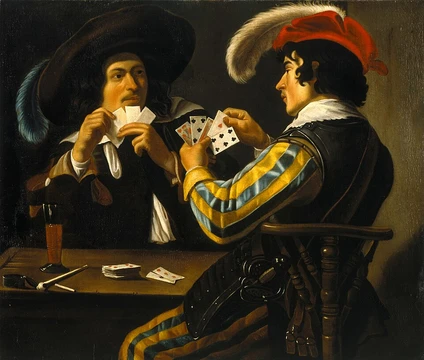
Concentration (card game)
A memory-based card game played with face-down pairs.

Matthew (WMF) · CC BY-SA 3.0
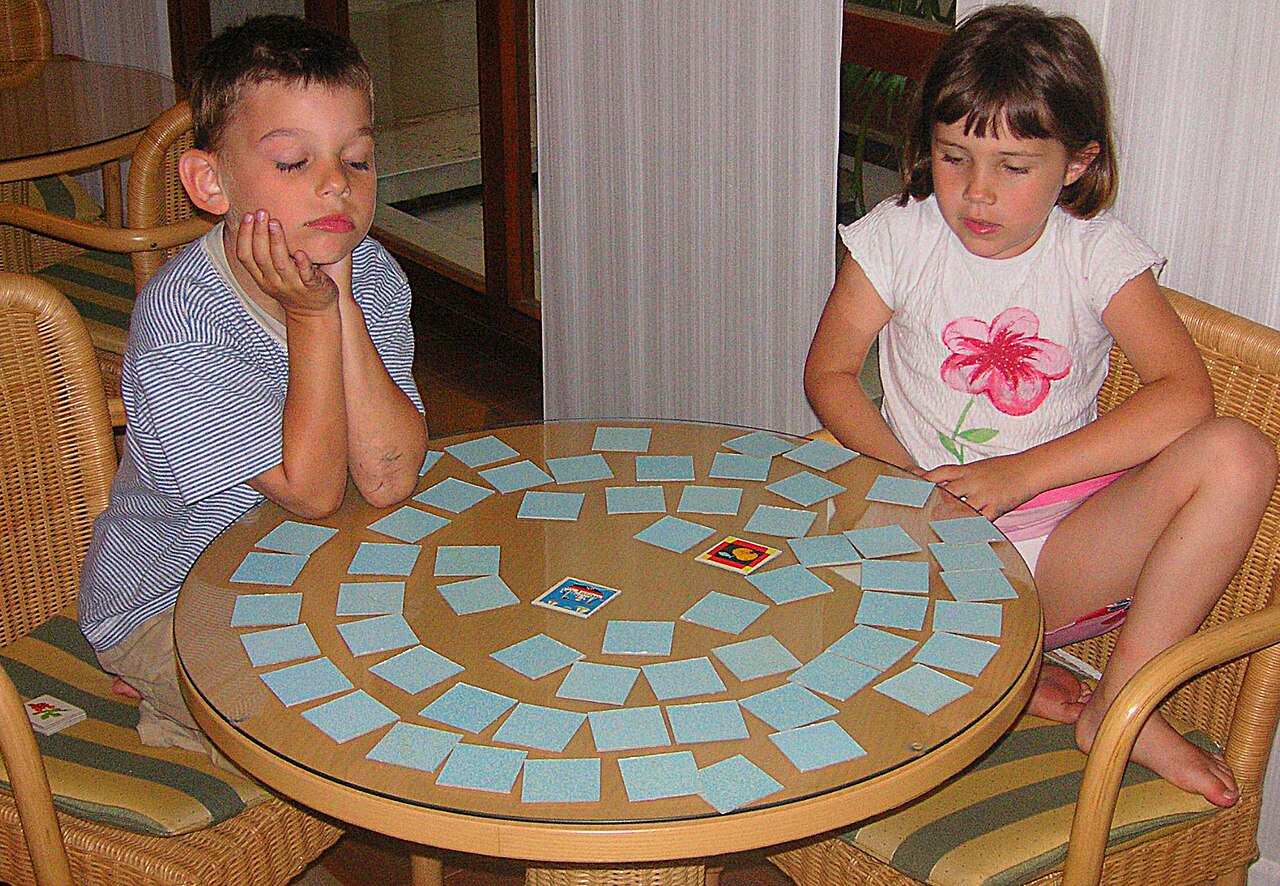
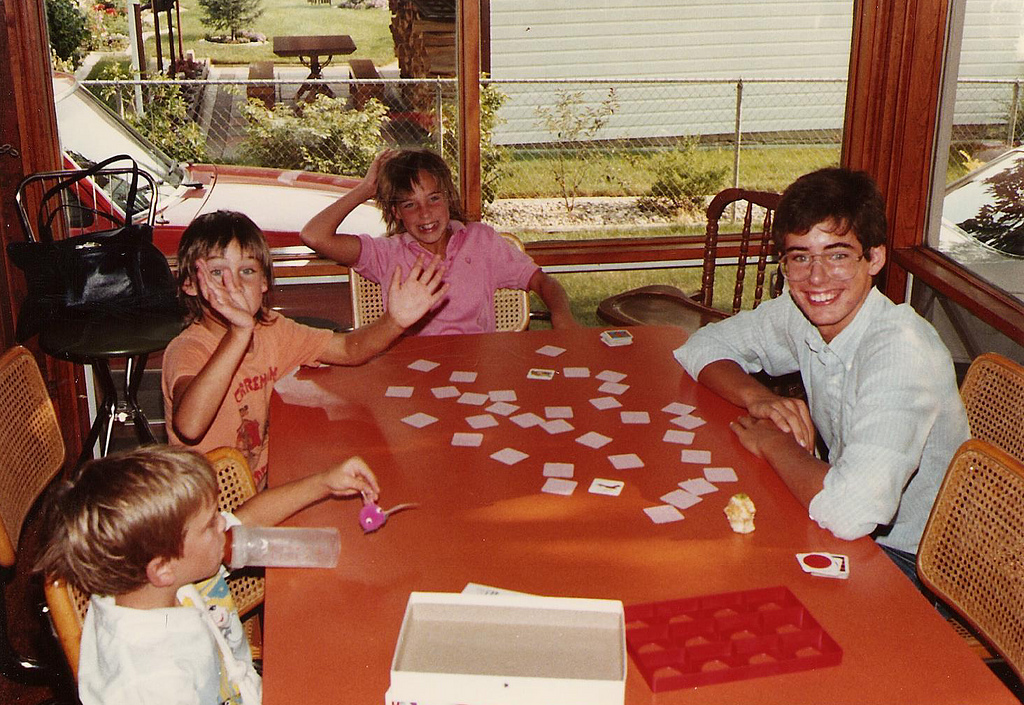
Concentration is a game where all cards are placed face down on a surface, and players flip two cards face up per turn, aiming to find matching pairs. It can be played by any number of people, alone as a solitaire or patience game, or used in quiz shows and educational settings. The game is especially good for young children but can also challenge and stimulate adults.
The game is also known as Memory, Matching Pairs, Match Match, Match Up, Pelmanism, Pexeso, or simply Pairs.
Any deck of playing cards works, though commercial sets with images exist. With a standard 52-card deck, cards are usually laid in four rows of thirteen. Including both jokers allows for six rows of nine. Extra packs can add interest, and cards may be spread anywhere, even around a room. Players take turns choosing two cards and turning them face up. If the cards match in rank and color (e.g., six of hearts and six of diamonds, or both jokers), the player wins the pair and takes another turn. If they don’t match, the cards are turned back over, and play passes left. Before starting, players can agree to match by rank only, or by both rank and suit. The game ends when the last pair is claimed, and the player with the most pairs wins, with ties possible.
In solitaire, the game can be played casually or scored by tracking non-matching pairs turned over (using chips, pennies, or marks). The goal is to clear the tableau in as few turns as possible. With perfect memory and optimal play, the expected number of moves for a deck of n cards approaches about 0.8n, or roughly 41.6 moves for a standard 52-card deck.
Strategy relies on memory: as the game progresses, players learn where certain cards are. A common mistake is to flip a card one is sure of first, then fail to find its match. A better approach is to flip a less certain card first, so if wrong, one doesn’t waste a sure match. With perfect memory, an ideal strategy for the One Flip variation is to flip an unknown card first. If it matches a known card, take that match. If not, choose one of the known cards to minimize information given to opponents. Exceptions occur when n is 0 or 1, or near the game’s end.
Variations include: Any Color (match by rank only, good for young children; jokers count double); One Flip (players who match do not get an extra turn); Zebra (match by rank but opposite color); Two Decks (shuffle two 52-card decks, lay in 8 rows of 13 or 9 rows of 12 with jokers, matches must be identical in rank and suit); Two Decks Duel (two players each lay out their own 52-card deck in 4 rows of 13, cannot access each other’s cards; player one flips a card, player two selects one from their own side; if they match, cards are removed; roles swap each turn); and Double Decker Checkerboard (a slightly easier two-pack version using decks with different backs).
- Also known as
- Memory, Matching Pairs, Match Match, Match Up, Pelmanism, Pexeso, Pairs
- Typical deck
- Standard 52-card deck, possibly with jokers
- Number of players
- Any number, or solitaire
- Objective
- Collect the most matching pairs
- Game end
- When the last pair is picked up
Lore & Background
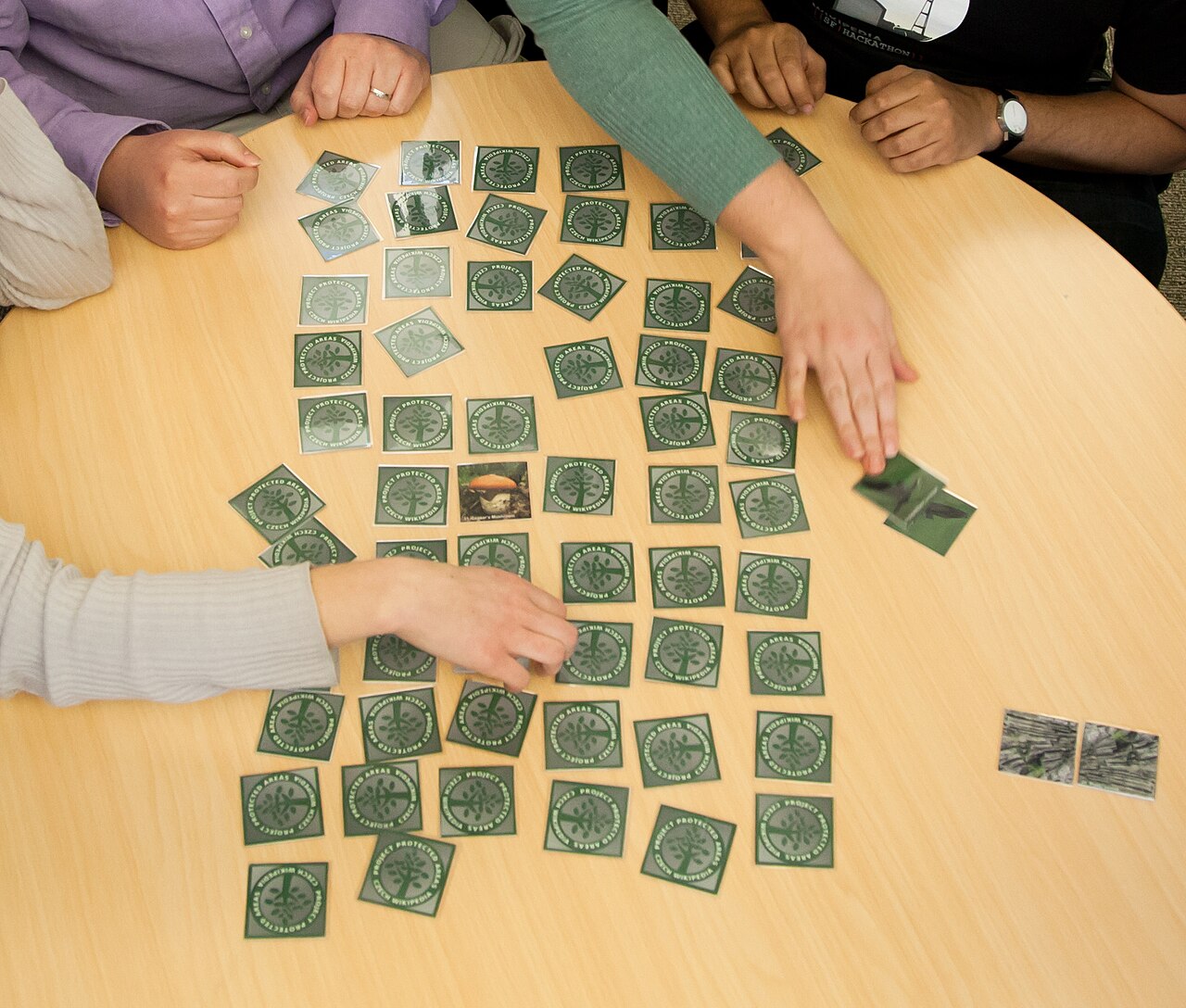
Concentration is played by laying all cards face down on a surface. In turn, each player chooses two cards and turns them face up. If they are of the same rank and color (e.g., six of hearts and six of diamonds), that player wins the pair and plays again. If not, they are turned face down again and play passes to the left. Rules can be varied: matching may require only the same rank, or both rank and suit. The game ends when the last pair is picked up, and the winner is the person with the most pairs. Concentration may be played solo either as a leisurely exercise or with scoring: the player keeps track of non-matching pairs turned over, aiming to clear the tableau in the fewest turns. With perfect memorization and optimal strategy, the expected number of moves for a standard 52-card deck is approximately 41.6 moves. Strategy involves turning over a less certain card first to avoid wasting a known match, and an ideal strategy for the One Flip variation is described mathematically. Numerous variations exist: Any Color (match by rank only), One Flip (players do not go again after a match), Zebra (match by rank but opposite color), Two Decks (identical rank and suit), Two Decks Duel (divided playing field), Double Decker Checkerboard (different backs in checkerboard pattern), Fancy (non-rectangular layouts), Spaghetti (cards strewn randomly), and Pexeso (64 square cards in an 8×8 grid). The game is not limited to playing cards; many children's versions have different themes, and in some computer versions cards may randomly move to increase difficulty.
Reader's Guide
Concentration is significant as a simple yet effective memory game that has been adapted for entertainment and education. Its core mechanic—flipping two cards per turn to find matching pairs—has been used in numerous quiz shows, some of which have used its name in their titles. The game's rules are highly flexible, allowing for variations that suit different ages, skill levels, and settings, from casual family play to competitive solitaire scoring. The mathematical analysis of optimal play, including the expected number of moves for a perfect-memory player, demonstrates its depth as a strategic exercise. Its legacy includes commercial card sets, computer versions, and its role as a foundational game for developing memory skills in young children. The variety of names—Memory, Matching Pairs, Pelmanism, Pexeso—reflects its widespread popularity across cultures.
Did You Know?
- Concentration is also known as Memory, Matching Pairs, Match Match, Match Up, Pelmanism, Pexeso, or simply Pairs.
- With perfect memorization and optimal strategy, the expected number of moves for a standard 52-card deck is approximately 41.6.
- In the Zebra variation, pairs must be of the same rank but opposite in color.
- The game can be played blindfolded if the opponent announces which cards have been turned up.
Gallery
More in Card Games 1-22
Spotted an error? Know more?
This is a living reference — every entry is fact-audited, and reader corrections feed straight into our audit queue. Suggest an edit · See this site's audit record