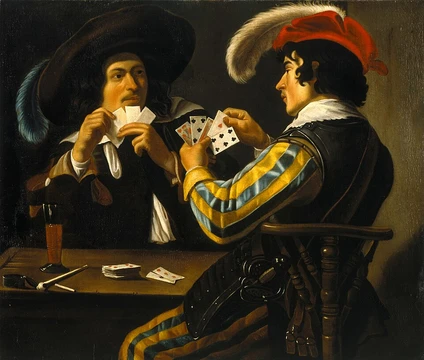
Trick-taking game
Card- or tile-based games centered on winning tricks.

A trick-taking game is a card or tile game where each hand is built around a series of fixed rounds, called tricks (or sometimes books). Each trick is played and then judged to determine who takes it. The goal of the game may depend on how many tricks a player collects—as in plain-trick games like contract bridge, whist, and spades—or on the point value of the cards inside those tricks, as in point-trick games like pinochle, the tarot family, briscola, and most evasion games such as hearts. In trick-and-draw games, players refill their hands after each trick. In trick-avoidance games like reversis or polignac, the aim is to avoid taking certain tricks or any tricks at all. The domino game Texas 42 is an example of a trick-taking game that uses tiles instead of cards.
The earliest card games were trick-taking games, with their rank-and-suit structure originating in ancient China and spreading westward in the early second millennium. Michael Dummett observed that these early games shared several features: they were played without trumps, following suit was not required (the highest card of the led suit won), rotation was counter-clockwise, they were plain-trick games, and the pip cards of one or more suits were in reverse order so that lower cards beat higher ones. Two major revolutions in European trick-taking games led to more complex play: the invention of trumps and the requirement to follow suit, both in the 15th century, and the introduction of bidding in the 17th century.
According to card game researcher David Parlett, the oldest known European trick-taking game is Karnöffel, mentioned in 1426 in the Bavarian town Nördlingen—about fifty years after playing cards first appeared in Europe (first recorded in Spain in 1371). Karnöffel is also the oldest known game where certain cards had special privileges: specific ranks of one suit were named Karnöffel, Devil, Pope, and so on, with an elaborate system of variable powers. However, these were not trumps in the sense of a suit whose cards uniformly beat all other suits. Around 1440 in Italy, special cards called trionfi were introduced with exactly that function. These trionfi are now known as tarots, and a deck that includes them is a tarot deck. The trionfi/tarots formed essentially a fifth suit, without ordinary ranks, consisting of trumps in a fixed hierarchy. A similar effect can be achieved by declaring all cards of a fixed or randomly chosen suit to be trumps—a method that originated with triomphe and is still used in many modern trick-taking games without an auction. Trumps were later added to some existing games, such as trappola, but it is much rarer for them to be removed. The invention of trumps became so popular that very few European trick-taking games exist without them, though this did not stop the two-handed game piquet from becoming the most popular card game in Europe during the 16th century. Parlett suggests that trumps gave players in games with more than two participants a better chance of winning a trick.
The invention of bidding for a trump suit is credited to ombre, the most popular card game of the 17th century. Instead of a randomly selected trump suit, players could now hold an auction for it. The most popular game of the 18th century was tarot, which experienced a major revival, and many tarot games borrowed bidding over the stock (taroc l'hombre). In the 20th century, whist—now with bidding and a dummy hand—evolved into contract bridge, the last global trick-taking game.
The practice of counting tricks in plain-trick games likely came from counting the cards won in tricks. It was a logical step to give some cards a higher counting value and others none at all, leading to point-trick games. These are at least as old as tarot decks and may even predate the invention of trumps. Elfern and Fünfzehnern are possible early examples, though the earliest references to them date from the 18th century. Nearly all point-trick games are played with tarot decks or stripped decks, which became standard in many countries before 1600. Neither point-trick games nor stripped decks have a tradition in England. While some games have unusual card-point values, such as trappola and all fours, most point-trick games belong to the large family of ace–ten card games that began with brusquembille. Pinochle, a representative of this family, is popular in the United States; other examples include belote and skat.
In contrast to Europe, Chinese trick-taking games did not develop trumps or bidding. Instead, they diverged into multi-trick games, where melds can only be beaten by other melds of the same number of cards. During the Qing dynasty, these multi-trick games evolved into the earliest draw-and-discard games, where the goal was to form melds and "go out" rather than capture opponents' cards. Khanhoo is an example of a multi-trick game that became a draw-and-discard game. Multi-trick games are also likely the source for climbing games like Zheng Shangyou and dou dizhu, which first appeared during the Cultural Revolution.
In trick-taking games with three or more players, certain actions always proceed in the same direction. In games from North and West Europe, including England, Russia, and the United States and Canada, rotation is typically clockwise (play goes to the left). In South and East Europe, South America, and Asia, it is typically anticlockwise (play goes to the right).
- earliest known European game
- Karnöffel, mentioned in 1426 in Nördlingen
- first mention of playing cards in Europe
- Spain, 1371
- invention of trumps
- 15th century
- invention of bidding
- 17th century
- most popular 17th-century game
- ombre
- most popular 18th-century game
- tarot
- last global trick-taking game
- contract bridge
Lore & Background
The earliest card games were trick-taking games, originating from ancient China and spreading westwards during the early second millennium. These early games were played without trumps, did not require players to follow suit, and used counter-clockwise rotation. They were plain-trick games, where the goal was simply to win tricks, and the pip cards of one or more suits were in reverse order, meaning lower cards beat higher ones. Two major revolutions in European trick-taking games led to more sophisticated play. The first, in the 15th century, was the invention of trumps—special cards or a designated suit that outrank all others—along with the requirement to follow suit, which constrained the power of trumps. The second was the introduction of bidding for the trump suit in the 17th century, allowing players to auction for the right to name trumps. Trick-taking games are defined by a series of finite rounds called tricks, where each player plays a card (or tile) and the highest card of the led suit, or the highest trump, wins the trick. The object may be to take the most tricks (plain-trick games like contract bridge, whist, and spades) or to capture cards of high point value (point-trick games like pinochle, tarot, briscola, and evasion games like hearts). Some games are trick-avoidance, where the aim is to take no tricks. Trick-and-draw games allow players to refill their hands after each trick. The domino game Texas 42 is an example of a non-card trick-taking game.
Reader's Guide
Trick-taking games have shaped the history of card games globally. The invention of trumps around 1440 in Italy, with special cards called trionfi (later tarots), created a fifth suit with a fixed hierarchy, a feature retroactively added to some games. Bidding for a trump suit, credited to ombre in the 17th century, allowed players to auction for the trump suit rather than having it randomly selected. In the 20th century, whist with bidding and the dummy hand developed into contract bridge, the last global trick-taking game. Point-trick games, at least as old as tarot decks, assign counting values to cards, with most belonging to the ace–ten family beginning with brusquembille. Chinese trick-taking games did not develop trumps or bidding, instead diverging into multi-trick games that evolved into draw-and-discard games and climbing games like Zheng Shangyou and dou dizhu.
Did You Know?
- The oldest known European trick-taking game, Karnöffel, was mentioned in 1426 in the Bavarian town Nördlingen.
- The invention of trumps is credited to special cards called trionfi introduced around 1440 in Italy.
- Bidding for a trump suit was invented in the 17th-century game ombre.
- The domino game Texas 42 is an example of a trick-taking game that is not a card game.
More in Card Games 1-22
Spotted an error? Know more?
This is a living reference — every entry is fact-audited, and reader corrections feed straight into our audit queue. Suggest an edit · See this site's audit record