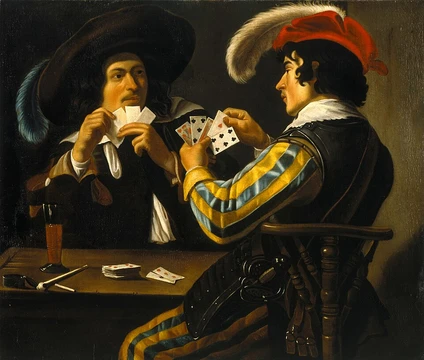
Tarot card games
Trick-taking games with a permanent trump suit, originating in Italy.

Tarot card games are trick-taking games played with specialized packs that feature a permanent trump suit in addition to the usual four suits. Originating in Italy, where they remain a stronghold, these games spread to France and Switzerland in the 16th century, then to Belgium in the late 17th century, and across much of Europe during the 18th century, though they never took hold in the British Isles, the Iberian peninsula, or the Balkans. The earliest known trump suit was ordered around 1420 by Filippo Maria Visconti, featuring 16 trumps depicting Greek and Roman gods, with a basic description appearing in a manuscript written before 1425. The first detailed rules for a tarot game were published in 1637 by the Abbé de Marolles, describing a three-player variant using a 66-card pack derived from a standard 78-card Italian-suited deck. In this variant, players declared card combinations for payments, and scoring was based on trick points. Tarot decks were invented purely for gaming, not for occult purposes; the association with ancient wisdom began with an essay by Court de Gébelin in 1781, later debunked. Tarot games are increasingly popular in Europe, especially in France, where French tarot is the second most popular card game after Belote. In Austria, Tarock games like Königrufen are widespread, with major national and international tournaments. Other countries where tarot family games are played include Hungary, Slovenia, Liechtenstein, Czechia, Slovakia, Switzerland, Denmark, southern Germany, and southern Poland. Deck compositions vary regionally: a full 78-card deck is used for French Tarot, while Austrian-Hungarian Tarock and Italian Tarocco decks are smaller, ranging from 63 down to 36 cards, with pip cards removed to increase the chance of void suits. Regional decks also differ in suit symbols, with Latin suits used in parts of Italy and Switzerland, and French suits elsewhere. The 78-card deck includes 14 cards per suit (pip cards from Ace to ten, plus four court cards), 21 numbered trumps, and the Fool, an unnumbered card that may excuse a player from following suit or act as the strongest trump. The 54-card Tarock deck retains 8 cards per suit and 22 trumps, including the Sküs, Mond, and Pagat as special honours.
- earliest_known_deck
- c. 1420, ordered by Filippo Maria Visconti with 16 trumps
- earliest_rule_description
- 1637, by Abbé de Marolles in Nevers
- common_deck_sizes
- 78, 66, 63, 54, 40, or 36 cards
- typical_number_of_players
- 2 to 8, most commonly 3 or 4
- key_regions
- France, Austria, Italy, Hungary, Slovenia, Czechia, Slovakia, Switzerland, Denmark, south Germany, south Poland
- notable_variant
- Königrufen in Austria
Lore & Background
Tarot games are played with specially designed packs that include a permanent trump suit alongside the usual four suits. These packs and games are known by various names across Europe, such as *tarocchi* in Italian and *Tarock* in German. The introduction of trumps, originally called *trionfi*, represents one of the two major innovations in trick-taking games, the other being bidding. The earliest known trump suit was commissioned around 1420, featuring sixteen trumps depicting Greek and Roman gods. Tarot decks were created solely for gaming, not for occult purposes, a misconception that arose later. Tarot games are increasingly popular in Europe, particularly in France, where French tarot is the second most popular card game, and in Austria, where games like Königrufen are widespread with major tournaments. Italy remains a stronghold, and the games are also played in Hungary, Slovenia, and other regions. A complete tarot deck typically contains seventy-eight cards: fourteen cards in each of four suits (including pip cards from one to ten and four court cards), twenty-one tarots as a permanent trump suit, and the Fool, an unnumbered card that may excuse the player from following suit or act as the strongest trump. Regional decks vary, with Austrian-Hungarian and Italian decks using smaller subsets of cards to increase the chance of void suits. The suits themselves differ by region: Latin suits of Cups, Coins, Clubs, and Swords are used in parts of Italy and Switzerland, while French suits of Hearts, Diamonds, Clubs, and Spades are used elsewhere. The trump suit is ranked by large numerals. Tarot can be played by two to eight players, with most rules designed for three or four, and players may compete individually, in fixed partnerships, or with variable alliances.
Reader's Guide
Tarot games are increasingly popular in Europe, especially in France where French tarot is the second most popular card game after Belote. In Austria, Tarock games, especially Königrufen, have become widespread with several major national and international tournaments each year. Italy, the home of tarot, remains a stronghold. Games of the tarot family are also played in Hungary, Slovenia, Liechtenstein, Czechia, Slovakia, Switzerland, Denmark, south Germany and south Poland. The earliest detailed description of rules for a tarot game was published by the Abbé de Marolles in Nevers in 1637, describing a three-player variant with a 66-card pack. As a result, tarot cards have since been used for cartomancy and divination as well as gaming, though fortune-tellers now tend to use specially developed decks rather than those used for games.
Did You Know?
- The earliest known tarot deck with trumps was ordered by Filippo Maria Visconti around 1420.
- The first detailed rules for a tarot game were published in 1637 by the Abbé de Marolles.
- In Austrian Tarock, the three highest trumps (Sküs, Mond, Pagat) are collectively called the Trull or Honours.
More in Card Games 1-22
Spotted an error? Know more?
This is a living reference — every entry is fact-audited, and reader corrections feed straight into our audit queue. Suggest an edit · See this site's audit record