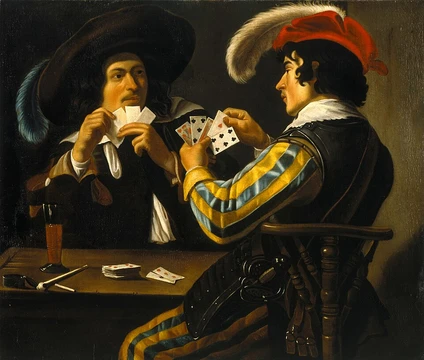
Standard 52-card deck
The most common playing card deck used worldwide.

The standard 52-card deck of French-suited playing cards is the most common pack of playing cards used today. In English-speaking countries, it is the predominant traditional pack for card games, though other types such as tarot and specialty packs also exist. A key feature is the double-sided design: the backs of all cards are identical to conceal each card’s identity during play, while the faces are unique, displaying a suit and rank used in game mechanics. The deck comprises 13 ranks in each of four suits: clubs, diamonds, hearts, and spades. Each suit includes three court cards (King, Queen, and Jack) with reversible, double-headed images, and ten numeral or pip cards from one (Ace) to ten. Each pip card shows the number of suit symbols corresponding to its rank, along with the appropriate numeral (except "A" for the Ace) in at least two corners. Commercial decks often include from one to six Jokers, most commonly two or three since the mid-20th century; these are not part of the standard 52 cards and are used only in games that require them, or as replacements for lost or damaged cards. The number of cards actually used can vary by game, as some formats remove certain ranks before play; for instance, many traditional European card games use shortened decks of 32 or 36 cards. Worldwide, the most common design for French-suited cards is the English pattern, also known as the Anglo-American or International pattern. The second most common is the Belgian–Genoese pattern, designed in France for export and spread to Spain, Italy, the Ottoman Empire, the Balkans, and much of North Africa and the Middle East. Other regional patterns include the Berlin, Nordic, and Dondorf Rhineland patterns. Modern playing cards carry index labels on opposite corners or all four corners to facilitate identification when cards overlap and to appear identical for players on opposite sides. For Ace and court cards, this label is the initial letter or letters of the name: in English, A, K, Q, and J. Other countries use different letters, such as Germany (A, K, D, B), Russia (Т, К, Д, В), Sweden (E, K, D, Kn), and France (1, R, D, V). All early playing cards were single-headed, but during the 19th century, manufacturers began designing double-headed cards so they could be identified whichever way up they were. Today, modern French-suited cards are invariably double-headed, while sin
- composition
- 52 cards: 4 suits × 13 ranks (Ace, 2–10, Jack, Queen, King)
- suits
- Clubs (♣), Diamonds (♦), Hearts (♥), Spades (♠)
- jokers
- Usually 2–3 since mid-20th century, not part of standard 52
- common_patterns
- English pattern (international), Belgian–Genoese pattern, others
Lore & Background
The standard 52-card deck of French-suited playing cards is the most common pack used today. Its defining feature is the double-sided design: all card backs are identical to conceal identity, while each face displays a unique suit and rank. The deck comprises 13 ranks in each of four suits: clubs, diamonds, hearts, and spades. Each suit includes three court cards (King, Queen, and Jack) with reversible, double-headed images, and ten numeral or pip cards from one to ten, with the one-pip card called an Ace. Pip cards show the number of suit symbols corresponding to their rank, plus the numeral (or "A" for the Ace) in at least two corners. Many commercial decks also include one to six Jokers, most commonly two or three since the mid-20th century, which are often distinguishable in design or color and may serve as replacements for lost cards. The most popular design worldwide is the English pattern, also known as the Anglo-American or International pattern. The second most common is the Belgian-Genoese pattern, designed in France for export and spread to Spain, Italy, the Ottoman Empire, the Balkans, and much of North Africa and the Middle East. Other regional patterns include the Berlin, Nordic, and Dondorf Rhineland patterns. Modern cards carry index labels on opposite corners or all four corners to aid identification when cards overlap; these labels use letters like A, K, Q, J in English-speaking countries, with variations elsewhere (e.g., Germany uses A, K, D, B). While early playing cards were single-headed, 19th-century manufacturers introduced double-headed designs so cards could be identified regardless of orientation; today, French-suited cards are invariably double-headed. Standard deck sizes vary by region, with 36-, 40-, 48-, and 52-card packs common depending on local traditions.
Reader's Guide
The standard 52-card French-suited deck is the predominant traditional pack for card games in English-speaking countries and is used internationally. The deck is delivered in New Deck Order (NDO): two Jokers (if any), then Ace-to-King of Spades, Ace-to-King of Diamonds, then King-to-Ace of Clubs, and King-to-Ace of Hearts. NDO aids quality control, gives a perception of freshness, and is useful for card tricks. The English pattern is the most popular design worldwide, while regional patterns like Belgian–Genoese are used in parts of Europe, North Africa, the Middle East, and the Balkans. Deck sizes vary by region, with 36-, 40-, 48-, and 52-card packs common.
Did You Know?
- New Deck Order (NDO) starts with Jokers, then Ace-to-King of Spades and Diamonds, then King-to-Ace of Clubs and Hearts.
More in Card Games 1-22
Spotted an error? Know more?
This is a living reference — every entry is fact-audited, and reader corrections feed straight into our audit queue. Suggest an edit · See this site's audit record