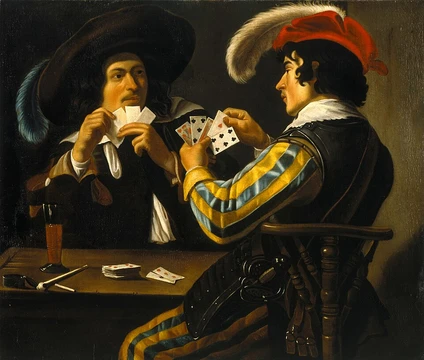
Solitaire
A genre of card games focused on arranging or pairing cards.

Solitaire, also called patience or card solitaire, is a genre of card games where the primary goal is to arrange cards into a systematic order or, less commonly, to pair them off for discard. While most games are designed for a single player, some variants accommodate two or more participants. The term "patience" is the earliest known name for these games in both British and American sources, derived from the idea that they serve as an exercise in patience. "Solitaire" became widespread in North America during the 20th century, though British scholar David Parlett argues for "patience" because it specifically refers to card games, whereas "solitaire" can also describe games played with dominoes or pegs. American authors Wood and Goddard note that "patience" involves arranging cards in systematic order, and that while most are for one player, excellent versions exist for multiple players. In North America, "solitaire" is often used to refer specifically to single-player card games, sometimes clarified as "card solitaire." Internationally, "solitaire" may denote one-player board games like peg solitaire, or even just the game Klondike.
The origins of solitaire are likely German or Scandinavian, with the earliest records appearing there in the late 1700s and early 1800s. The first known description dates to a 1783 German game anthology, which called it "Patience" and described a two-player alternating game. No earlier mentions exist in major game compendia from the 1600s. The game spread to France in the early 19th century, then to Britain and America later that century. The first English-language collection is often credited to Lady Adelaide Cadogan around 1870, though a lost 1860 book titled *Patience* by "Perseverance" (William Henry Cremer) predates it. The earliest American treatise was by Ednah Dow Littlehale Cheney in 1869. Mary Whitmore Jones became a prolific author, publishing several volumes containing around 250 different games by 1911. Solitaire games are classified by their aim, most commonly building sequences of cards by suit, often from Ace to King or in descending order, starting from a foundation card. They combine skill and chance.
- earliest_known_source
- Das neue Königliche L'Hombre-Spiel (Germany)
- common_card_size
- about 67 x 42 mm
Lore & Background
Solitaire, also known as patience or card solitaire, encompasses a genre of card games where the primary goal is to arrange cards into a systematic order or, in some cases, to pair them off for removal. Most are designed for a single player, though some variants accommodate two or more participants. The term "patience" is the earliest recorded name, deriving from the perception of the games as an exercise in patience. In North America, "solitaire" became common during the 20th century, though it can also refer to games played with dominoes or peg boards. The earliest known description of a solitaire game appears in a 1783 German anthology, where it describes a two-player game played alternately. The genre likely originated in Germany or Scandinavia, with records from the late 1700s and early 1800s. It gained popularity in France in the early 19th century before reaching Britain and America later that century. The first English-language collection is often credited to Lady Adelaide Cadogan’s *Illustrated Games of Patience* (circa 1870), though a lost 1860 book titled *Patience* by "Perseverance" predates it. The earliest American treatise was published in 1869 by Ednah Dow Littlehale Cheney. Solitaires are generally categorized by their aim: building sequences, often by suit, from a shuffled pack dealt into a prescribed layout. Cards are moved to form ascending or descending sequences, with the starting card known as the foundation or base card. Games may involve skill, chance, or a combination of both.
Reader's Guide
The genre encompasses three main objectives: building sequences, pairing cards, or totalling values. While most solitaires are designed for a single player, some accommodate two or more players, and they are games of skill, chance, or a combination. The terminology varies by region: 'patience' is the older term in British and American sources, while 'solitaire' became dominant in North America during the 20th century, though it can also refer to peg or marble games. Notable early authors include Lady Adelaide Cadogan, whose Illustrated Games of Patience (c. Solitaire's legacy includes its adaptation into digital formats and its enduring popularity as a pastime worldwide.
Did You Know?
- The name 'patience' derives from the games being seen as an exercise in patience.
More in Card Games 1-22
Spotted an error? Know more?
This is a living reference — every entry is fact-audited, and reader corrections feed straight into our audit queue. Suggest an edit · See this site's audit record