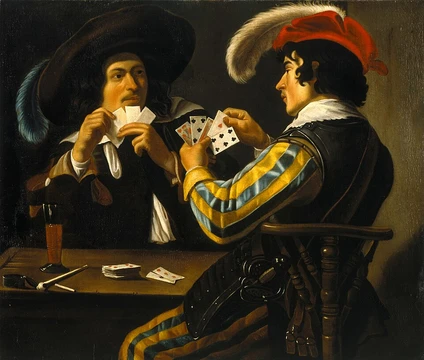
Seven-card stud
A classic stud poker variant with seven cards per player.

Seven-card stud, also called Seven-Toed Pete or Down-The-River, belongs to the stud poker family. Before Texas hold 'em took off in the 2000s, this game was a top choice for home games across the United States and in casinos on the East Coast. While it is less common in casinos now, online play remains available. The game typically works with two to eight players, though eight may need special rules for the final cards if nobody folds; nine players can also be accommodated. In casinos, a small ante plus a bring-in is standard, whereas home games often use only an ante. Seven-card stud is the "S" in HORSE and other mixed-game formats.
**Rules** Each player starts with two cards face down and one card face up. The player showing the lowest-ranking up-card must pay the bring-in, and betting then moves clockwise. Because the bring-in counts as an open, the next player cannot check. If two players have equally low cards, suit breaks the tie (using high card by suit). When there is no bring-in, the first betting round starts with the player showing the highest up-card, who may check; suit does not break ties here—instead, the player closest to the dealer's left in clockwise order acts first.
After the first betting round, another up-card is dealt to each player (following a burn card, starting to the dealer's left for all subsequent rounds). A second betting round begins with the player whose face-up cards form the best poker hand. Since fewer than five cards are visible, straights, flushes, and full houses do not count at this stage. On this and later rounds, the player with the best visible hand acts first and may check or bet up to the game's limit.
A third up-card and betting round follow, then a fourth up-card and betting round, then a final down-card, a fifth betting round, and a showdown if needed. The sequence is "two down, four up, one down." At showdown, each player makes the best five-card hand from their seven cards.
With seven cards for eight players plus four burn cards, 60 cards are needed, but the deck has only 52. This is usually fine because players fold early. If the deck runs out, the four burn cards can be used; if still insufficient, a single community card is dealt to the center for the final round instead of a down-card to each player. Discarded cards from folded hands are not reused.
Players use visible cards to make strategic decisions. Seeing a certain card folded means it cannot appear in another opponent's hand.
**Variants** Several variations exist, though not all appear in poker rooms; many are played at home. - **Down the River**: The basic version, standard in poker rooms. - **Mississippi**: Removes the betting round between fourth and fifth streets, leaving four betting rounds. The fourth and fifth cards are dealt face up, making the structure closer to Texas hold 'em. - **Roll Your Own**: Four rounds of two down cards each are dealt; after each round, a player "rolls" one card face up, followed by betting. Except for the first round, the rolled card may come from any round. - **Queens and After**: All Queens are wild, and the card dealt face up immediately after a Queen becomes wild too—all copies of that rank are wild. If another Queen appears face up, the wild card changes to the next card dealt after that Queen. - **Baseball**: Threes and nines are wild; a four dealt face up earns an extra card. - **Low Chicago**: The lowest spade in the hole wins half the pot. High Chicago uses the highest spade instead. "Chicago" alone can mean either. - **Acey Ducey**: Aces and twos are wild. - **One-eyed Jacks** or **Suicide King**: These can be specified as wild. - **Razz**: A lowball version where the goal is the lowest hand. - **Seven-Card Stud High-Low**: The pot is split between the highest and lowest hands, provided the low hand is at least an 8. Also called Seven-Card Stud/8 or Seven-Card Stud Split.
**Sample deal** Four players: Jimmy (dealer), Larry (left of Jimmy), Craig (left of Larry), Katherine (left of Craig). All ante 25¢. Jimmy deals two down and one up to each, starting with Larry. Larry gets 4♠, Craig K♦, Katherine 4♦, Jimmy 9♣. With a $1 bring-in, Katherine must start (her 4♦ is lower than 4♠ by suit). She bets only the required $1. Jimmy calls. Larry folds (turns his upcard down and discards). Craig raises to $3. Katherine folds. Jimmy calls. Jimmy then deals a second face-up card to each remaining player.
- Type
- Poker variant
- Also known as
- Seven-Toed Pete, Down-The-River
- Players
- 2 to 8 (9 possible)
- Betting structure
- Ante and bring-in (casino); ante only (home games)
- Deal
- Two down, four up, one down
- Part of mixed games
- HORSE and similar formats
Lore & Background
Seven-card stud is played with two to eight players, though eight may require special rules for the last cards dealt if no players fold, and playing with nine is possible. In casino play, it is common to use a small ante and bring-in; in home games, using only an ante is typical. The game begins with each player being dealt two cards face down and one card face up. The player with the lowest-ranking up-card pays the bring-in, and betting proceeds in normal clockwise order. If two players have equally-ranked low cards, the card's suit may be used to break the tie. If there is no bring-in, the first betting round begins with the player showing the highest-ranking up-card, who may check; suit is not used to break ties in that case.
Reader's Guide
Seven-card stud is the 'S' game in HORSE and similar mixed game formats. Its significance lies in its historical prominence as one of the most widely played poker variants in the United States before the Texas hold 'em boom. The game requires players to use information from face-up cards to make strategic decisions, as a player who sees a certain card folded knows that card will never appear in another opponent's hand. The sample deal illustrates typical play: four players ante, receive cards, and proceed through multiple betting rounds until showdown, where each player makes the best five-card poker hand from their seven cards. Variants include Mississippi, roll your own, Queens and after, Baseball, Low Chicago, High Chicago, Acey Ducey, one-eyed Jacks or Suicide King as wild, Razz (lowball), and Seven-Card Stud High-Low (split pot). In popular culture, the game is referenced at the end of Tennessee Williams' play A Streetcar Named Desire.
Did You Know?
- Seven-card stud is also known as Seven-Toed Pete or Down-The-River.
- The game is commonly played with two to eight players, but playing with nine is possible.
- In casino play, a small ante and bring-in are common; in home games, only an ante is typical.
- Seven-card stud is the 'S' game in HORSE and similar mixed game formats.
More in Card Games 1-22
Spotted an error? Know more?
This is a living reference — every entry is fact-audited, and reader corrections feed straight into our audit queue. Suggest an edit · See this site's audit record