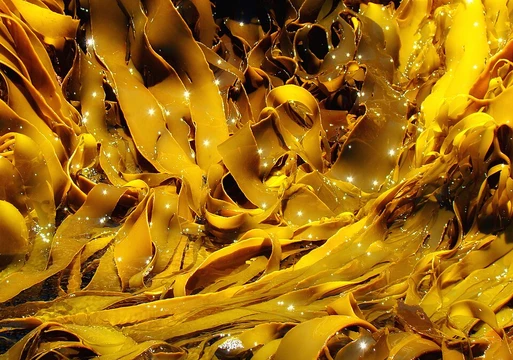
Ecklonia cava
Edible brown alga used in herbal extracts and traditional cuisine.
Last updated
Ecklonia cava—called paddle weed, noro-kajime, or gamtae—is a brown seaweed that grows in the ocean near Japan and Korea and is safe to eat. It is used in herbal medicine, with extracts sold as Seanol (a polyphenolic extract) and Ventol (a phlorotannin-rich agent). The alga contains phlorotannins like fucodiphlorethol G, 7-phloro eckol, 6,6'-bieckol, eckol, 8,8'-bieckol, 8,4"'-dieckol, and phlorofucofuroeckol A, as well as common sterol derivatives such as fucosterol, ergosterol, and cholesterol. It is also considered a useful source of colloids for the biotech industry.
Nomenclature
The English common name is paddle weed; in Japanese it is known as kajime or noro-kajime. The standard modern Japanese name for E. cava is distinct from that of the wrinkled-leaved Eisenia bicyclis (also called Ecklonia bicyclis), which is known as arame. However, these names are very misleading. A pioneering Japanese algae expert noted that the terms kajime and arame are regionally confused, with some places calling kajime “arame” and vice versa.
Local names for E. cava include kajime, gohei kajime, noro kajime, aburame, and obirame in Chiba Prefecture; anroku in Mie and Tokushima Prefectures; and amoto or ista in parts of Mie Prefecture, according to name lists by Endo and later writers. The confusion persists: in Endo (1903), the name kajime was applied to E. bicyclis, and in Shizuoka Prefecture the plant is often called kajime, kachime, or kaome. Historically, going back to the Nara Period, arame seems to have referred to either seaweed, and kajime (kachime) was not a name for a different plant but for the same seaweeds processed into dried powders. This is based on studies of wooden shipping tags from the 7th–8th centuries: products labeled as one or the other are thought to have been E. cava or E. bicyclis depending on origin, and the term kajime likely meant a pulverized form of either, as explained in the Wamyō Ruijushō dictionary, where it is written as “pounding cloth/seaweed.”
Range and speciation
Ecklonia cava is a perennial brown alga found mainly in subtidal areas off Japan and Korea, especially in kelp forests along central Pacific Honshu (from southern Bōsō Peninsula/Chiba Prefecture to Wakayama Prefecture), parts of the Seto Inland Sea, the southern Sea of Japan coast, and the coast of Kyushu. Its type locality is Yokosuka, Kanagawa. Two similar algae, Ecklonia kurome (kurome) and Eisenia bicyclis (arame), share similar appearance, habitat, and distribution. E. kurome has a wrinkled lamina, while E. bicyclis has a wrinkled lamina that becomes forked.
The smooth-lamina E. cava extends north only to the edge of Fukushima Prefecture, whereas arame thrives farther north to Iwate Prefecture. Wrinkled kurome is far more abundant than smooth kajime from the Kii Peninsula westward. However, the morphological distinction between E. kurome and E. cava has been recognized as falsely indicating genetic differences; recent papers treat E. kurome as a synonym. It has been proposed that E. kurome be considered a subspecies of E. cava, alongside Ecklonia cava ssp. stolonifera.
Algae identified as kajime based strictly on morphology have been reported in Shikoku, parts of Kyushu, and southern Sea of Japan coasts, but these tend to be the kurome or tsuruarame subspecies. This alga typically forms seaweed beds (marine forests) in waters 2 to 25 meters deep and can grow over 130 cm long. As a brown alga, it is a key part of its ecosystem, providing food and shelter for many marine organisms. It is a primary producer, and many animals use it for reproduction.
Ecosystem
Despite its ecological importance and human uses, E. cava numbers have been declining in recent years. Possible causes include rising water temperature, overgrazing, and overuse by humans, but the direct cause has not been extensively studied. Some evidence points to higher water temperature, while low nitrogen availability can also increase death rates.
A combination of both is likely, since higher temperatures reduce nitrogen availability. E. cava is an important food for snails like Littorina brevicula and Haliotis discus, as well as other marine organisms. In one aquaculture experiment, farmed abalone gained 1 kg for every 15 kg of this seaweed eaten. The alga has a defense mechanism that makes it less palatable after being attacked by a herbivore, and these defenses are specific to each herbivore species.
Medicinal uses
Many seaweeds and plants have similar defenses, but the specifics have not been pinpointed. The health benefits of E. cava and its chemistry have been studied to some extent, leading to its use in dietary supplements and herbal remedies. One active ingredient, fucosterol, may have antidepressant, antidiabetic, and anticonvulsant effects. The seaweed is also used in cooking.
Scientific classification
- CladeEukaryota
- CladeSar<!-- Do not change Sar to SAR. The consensus was to use Sar in the taxonomy template. -->
- Clade
- Class
- OrderLaminariales
- FamilyLessoniaceae
- GenusEcklonia
- SpeciesEcklonia cava
Named by Kjellm., 1885
Sources: Wikipedia taxobox: Ecklonia cava (CC BY-SA 4.0) · order, family and genus agree with WoRMS AphiaID 371986 (CC BY 4.0)
How big is it?
Largest length in the source, 1.3 m, next to a 1.8 m person.
Diagram: drawn by Codexery, schematic shapes to scale (not a likeness). Length: Wikipedia: Ecklonia cava
Where the ecklonia cava has been recorded
Map: drawn by Codexery. Data: Natural Earth basemap (public domain) · place coordinates: Wikipedia (CC BY-SA 4.0)
More in Brown Macroalgae and Kelp
Sources
Compiled from Wikipedia and the sources listed below. Text from Wikipedia is available under CC BY-SA 4.0; this entry is adapted from it.
- Wikipedia: Ecklonia cava (CC BY-SA 4.0).
- Classification: the source article's taxobox; order, family and genus checked against WoRMS, the World Register of Marine Species (CC BY 4.0).
- Word definitions: the , each quoted from its Wikipedia article.
Spotted an error? Know more?
Reader corrections go straight into our review queue. Suggest an edit · How this site is sourced