Shizuoka Prefecture
Prefecture on Japan's Pacific coast, home of Mount Fuji and major industries.

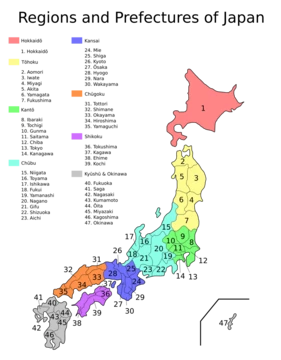
Shizuoka Prefecture, situated in Japan’s Chūbu region on the Pacific coast, is an elongated area that follows Suruga Bay and extends westward into the Japan Alps, while to the east it narrows along the base of Mount Fuji before reaching the Izu Peninsula, a popular resort destination. The prefecture was formed from the historic provinces of Tōtōmi, Suruga, and Izu. It was the home of the first Tokugawa shōgun, Tokugawa Ieyasu, who held the region before conquering the Kantō area; after becoming shōgun, he placed the land around modern-day Shizuoka City under direct shogunate control. In 1868, the Shizuoka han was created from the Sunpu Domain, again becoming the residence of the Tokugawa family. Mount Fuji, Japan’s tallest volcano and a national cultural icon, lies partially within Shizuoka on its border with Yamanashi Prefecture. The prefecture’s climate features warm, oppressive summers and cold, windy winters, with temperatures typically ranging from 1.1°C to 30.5°C. Shizuoka is a major industrial center: Honda, Suzuki, and Yamaha all originated here, and the prefecture accounts for 28% of Japanese motorcycle exports. It is also a global hub for musical instruments; Yamaha and Kawai, both founded in Shizuoka, are the world’s leading piano manufacturers, while Yamaha and Roland produce electronic instruments, synthesizers, and drum machines. About 200 instrument-making companies operate in the prefecture, most concentrated in Hamamatsu City. The region is famed for supplying most of Japan’s green tea and maguro tuna, and its natural landscape includes Lake Hamana, one of Japan’s largest lakes. Eleven percent of the prefecture’s land is designated as natural parks, including parts of the Fuji-Hakone-Izu and Minami Alps National Parks. Historically, the area has experienced a large earthquake every 100 to 150 years, most recently a magnitude 6.2 quake in March 2011.
- Population (2023)
- 3,555,818
- Area
- 7,777.42 km²
- Capital
- Shizuoka
- Largest City
- Hamamatsu
- Region
- Chūbu, Honshu
- Notable Industry
- Motorcycles (28% of Japanese exports), musical instruments
- Major Geographic Feature
- Mount Fuji (partially located in prefecture)
Lore & Background
Shizuoka Prefecture is an elongated region on Japan’s Pacific Ocean coast, stretching from the Izu Peninsula in the east—a popular resort area pointing south into the sea—to the western reaches that extend deep into the Japan Alps. Its eastern coast narrows as it runs north of Mount Fuji, the tallest volcano in Japan and a national cultural icon, which lies partially within the prefecture on the border with Yamanashi Prefecture. Suruga Bay, formed by the Izu Peninsula, defines much of the coastline, while Lake Hamana, one of Japan’s largest lakes, lies in the west. Eleven percent of the prefecture’s land is designated as natural parks, including the Fuji-Hakone-Izu and Minami Alps National Parks, the Tenryū-Okumikawa Quasi-National Park, and four Prefectural Natural Parks. The climate features warm, oppressive, mostly cloudy summers and very cold, windy, mostly clear winters, with temperatures typically ranging from 1.1 °C to 30.5 °C. Shizuoka is the capital, while Hamamatsu is the largest city; other major cities include Fuji, Numazu, and Iwata. The prefecture is the founding location of Honda, Suzuki, and Yamaha, and is home to the Fuji International Speedway, reflecting a significant motoring heritage. It also supplies most of Japan’s green tea and maguro tuna, and is known for cherry shrimp. Historically, the area comprised the former Tōtōmi, Suruga, and Izu provinces and was the home of the first Tokugawa shōgun, Tokugawa Ieyasu.
Reader's Guide
Shizuoka Prefecture holds a significant place in Japanese history and industry. It was the domain of Tokugawa Ieyasu, the first Tokugawa shōgun, and later became the residence of the Tokugawa family after the creation of the Shizuoka han in 1868. The prefecture is also the birthplace of Honda, Suzuki, and Yamaha, and accounts for 28% of Japanese motorcycle exports. Additionally, Yamaha and Kawai, both global piano brands, started in Shizuoka, and the prefecture hosts about 200 musical instrument manufacturing companies, mostly in Hamamatsu City. Shizuoka is famed for supplying most of Japan's tea and maguro tuna, and its geography includes Suruga Bay, the Izu Peninsula, and part of Mount Fuji. The prefecture has experienced large earthquakes every 100 to 150 years throughout history, including a magnitude 6.2 earthquake on 15 March 2011.
Did You Know?
- Shizuoka Prefecture accounts for 28% of Japanese motorcycle exports, with Honda, Suzuki, and Yamaha all having their roots there.
- Yamaha and Kawai, the top two global piano brands, both got their start in Shizuoka Prefecture in the early twentieth century.
- Mount Fuji, Japan's tallest volcano, is partially located in Shizuoka Prefecture on the border with Yamanashi Prefecture.
- On 15 March 2011, Shizuoka Prefecture was hit with a magnitude 6.2 earthquake approximately 42 km NNE of Shizuoka City.
- Shizuoka Prefecture is famed for supplying most of Japan's tea and maguro tuna.
Frequently Asked Questions
Who is Shizuoka Prefecture?
Shizuoka is a Pacific-coastal prefecture in Japan's Chūbu region on Honshu, with Shizuoka city as its capital and Hamamatsu as its largest urban center. It spans roughly 7,777 square kilometers and is home to about 3.5 million residents.
What are Shizuoka Prefecture's powers/role?
The prefecture is a manufacturing heavyweight, producing around a quarter of Japan's motorcycle exports and serving as the birthplace of Honda, Suzuki, and Yamaha. It also anchors the country's green tea and musical instrument industries while hosting part of Mount Fuji.
How does Shizuoka Prefecture's story end?
As a living place rather than a fixed narrative, Shizuoka's ongoing 'ending' is its present identity as a bustling industrial, cultural, and tourist hub. Its legacy as a cradle of global brands and Edo-era politics continues to shape Japanese culture to this day.
Why is Shizuoka Prefecture important?
It is the historical home of Tokugawa Ieyasu, the first shōgun of the Edo period, making it a cornerstone of Japan's feudal narrative. Beyond that history, its outsized output in motorcycles and instruments gives it economic weight well beyond its mid-sized population.
Where does Shizuoka Prefecture live?
It stretches along the Pacific coastline of central Honshu in the Chūbu region, with the Izu Peninsula to the south and the foothills of Mount Fuji to the north. Its capital, Shizuoka city, sits where coastal plains meet the mountainous interior.
More in Japanese Prefectures 1-24
Spotted an error? Know more?
This is a living reference — every entry is fact-audited, and reader corrections feed straight into our audit queue. Suggest an edit · See this site's audit record