Tokushima Prefecture
A Shikoku prefecture known for agriculture and the Ōnaruto Bridge.

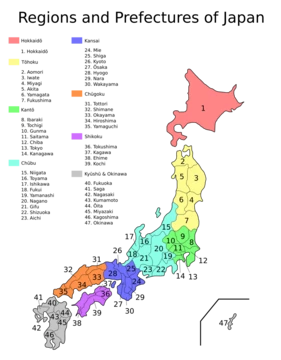
Tokushima Prefecture (徳島県, Tokushima-ken) is a prefecture of Japan located on the island of Shikoku. It has a population of 682,439 (as of 1 February 2025) and a geographic area of 4,146 km². Tokushima is the capital and largest city, with other major cities including Anan, Naruto, and Yoshinogawa. The prefecture borders Kagawa Prefecture to the north, Ehime Prefecture to the west, and Kōchi Prefecture to the southwest. It lies on the Kii Channel, which connects the Pacific Ocean and the Seto Inland Sea, across from Wakayama Prefecture on Honshu’s Kii Peninsula. The Ōnaruto Bridge spans the Naruto Strait to link Tokushima with Awaji Island, part of the Kobe-Awaji-Naruto Expressway that connects the prefecture to Kobe and the San'yō Expressway on Honshu.
Historically known as Awa Province until the Meiji Restoration, the area that became Tokushima Prefecture underwent several administrative changes. In 1871, following the abolition of the fiefdom system, the region was designated Myodo Prefecture, initially including the Awa region and Awaji Island. By 1873, it also incorporated what is now Kagawa Prefecture. In 1875, the Sanuki Region split off to form modern Kagawa Prefecture, and in 1876, Awaji Island joined Hyōgo Prefecture while the Awa region was merged into Kochi Prefecture. On March 2, 1880, Myodo Prefecture fully separated from Kochi Prefecture and was inaugurated as Tokushima Prefecture.
Notable events in the prefecture’s modern history include the destruction of Tokushima Castle’s Washi no Mon gate by fire at the end of World War II in August 1945, and the devastating Nankai earthquake in December 1946. Tokushima University was established in May 1949. In 1974, Tokushima-born Takeo Miki was elected Prime Minister of Japan. The Ōnaruto Bridge was completed in 1985, and the Akashi Kaikyo Bridge in 1998 connected Tokushima to mainland Japan. The Otsuka Museum of Fine Arts opened in 1998. In 2000, a referendum rejected a proposed sluice-gate dam over the Yoshino River. Governor Toshi Endo was arrested on bribery charges in 2002.
- capital
- Tokushima
- population
- 682,439 (1 February 2025)
- area
- 4,146 km² (1,601 sq mi)
- island
- Shikoku
- bordering_prefectures
- Kagawa, Ehime, Kōchi
- known_for
- Largest supplier of cauliflower and lotus roots; only producer of Japanese indig
Verified Timeline
Lore & Background
Tokushima Prefecture was known as Awa Province until the Meiji Restoration. In the first wave of government consolidation in 1871, it became Myodo Prefecture, including the Awa region and Awaji Island. In 1873 it incorporated the area of modern Kagawa Prefecture. After further consolidations in 1875 and 1876, Myodo Prefecture fully separated from Kochi Prefecture on March 2, 1880, to become Tokushima Prefecture. Post-war events include the destruction of the Washi no Mon gate to Tokushima Castle by fire in August 1945, the Nankai earthquake in December 1946, and the inauguration of Naruto City in May 1947. Tokushima University was created in May 1949. The Ōnaruto Bridge, connecting Tokushima and Hyōgo Prefectures, was completed in 1985. In 1998, the Akashi Kaikyo Bridge connected Tokushima to mainland Japan. The soccer team Tokushima Vortis entered J2 in December 2004, making the first ever Shikoku J-league team. In April 2023, a school of tech entrepreneurship—the first of its kind in Japan—was opened in the Tokushima town of Kamiyama, founded by Chikahiro Terada, boss of Tokyo-based start-up Sansan.
Reader's Guide
Tokushima Prefecture holds significance as a historical and agricultural hub on Shikoku. Its evolution from Awa Province through the Meiji-era prefectural consolidations reflects Japan's administrative modernization. The prefecture's economy depends on agriculture, forestry, and fisheries, with rice fields along the Yoshino River and production of vegetables and flowers. It is the nation's largest supplier of cauliflower and lotus roots, and the only producer of Japanese indigo. Infrastructure developments, such as the Ōnaruto Bridge and the Akashi Kaikyo Bridge, have accelerated growth in northern Tokushima, connecting it to Kobe and Honshu. The prefecture is also notable for cultural events like the Awa Odori Dance Hall and the 22nd National Culture Festival in 2007. The opening of a tech entrepreneurship school in Kamiyama in 2023 highlights a modern shift toward innovation. Tokushima's legacy includes political figures like Prime Minister Takeo Miki, born in the prefecture, and its role in Shikoku's sports history with the Tokushima Vortis soccer team.
Did You Know?
- Tokushima Prefecture is the nation's largest supplier of cauliflower and lotus roots.
- It is the only producer of Japanese indigo in Japan.
- The Ōnaruto Bridge, completed in 1985, connects Tokushima to Awaji Island and Hyōgo Prefecture.
- Tokushima-born Takeo Miki was elected Prime Minister of Japan in October 1974.
- In April 2023, the first school of tech entrepreneurship in Japan opened in Kamiyama, founded by Sansan boss Chikahiro Terada.
Frequently Asked Questions
Who is Tokushima Prefecture?
Tokushima is the northernmost prefecture on Shikoku island, home to roughly 682,000 residents spread across about 4,146 square kilometers. Its seat and largest city is also called Tokushima.
What are Tokushima Prefecture's powers/role?
It is Japan's largest supplier of cauliflower and lotus roots and the only region still producing Japanese indigo dye. The prefecture is also home to the Awa Odori Dance Hall, a major cultural draw every summer.
How does Tokushima Prefecture's origin story go?
The area was long known as Awa Province, and after the Meiji-era reorganizations it split away from what is now Kochi Prefecture before being formally inaugurated on March 2, 1880.
Why is Tokushima Prefecture important?
Beyond its agricultural and dyeing heritage, Tokushima is the birthplace of former Prime Minister Takeo Miki and is home to the Ōnaruto Suspension Bridge, one of the longest in the world.
Who are Tokushima Prefecture's neighbors?
It shares borders with three fellow Shikoku prefectures: Kagawa to the north, Ehime to the west, and Kōchi to the south.
More in Japanese Prefectures 1-24
Spotted an error? Know more?
This is a living reference — every entry is fact-audited, and reader corrections feed straight into our audit queue. Suggest an edit · See this site's audit record