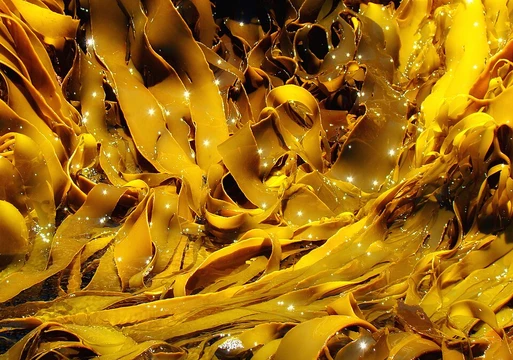
Hormosira
Monotypic brown alga with buoyant beads, native to Australia and New Zealand.
Last updated

via Wikipedia: Hormosira · Public domain
Hormosira is a monotypic genus of brown macroalgae in the family Hormosiraceae, comprising the single species Hormosira banksii. Commonly known as Neptune's necklace, Neptune's pearls, sea grapes, or bubbleweed, it is native to Australia and New Zealand and is notable for its distinctive thallus of olive-brown, gas-filled beads and its role as an ecosystem engineer in intertidal zones.
Scientific classification
- CladeEukaryota
- CladeSar<!-- Do not change Sar to SAR. The consensus was to use Sar in the taxonomy template. -->
- CladeStramenopiles
- ClassPhaeophyceae
- OrderFucales
- FamilyHormosiraceae
- GenusHormosira
- SpeciesHormosira banksii
Named by (Turner) Dcne.
Sources: Wikipedia taxobox: Hormosira (CC BY-SA 4.0) · order, family and genus agree with WoRMS AphiaID 373322 (CC BY 4.0)
Where the hormosira has been recorded
Each dot is a place where the species has been observed and reported (7,946 records, half-degree grid) — not a modelled range. 83 inland records left out (institution coordinates).
Map: drawn by Codexery. Data: GBIF occurrence search (records CC0 / CC BY) · Natural Earth basemap (public domain)
Quick Facts
- Grandparent authority
- Fritsch
- Species
- banksii
Facts from the source article.
Background
Hormosira is a perennial brown alga in the order Fucales, abundant on low-energy rocky reefs within the intertidal zone. Its thallus consists of strings of olive-brown, spherical, gas-filled pneumatocysts (beads) that taper toward a small holdfast.
The beads are buoyant, rising to the water surface at high tide to allow the plant to move with currents and access more sunlight. The species produces a slime layer to reduce desiccation and often grows in high densities, further reducing dehydration by limiting surface area exposed to the sun. Despite substantial morphological variation across its range, genetic analyses of mitochondrial COI and microsatellite DNA sequence data indicate low genetic variation across the Australian range, confirming it as a single species.
Reproduction is sexual and monoecious, with sex organs (conceptacles) visible as rough dimples on the bead surfaces. Eggs are released directly into the water at high tide, are negatively buoyant, and sink to the substrate to develop for several days before attachment.
All individuals release simultaneously to maximize fertilization. Peak reproduction occurs from July to October in northern New Zealand when sea temperature is around 14 °C, as egg viability is low at higher temperatures (17–22 °C). The species can also reproduce asexually from broken and dislodged fragments.
More in Brown Macroalgae and Kelp
Sources
Compiled from Wikipedia and the sources listed below. Text from Wikipedia is available under CC BY-SA 4.0; this entry is adapted from it.
- Wikipedia: Hormosira (CC BY-SA 4.0).
- Classification: the source article's taxobox; order, family and genus checked against WoRMS, the World Register of Marine Species (CC BY 4.0).
- Occurrence records: GBIF (CC0 / CC BY). Basemap: Natural Earth (public domain).
- Word definitions: the , each quoted from its Wikipedia article.
Spotted an error? Know more?
Reader corrections go straight into our review queue. Suggest an edit · How this site is sourced